▲이촌(以邨) 김재봉 서예가(사진. 학술단체 근묵서학회 고문-전각가)의 서예전시회가 서울 종로구 인사동 한국미술관(종로구 인사동길 12 대일빌딩)에서 4월10일부터 16일까지 열린다. ©브레이크뉴스 |
이촌(以邨) 김재봉 서예가(학술단체 근묵서학회 고문-전각가)의 서예전시회가 서울 종로구 인사동 한국미술관(종로구 인사동길 12 대일빌딩)에서 4월10일부터 16일까지 열린다. 주제는 “학초우득전(學草偶得展)“.
김재봉 서예가는 그간 •대한민국미술대전 초대작가 •예술의전당 청년작가전 5회 선발 •세계서예전북비엔날레 휘호 대상 •예산 추사휘호대회 문예진흥원장상 •금파서예술대전 문화체육부장관상 •KBS 전국휘호대회 우수상 등을 수상한 유명 서예가이다. 저서로는 •노자 도덕경(2004) •정선강의 채근담(2009) •한대 사신비 기법 •수대 소효자묘지명 기법 •장조 유몽영(2022) •서예미학담론(2024) 등이 있다.
김재봉 서예가는 이 전시회의 자서(字書)에서 “동양을 대표하는 2대 핵심사상은 음양(陰陽)과 오행(五行) 사상이다. 전국(戰國)과 진한(秦漢) 시기의 사상계에서 유행한 음양오행설(陰陽五行說)은 독자적 경계로부터 출발하여 이후 음양설과 오행설이 융합하여 사상적 토대를 구축하게 되었다. 음양설(陰陽說)에서 음양의 개념은 우주 생명을 창조하는 한 쌍의 모순적 힘을 가리킨다. 장자(莊子)는「則陽篇」에서 대공조의 '만물은 어디에서 생겨나는가?'라는 물음에 '온갖 생명의 생(生)은 곧 음양이 서로 비추고 서로 해치며 서로 다스리고,…… 모이고 흩어짐이 만든다.'고 하여 만물은 자웅(雌雄) 한 쌍의 모순적 힘이 상호 작용한 힘이라는 점을 긍정하였고, 순자(荀子)를 비롯한 일련의 제 사상가들 또한 이에 동의하였다. 즉 그들에게 음양개념은 이미 일체의 모순된 힘이 갖고 있는 상반상성(相反相成)하는 두 가지 종류의 작용과 속성으로 인식되어 있음을 알 수 있다”고 설명하면서 “나의 이번 작업은 오행에서의 오방색(五方色)을 활용하되 먹을 바탕에 두고 적(赤)을 통해 상극을 극복하는 과정을 보여주는 것이다. 즉, 오행에서 먹은 북방의 색으로 수(水)에 해당하고 적(赤)은 남방의 색으로 화(火)에 속한다. 수(水)는 화(火)와 상극[水剋火]이니 물은 불을 진화하고자 하고 불은 물을 벗어나고자 한다. 이때 불은 물을 벗어나기 위해 물로 감히 끌 수 없는 거대함, 혹은 열정, 혹은 돌출감...... 과 같은 유형, 무형의 그 무엇이 필요하고 그래서 선택한 재료가 수성이 아닌 유성의 적색 애나멜(enamel)이다. 기름이 물을 극복하여 발돋움할 수 있다면, 서예술 창작의 또 다른 방편이 될 수 있겠다는 생각”이라고 강조했다.
 ▲ 이촌(以邨) 김재봉 서예가의 작품. ©브레이크뉴스 |
 ▲ 이촌(以邨) 김재봉 서예가의 작품. ©브레이크뉴스 |
 ▲이촌(以邨) 김재봉 서예가의 작품. ©브레이크뉴스 |
 ▲ 이촌(以邨) 김재봉 서예가의 작품. ©브레이크뉴스 |
 ▲이촌(以邨) 김재봉 서예가의 작품. ©브레이크뉴스 |
 ▲이촌(以邨) 김재봉 서예가의 작품. ©브레이크뉴스 |
이어 “이번 작업에서 나의 또 다른 시도는 초서 자형을 화면 중앙의 주(主)로 삼되 해서 명조체 글꼴을 차(次)로 삼아 현대(現代)와 고전(古典), 초서(草書)와 해서(楷書)의 복합적 조화를 구상한 것이다. 그 근거는 중당 때 안진경(顏眞卿)이 쓴《裵將軍詩碑》이다. 이 비의 글씨는 서체의 격식을 깨뜨린 새로운 양식으로 해서(楷書)에 전서(篆書)와 예서(隷書), 초서(草書), 심지어는 금석(金石)의 운치가 섞여 있어 생동발랄(生動潑剌)함을 느끼게 하기에 충분하다. 안진경은 행초에도 일가견이 있지만, 그의 해서는 전 서예사를 통틀어 독출(獨出)한 경지를 보여주었다는 점에서 더욱 그러하다. 해서는 후한 때부터 사용되기 시작하여 위진남북조를 거치면서 당대 표준체가 된 서체로, 방정하고 모범적인 자형을 대표한다. 이후 대각체(臺閣體)로써 가로획이 가늘고 세로획이 굵은 특징을 지닌 명나라 글꼴이라는 의미의 명조체(明朝體)가 만들어졌다. 그리고 초서는 오체 가운데 동적인 흐름이 가장 원활하고 필세(筆勢)가 비동(飛動)한 특징을 지닌다. 발생 초기의 장초(章草)로부터 금초(今草)와 광초(狂草) 등 다양한 형식을 지니고 있으며 서사의 편의성과 민첩성을 장점으로 하지만, 동시에 가독성이 떨어지는 단점도 동시에 지니고 있다. 초서를 잘 이해하지 못하는 시대적 현실에서 나는 대중이 쉽게 이해할 수 있는 해서의 명료함과 초서의 예술성을 동시에 구현해보고자 《學草偶得展》에서 이를 시도한 것”이라면서 “현란한 색채의 홍수 속에 노출된 이 시대 대중들은 시간이 흐를수록 가슴 한구석에 어찌할 수 없는 허전함을 느끼는 동시에 무언가 정신적인 것, 그리고 형언할 수는 없지만, 어떤 심오함을 채우고자 하는 욕망을 갖는다. 채도가 없는 무채색을 부지불식간에 가까이하고 찾게 되는 것은 아마도 이런 이유일 것이다. 하지만 역설적으로 요즈음 사람들은 무채색을 대표하는 예술, 서예(書藝)를 가까이하려고 하지는 않는다. 그에 대한 사람들의 이유는 다양하겠지만, 아마도 붓을 다루는데 많은 시간이 소요되고 한문을 알아야 하며 단순한 선(線)과 색(色) 속에서 현묘(玄妙)함보다 오히려 무료(無聊)함을 느끼기 때문일 것”이라고 덧붙였다.
 ▲이촌(以邨) 김재봉 서예가의 작품. ©브레이크뉴스 |
 ▲이촌(以邨) 김재봉 서예가의 작품. ©브레이크뉴스 |
 ▲이촌(以邨) 김재봉 서예가의 작품. ©브레이크뉴스 |
 ▲이촌(以邨) 김재봉 서예가의 작품. ©브레이크뉴스 |
이촌(以邨) 김재봉 서예가는 최근 서예미학담론(書藝美學談論)이라는 저서를 출판(<주> 이화문화출판사)했다. 김재봉 서예가는 이와 관련 “이번 서예전시회는 이 책의 출판기념회와 겸한다”고 알렸다.
4월10일, 서예전 개관 행사에서 한화갑 전 민주당 대표가 축사를 했다.
 ▲이촌(以邨) 김재봉 서예가는 최근 서예미학담론(書藝美學談論-사진)이라는 저서를 출판(<주> 이화문화출판사)했다. ©브레이크뉴스 |
아래는 이촌(以邨) 김재봉 서예가의 약력 주요 약력이다.
이촌(以邨) 김재봉 서예가의 주요 약력
-1961년 광주생,
-학력:수원대학교 미술대학원 미술학박사 과정
▲개인전
•2004 노자 도덕경전
•2009 만해 채근담전
•2022 장조 유몽영전
•2024 학초우득 갑진전
▲수상
•대한민국미술대전 초대작가 및 심사 역임
•예술의전당 청년작가전 5회 선발 초대작가 선정
•세계서예전북비엔날레 휘호 대상
•예산 추사휘호대회 문예진흥원장상
•금파서예술대전 문화체육부장관상
•KBS 전국휘호대회 우수상
▲저서
•노자 도덕경 2004
•정선강의 채근담 2009
•한대 사신비 기법
•수대 소효자묘지명 기법
•장조 유몽영 2022
•서예미학담론 2024
▲현재
•학술단체 근묵서학회 고문
•(사)한국학원총연합회 서예교육협의회 회장 역임
•(사)한국서학회 부이사장
•(사)국제서예가협회 사무차장
•(사)한국서예술협회 학술이사.
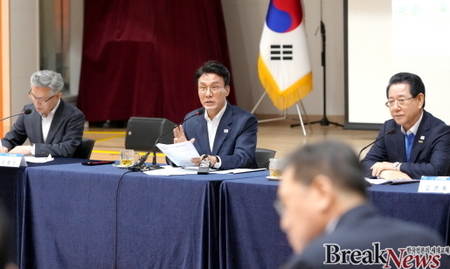
 ▲4월10일, 서예전 개관 행사에서 한화갑 전 민주당 대표(사진)가 축사를 했다. ©브레이크뉴스 |
 ▲4월10일, 서예전 개관 행사에서 한화갑 전 민주당 대표(사진 왼쪽)가 축사를 했다. ©브레이크뉴스 |
Ichon (以邨) Calligrapher Kim Jae-bong holds a calligraphy exhibition at the Korean Art Museum in Insa-dong.
From April 10th to 16th at the Korean Museum of Art in Insa-dong, Jongno-gu, Seoul...the theme is “Hakcho Udeuk Exhibition.”
-Reporter Park Jeong-dae
A calligraphy exhibition by calligrapher Lee Chon Kim Jae-bong (advisor of the academic group Geunmuk Calligraphy Society) will be held from April 10 to 16 at the Korean Art Museum in Insa-dong, Jongno-gu, Seoul (Daeil Building, 12 Insa-dong-gil, Jongno-gu). The theme is “Hakcho Udeuk Exhibition (學草偶得展)”.
Calligrapher Kim Jae-bong has so far received the following: • Invited artist at the Korea Fine Arts Exhibition • Selected for 5 times at the Seoul Arts Center’s Young Artist Exhibition • World Calligraphy Biennale Jeonbuk Calligraphy Grand Prize • Yesan Chusa Calligraphy Contest Director’s Award from the Arts Council • Geumpaseo Art Exhibition Minister of Culture and Sports Award • KBS National Calligraphy Contest Excellence Award, etc. He is a famous and award-winning calligrapher. Her books include • Lao-tzu Tao Te Ching (2004) • Jeong Seon-gang’s Chaegeundam (2009) • Han Dynasty History Mystery Technique • Sui Dynasty Minor Filial Inscription Technique • Major Yu Mong-yeong (2022) • Calligraphy Aesthetic Discourse (2024).
In his autobiography for this exhibition, calligrapher Kim Jae-bung said, “The two core ideas representing the East are the ideas of yin and yang and the five elements. The yin-yang and five-element theory, which was popular in the ideological world of the Warring States and Qin and Han periods, started from an independent boundary, and later the yin-yang theory and the five element theory were fused to build an ideological foundation. In yin-yang theory, the concept of yin-yang refers to a pair of contradictory forces that create life in the universe. In 「則陽篇」, Zhuangzi (莊子) responded to the Great Duke's question 'Where do all things originate?' by answering the question, 'The life of all kinds of life is that yin and yang illuminate each other, harm each other, and govern each other...' … Gathering and dispersion create,' affirming that all things are the result of the interaction of a pair of contradictory forces, and a series of thinkers, including Xunzi, also agreed with this. In other words, we can see that for them, the concept of yin and yang is already recognized as two types of contradictory actions and properties of all contradictory forces,” he explained, adding, “My current work is based on the five elements in the five elements. It utilizes the five colors, but based on ink, it shows the process of overcoming opposites through red. In other words, in the Five Elements, red is the color of the north and corresponds to water, and red is the color of the south and belongs to fire. Water is the opposite of fire, so water wants to extinguish fire and fire wants to escape water. At this time, in order to escape the water, the fire needs something tangible or intangible, such as a feeling of immensity or passion or a sense of prominence that cannot be extinguished by water, so the material chosen is oil-based red enamel, not water-based. am. “I think that if oil can overcome water and rise above water, it can become another means of creating calligraphy art,” he emphasized.
He continued, “My other attempt in this work is to use the cursive character form as the main character in the center of the screen, and use the Ming-jo font as the secondary character to create a mix of modern and classic, cursive and calligraphic writing. ) is designed to be a complex harmony of. The basis for this is 《裵將軍詩碑》 written by An Jin-gyeong (顏眞卿) during the Tang Dynasty. The writing of this stele is a new style that breaks the formality of calligraphy, and is a mixture of calligraphy, formal writing, cursive writing, and even gold stone, making it lively and lively. ) is enough to make you feel that way. An Jin-gyeong is well-versed in calligraphy, but his writings are even more so in that he has shown the level of reading the entire history of calligraphy. It is a font that began to be used in the late Han Dynasty and became the standard font of the time through the Wei, Jin, Southern and Northern Dynasties, and represents straight and exemplary character shapes. Afterwards, the Mingjo font, meaning a diagonal font with thin horizontal strokes and thick vertical strokes, was created. And Chaucer has the characteristics of having the smoothest dynamic flow and fluctuating strokes among the five scripts. It has a variety of forms, from Jangcho (章草) at the beginning of its development to Geumcho (今草) and Gwangcho (狂草), and has the advantage of convenience and agility in narrative, but at the same time has the disadvantage of poor readability. “In the reality of the times when Chaucer is not well understood, I attempted to embody the clarity of Hae-seo and Chaucer’s artistry that the public can easily understand at the same time in the 《Hakseong-yeon-dong exhibition》,” he said, adding, “This person exposed to a flood of dazzling colors As time passes, the public of this era feels an inexplicable emptiness in their hearts, and at the same time, they have a desire to fill something spiritual and something profound that cannot be expressed. This is probably why we unconsciously approach and seek out achromatic colors without saturation. However, paradoxically, people these days do not try to get close to calligraphy, an art that represents achromatic colors. People's reasons for this may vary, but it may be because it takes a lot of time to handle a brush, having to know Chinese characters, and feeling bored rather than mysterious in simple lines and colors. “He added.
Meanwhile, calligrapher Kim Jae-bong of Ichon recently published a book titled Discourse on Calligraphy Aesthetics (Ewha Culture Publishing Company). In relation to this, calligrapher Kim Jae-bong announced, “This calligraphy exhibition also serves as a celebration of the publication of this book.”
On April 10, former Democratic Party leader Han Hwa-gap gave a congratulatory speech at the opening ceremony of the calligraphy exhibition.
Below is the main biography of calligrapher Kim Jae-bong of Ichon (以邨).
Ichon (以邨) Main biography of calligrapher Jaebong Kim
-Born in Gwangju in 1961,
-Education: Doctorate in Fine Arts, Suwon University Graduate School of Fine Arts
▲Solo exhibition
•2004 Lao Tzu’s Moral Classics
•2009 Manhae Chaegeundam Exhibition
•2022 Major Yu Mongyeong Exhibition
•2024 Hakcho Udeuk Gapjinjeon
▲Award
•Served as an invited artist and judge at the Korea Art Exhibition
•Selected as an invited artist for the 5th Seoul Arts Center Young Artist Exhibition
•World Calligraphy Jeonbuk Biennale Grand Prize
•Yesan Chusa Inscription Contest Award from the Director of the Arts Council
•Geumpaseo Art Competition Minister of Culture and Sports Award
•KBS National Whistle Contest Excellence Award
▲Book
•Lao Tzu Tao Te Ching 2004
•Chaegeundam Jeongseon Lecture 2009
•Han Dynasty’s Sasinbi technique
•Sui Dynasty Sohyoja grave naming technique
•Major Yu Mong-yeong 2022
•Calligraphy Aesthetics Discourse 2024
▲Current
•Advisor to the academic organization Geumsukseo Society
•Served as Chairman of the Calligraphy Education Council of the Korea Association of Academies
•Vice-President of the Korean Book Society
•Deputy Secretary-General of the International Calligraphers Association
•Academic director of the Korean Calligraphy Art Association.