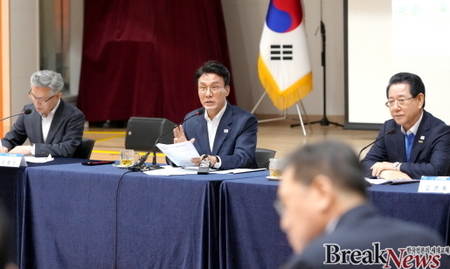
▲ 전국시도교육감협의회 © |
【브레이크뉴스 대구】진예솔 기자=전국시도교육감협의회(회장 강은희 대구광역시교육감)가 최근 일부 언론과 정치권에서 제기되고 있는 ‘지방교육재정 축소’ 논의에 대해 심각한 우려를 표했다.
협의회는 이러한 주장이 공교육의 가치와 헌법에 명시된 국가의 교육 책무에 대한 신뢰를 흔들 수 있으며, 교육의 공공성과 형평성, 지방교육자치의 자율성과 지속 가능성까지 위협하는 중대한 사안이라고 지적했다.
협의회는 지난 17일 경북 안동에서 열린 제103회 총회에서 이 같은 입장을 정리하고, 지방교육재정의 위기 상황과 그에 따른 교육 현장의 현실을 구체적으로 밝혔다.
3년째 이어진 재정 축소, 교육 현장은 한계 직면
협의회는 “지방교육재정 축소는 지난 3년간 지속돼 이제는 한계점에 이르렀다”고 밝혔다. 교육은 헌법이 보장한 국민의 권리이자, 국가는 이를 실현할 책무를 갖고 있으며, 지방교육재정은 그 기반임에도 불구하고 심각한 구조적 위기를 겪고 있다는 설명이다.
협의회에 따르면 2023~2024년 정부의 세수 감소와 새 정부 출범 이후의 추경 등으로 교육교부금은 총 18조 원 감액되었고, 2025년부터는 고교 무상교육 특례 조항이 일몰되며 1조 원이 줄어든다.
교육세 일부가 고등·평생교육지원특별회계로 전용되며 5.9조 원이 빠져나갔고, 누리과정 안착을 위해 운영돼 온 유아교육지원특별회계(3.1조 원) 역시 올해 말 종료를 앞두고 있다.
여기에 시도지사협의회가 지방교육세(7.5조 원)와 시·도세(3.9조 원)의 법정전입금 전출률을 절반으로 축소할 것을 요구하고 있어 현실화될 경우 2025년 기준 최대 5.7조 원 규모의 교육재정이 추가로 줄어들 가능성도 있다.
결과적으로 지방교육재정은 최소 31.3조 원의 결손이 누적되었고, 대부분의 시도교육청은 필수 사업 유지를 위해 재정안정화기금을 투입했으나 이제는 그마저 바닥난 상태다. 일부 교육청은 지방채 발행까지 검토하고 있는 상황이다.
인건비·시설·교육지원 전방위 흔들…학생 피해 현실화
재정 축소의 직접적 영향은 학생들의 교육권으로 이어지고 있다. 정부 주도로 추진돼 왔던 학교스포츠강사, 문화예술강사, 노후 교사동 개축 등의 국고지원 사업이 중단되거나 축소되면서 학생들의 배움의 기회가 줄어들고 있다. 협의회는 “이는 장기적으로 공교육의 질 저하로 이어질 수밖에 없다”고 경고했다.
“학령인구 감소는 재정 축소의 근거 될 수 없어”
학령인구 감소를 이유로 교육재정을 줄여야 한다는 주장에 대해서도 협의회는 반박했다. 학생 수는 줄어들었지만, 장애학생·이주배경학생 증가 등으로 맞춤형 지원 수요는 오히려 늘어났고, 이에 따라 학급 수도 증가하는 추세라는 것이다.
협의회는 “지금은 출생률 저하, 지역소멸, 기초학력 저하, AI의 일상화 등 교육을 둘러싼 대전환기가 동시에 진행되고 있는 상황”이라며 “이럴 때일수록 학생 개개인에게 더 질 높은 교육을 제공하고, 미래 교육 수요에 선제적으로 대응해야 한다”고 강조했다.
“교육재정은 국가 책임의 핵심 기반”
지방교육재정은 해방 이후 국가 책임 아래 발전해 온 구조다. 1949년 제정된 교육법은 교원 봉급 일부를 국고에서 직접 부담하도록 했으며, 1964년에는 지방교육교부세법이 제정돼 교육비특별회계를 통해 국가 지원 체계가 확립됐다. 이후 교육세와 시도 전입금 등 안정적 재정 구조가 구축되면서 공교육의 기반을 지탱해 왔다.
협의회는 “이 같은 구조는 교육이 단순한 행정 서비스가 아닌 국가가 책임져야 할 공공의 책무임을 제도적으로 실현해 온 결과”라며, “교육세와 전입금 제도는 국가책임교육의 핵심 기반으로, 이를 약화하거나 축소하려는 시도는 단순한 세제 조정 차원을 넘어 국가의 미래에 중대한 영향을 미칠 수 있다”고 밝혔다.
“국가의 교육 책임 다하기 위한 기반, 오히려 강화해야”
전국시도교육감협의회는 “지금 필요한 것은 교육재정의 근간을 흔드는 변화가 아니라 국가가 교육 책임을 다하기 위한 재정 기반을 안정적이고 지속 가능하게 유지·강화하는 일”이라고 강조하며, 국회와 정부에 지방교육재정의 법적 지위를 명확히 보장하고 그 공공성과 목적성을 훼손하지 않도록 신중한 정책 추진을 촉구했다.
끝으로 협의회는 “지금이야말로 왜 우리가 교육을 ‘백년지대계’로 삼아야 하는지를 다시 되새겨야 할 시점”이라며 “전국의 교육감들은 모든 아이들의 배움과 삶을 지키기 위해 끝까지 최선을 다할 것”이라고 밝혔다.
<구글 번역으로 번역한 영문 기사의 전문 입니다. 번역에 오류가 있을 수 있음을 밝힙니다.>
National Council of Metropolitan and Provincial Education Superintendents Strongly Concerned about Discussion on Reducing Local Education Finance
The National Council of Metropolitan and Provincial Education Superintendents (Chairperson Eun-hee Kang, Daegu Metropolitan City Superintendent of Education) expressed serious concern about the recent discussion on ‘reducing local education finance’ raised by some media and political circles.
The council pointed out that such claims could shake trust in the value of public education and the state’s educational responsibility stated in the Constitution, and that they are a serious issue that threatens the public nature and equity of education, as well as the autonomy and sustainability of local education autonomy.
At the 103rd General Assembly held in Andong, Gyeongbuk on the 17th, the council organized this position and specifically revealed the crisis situation of local education finance and the reality of the education field accordingly.
Finance reduction for 3 years, education field facing its limit
The council stated that “the reduction of local education finance has continued for the past 3 years and has now reached its limit.” Education is a right of the people guaranteed by the Constitution, and the state has a responsibility to realize it, and local education finance is the foundation, but it is experiencing a serious structural crisis.
According to the council, due to the decrease in government tax revenue in 2023-2024 and the supplementary budget after the launch of the new government, the total amount of education grants has been reduced by 18 trillion won, and from 2025, the special provision for free high school education will be terminated, reducing it by 1 trillion won.
A portion of the education tax was transferred to the Special Account for Supporting Higher and Lifelong Education, and 5.9 trillion won was lost, and the Special Account for Supporting Early Childhood Education (3.1 trillion won), which was operated to stabilize the Nuri Curriculum, is also scheduled to end at the end of this year.
Here, the Provincial Governors’ Council is demanding that the statutory transfer rate of local education tax (7.5 trillion won) and city/provincial tax (3.9 trillion won) be reduced by half, which could lead to an additional decrease of up to 5.7 trillion won in education finances by 2025.
As a result, local education finances have accumulated a deficit of at least 31.3 trillion won, and most provincial offices of education have invested in the financial stabilization fund to maintain essential projects, but now even that has run out. Some offices of education are even considering issuing local bonds.
All-round shake-up in personnel expenses, facilities, and education support… Student damage becomes reality
The direct impact of the budget reduction is affecting students’ right to education. As government-led projects such as school sports instructors, culture and arts instructors, and renovation of old school buildings are being discontinued or reduced, students’ learning opportunities are decreasing. The council warned, “This will inevitably lead to a decline in the quality of public education in the long term.”
“The decline in the school-age population cannot be the basis for reducing finances”
The council also refuted the argument that education finances should be reduced due to the decline in the school-age population. The number of students has decreased, but the demand for customized support has increased due to the increase in disabled students and students with immigrant backgrounds, and the number of classes has increased accordingly.
The council emphasized that “now, a major transition period surrounding education is simultaneously taking place, including a decline in the birth rate, regional extinction, decline in basic academic ability, and the daily use of AI,” and that “at such times, we must provide higher quality education to each student and proactively respond to future education demands.”
“Education finance is the core foundation of national responsibility”
Local education finance is a structure that has developed under national responsibility since liberation. The Education Act enacted in 1949 stipulated that a portion of teachers’ salaries should be directly covered by the national treasury, and in 1964, the Local Education Grant Tax Act was enacted, establishing a national support system through the Education Expenses Special Account. Since then, a stable financial structure, including education taxes and provincial transfer funds, has been established to support the foundation of public education.
The council stated, “This structure is the result of institutionally realizing that education is not a simple administrative service but a public responsibility that the state must take responsibility for,” and “The education tax and transfer funds system is the core foundation of national responsibility for education, and attempts to weaken or reduce them can have a significant impact on the future of the nation beyond simple tax adjustments.”
“The foundation for fulfilling the nation’s responsibility for education should be strengthened instead”
The National Council of Provincial and Metropolitan Education Superintendents emphasized, “What is needed now is not a change that shakes the foundation of education finance, but to stably and sustainably maintain and strengthen the financial foundation for the nation to fulfill its responsibility for education,” and urged the National Assembly and the government to clearly guarantee the legal status of local education finance and to carefully promote policies so as not to undermine its public nature and purpose.
Finally, the council stated that “now is the time to reflect again on why we must treat education as a ‘centennial plan,’” and that “superintendents of education across the country will do their best until the end to protect the learning and lives of all children.”
원본 기사 보기:브레이크뉴스 대구경북