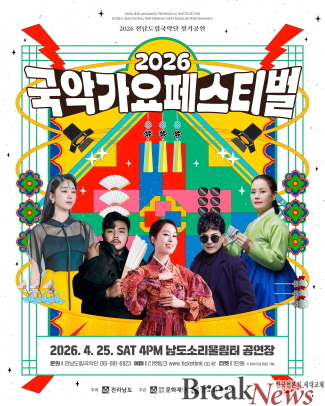
▲ 김춘옥 초대 개인전 “자연-관계성” 전시 포스터 © 이일영 칼럼니스트 |
원로 한국화가 김춘옥 작가 초대 개인전 “자연-관계성”이 서울 용산구 후암동에 소재한 갤러리 U.H.M에서 3월 14일부터 4월 5일까지 열린다.
50여 년간 한국화의 길을 걸어온 김춘옥 선생의 1990년대 작품부터 최근 신작에 이르는 40여 점이 선보이는 전시이다. 김춘옥 작가는 우리의 그림 한국화의 전통을 바탕으로 현대적 발전을 추구하여 온 대표적인 작가이다.
작가는 겹겹으로 배접한 한지를 뜯고, 때론 걷어내면서 동양 회화의 영원한 빛깔 먹물과 물감을 드리운다. 세상에 눈비가 내리듯 스며든 먹빛 흥건한 한지를 뜯어낼 때마다 드러나는 먹빛의 번짐과 변화의 그림자가 자연스러운 층을 이루며 신성한 풀잎이 돋아나고 겹겹의 꽃잎이 피어나며 자연에 깃든 생명의 숨결이 그려진다.
 ▲ 김춘옥 作 무위자연, 81x147cm, 한지, 색지, 먹, 2022 © 이일영 칼럼니스트 |
작가의 작업을 이루는 중심적인 기법은 뜯어내거나 찢거나 해체해 가는 과정에서 드러나는 우연성의 효과를 예술적 감성으로 승화시킨 현대적 기법 데콜라주(Décollage)이다. 이는 회화의 조형적 형상을 오려 붙이거나 재구성하는 미술 기법 콜라주의 반대 기법이다.
데콜라주 기법은 1960년대 초를 지배하던 추상 미술의 현실 도피적 주관에 반발하여 프랑스 비평가 피에르 레스타니의 주도로 탄생한 신사실주의(누보 리얼리즘) 작가들의 확장된 작업이었다. 이후 독일 행위 예술가 볼프 포스텔에 의하여 제시된 명칭으로 삶과 예술의 조화를 주창한 전위예술 플럭서스 운동 중심 작가들이 합류하여 발간한 잡지 데콜라주에 의하여 구체화 되었다.
작가의 깊은 의식이 함축된 명제인 “자연-관계성”은 자연의 다양한 현상과 환경에 존재하는 생명체의 생태학적 관점의 상호 작용과 상호 의존성을 의미한다. 이는 인간과 자연의 관계성을 거울처럼 비추어가는 의식이다.
 ▲ 김춘옥 作 자연-관계성, 45x54cm, 한지, 색지, 먹, 2009 © 이일영 칼럼니스트 |
이러한 사실은 작가 의식과 예술적 작업을 함축한 다음과 같은 작가 노트의 짧은 행간에서 쉽게 살펴진다.
(어떤 사물이든 그 자체의 독립적인 존재로 보지 않고 시간적 공간적 관계 속에서 파악해야 한다고 생각하면, 세상에서 혼자서 독자적으로 자유로운 존재는 없다고 본다. 대상을 눈앞에 보이는 존재, 직접적인 관계로만 보지 않고 다른 사물과의 관계성 속에서 누리는 미감이 유현(幽玄)의 미감이다. 이러한 유현(幽玄)의 미감이 내가 추구하고 고민하는 예술적 가치의 중요한 구성요소라고 생각한다. - 김춘옥 작가 노트 중)
작가가 언급한 유현(幽玄)이란 당나라 시대에 서위와 북주의 역사를 기록한 주서(周書)의 무제 상(武帝-上)편에 무한한 신비함을 이르는 이급유현(理极幽玄)에서 유래된 말이다. 불교의 가르침은 헤아리기 어려운 무한의 깊음을 가지고 있다는 말이다.
나아가 노자의 도덕경에서 도(道)의 본질에 대하여 현지우현(玄之又玄)이라 하였다. 즉 검고 또 시커멓다.라는 심오하고도 깊음을 나타내는 말이 품은 것은 바로 먹빛이다. 김춘옥 작가의 먹물과 물감이 스며든 겹겹의 한지를 뜯고 걷어내며 생겨난 먹빛과 빛깔의 깊이를 가슴으로 깨물게 한다.
이와 같은 의식 속에 탄생한 작품은 오랜 역사의 신성한 서정이 멈춘 듯 흐르는 듯 존재한다. 겹겹으로 감춰진 자연의 숨결이 바람이 되어 세상 모든 것들을 매만지며 흐른다. 포개고 쌓인 중첩의 화면에 깊은 울림으로 배어든 소리를 쫓아가면 젊은 날 가슴에 시어를 씻어대던 시인 김춘옥의 감성을 만나게 된다.
 ▲ 김춘옥 作 자연-관계성, 147x210cm, 한지, 색지, 먹, 2014 © 이일영 칼럼니스트 |
문득 중국의 가곡 작은 풀(小草)이 생각난다.
(꽃향기도 없고 큰 나무도 아닌-没有花香, 没有树高) / (나는 아무도 아는 이 없는 작은 풀-我是一棵无人知道的小草) / (그러나 외롭지도 걱정하지도 않아-从不寂寞, 从不烦恼) / (내 친구들은 세상 어디에나 있어(你看我的伙伴遍及天涯海角)
청아한 음색이 뛰어난 가수 쟝 샤오청(江小城)이 부르던 맑은 노래의 가사가 마치 작가의 작품을 말하고 있는 느낌이 드는 것은 무엇일까!
서울대에서 동양화를 전공한 작가는 한국전업미술가협회 이사장, 마을미술프로젝트 추진위원장, 한국화여성작가회 회장 등을 맡아 한국화의 발전을 위한 열정적인 활동을 통하여 많은 업적을 이루었다. 이러한 공로로 2003년 옥관문화훈장을 받았으며 현재도 한국화진흥회 회장이라는 소명을 짊어지고 있다.
작가는 우리의 것에 대한 드높은 열정과 소명 속에 정작 자신의 작품에 대한 평가는 언제나 뒷전에 감추었다. 필자가 가장 아쉬워하는 점이다. 이웃 나라 가곡에 담긴 노랫말을 가슴에서 읊조리며 작가의 승화된 예술혼에 대한 온전한 평가를 기대한다. artwww@naver.com
필자: 이일영
한국미술센터 관장. 칼럼니스트. 시인
*아래는 위 기사를 '구글 번역'으로 번역한 영문 기사의 [전문]입니다. '구글번역'은 이해도 높이기를 위해 노력하고 있습니다. 영문 번역에 오류가 있을 수 있음을 전제로 합니다.<*The following is [the full text] of the English article translated by 'Google Translate'. 'Google Translate' is working hard to improve understanding. It is assumed that there may be errors in the English translation.>
Senior Korean Painter Kim Chun-ok's first solo exhibition "Nature-Relationality" will be held from March 14 to April 5 at U.H.M., a gallery in Huam-dong, Yongsan-gu, Seoul.
It is an exhibition featuring more than 40 works ranging from the 1990s works of Kim Chun-ok, who has been on the path of Korean painting for more than 50 years, to recent new works. Kim Chun-ok is a representative artist who has pursued modern development based on the tradition of Korean painting.
The artist tears off the layers of Korean paper and sometimes removes them, casting ink and paint on the eternal color of oriental painting. The smudges of ink and shadows of change, which are revealed every time the Korean paper is torn off like snow falling in the world, form a natural layer, and divine grass grows, layers of petals bloom, and the breath of life in nature is depicted.
The central technique that makes up the artist's work is the modern technique Décolage, which sublimates the effect of contingency revealed in the process of tearing, tearing, or dismantling into artistic sensibility. This is the opposite technique of the art technique collage, which cuts and pastes or reconstructs the formative shape of a painting.
The decolage technique was an extended work of neo-realist (Nouveau Realism) writers born under the leadership of French critic Pierre Restani in opposition to the escapist subjectivity of abstract art that dominated the early 1960s. It was later embodied by Decolage, a magazine published by the avant-garde Fluxus movement-centered writers who advocated the harmony of life and art under the name presented by German performance artist Wolf Postel.
"Nature-relationality," a proposition that implies the artist's deep consciousness, means the interaction and interdependence of the ecological perspectives of life existing in various phenomena of nature and the environment. This is a ritual that mirrors the relationship between humans and nature.
This fact is easily examined between the short lines of the following author's notes, implying author consciousness and artistic work.
(If we think that any object should be grasped in a temporal and spatial relationship without seeing it as an independent being of its own, I don't think there is a free existence in the world alone. Yu-hyun (幽玄)'s sense of aesthetics is the sense of aesthetics that he enjoys in his relationship with other objects without seeing the object as a visible being or a direct relationship. I think this sense of aesthetics of Yu-hyun (幽玄) is an important component of the artistic value I pursue and consider. - Among Kim Chun-ok's notes)
Yu-hyeon (幽玄) mentioned by the artist is derived from the 极幽玄 of Reason, which leads to infinite mystery in the Wu Zhi 帝 and the Wu Zhi 周 Book, which records the history of Western Wei and Northern Zhou during the Tang Dynasty. The teachings of Buddhism are infinitely deep, which are hard to fathom.
Furthermore, in Lao-tzu's Moral Sutra, the essence of Tao was called Local Woo-hyun (玄 of 又玄). In other words, it is black and black. It is ink that shows the depth of ink and color generated by tearing and removing the layers of Korean paper infused with ink and paint by artist Kim Chun-ok.
Works born in such consciousness exist as if the sacred lyricism of a long history has stopped flowing. The breath of nature hidden in layers becomes the wind and flows while touching everything in the world. If you pursue the sound ingrained in deep reverberation on the overlapping and stacked screen, you will encounter the sensibility of poet Kim Chun-ok, who washed his heart with poetry on a young day.
Suddenly, it reminds me of a small grass (a small 草) in China.
(No scent of flowers, not a big tree - 没 flower 香, 树) / (I'm a little grass- 我是 棵无 that no one knows) / (But I'm not lonely or worried - 从 不, 从 烦恼) / (My friends are everywhere in the world (你看我 涯 伙伴遍及)
What does it feel like the lyrics of a clear song sung by singer Jean Xiaocheng, who has a clear tone, are talking about the author's work!
The artist, who majored in oriental painting at Seoul National University, has achieved many achievements through his passionate activities for the development of Korean painting by serving as the chairman of the Korean Association of Professional Artists, the chairman of the Village Art Project Promotion Committee, and the chairman of the Korean Women's Writers Association. For these achievements, he was awarded the Okgwan Order of Cultural Merit in 2003 and is still the chairman of the Korean Painting Promotion Association.
Amid high enthusiasm and calling for "Our Things," the artist has always hidden her evaluation of her work behind the scenes. This is the part that I regret the most. Reciting lyrics from songs by neighboring countries, she expects full evaluation of the artist's sublimated artistic spirit. artwww@naver.com
Author: Lee Il-young
Director of the Korean Art Center. Columnist. Poet