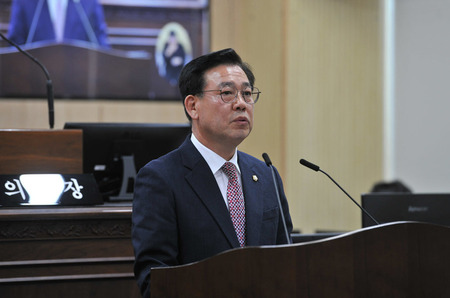
▲ 이장우 대전시장이 2일 대전충남통합특별법에 대한 의견을 밝히고 있다=대전시 제공 © 김정환 기자 |
대전과 충남의 통합 논의가 본격화되는 가운데, 정치권과 지역사회 일각에서 “행정조직의 단순 결합이 아닌 실질적 자치권 보장을 전제로 한 통합이 이뤄져야 한다”는 비판과 우려가 제기됐다.
이장우 대전시장은 2일 대전시청에서 브리핑을 통해 더불어민주당이 당론으로 발의한 '충남대전통합특별시 설치 및 경제과학국방중심도시 조성을 위한 특별법안'이 지난 2024년 10월 발의된 '대전충남특별시 설치 및 경제과학수도 조성을 위한 특별법안' 대비 핵심 권한과 재정 특례가 대폭 축소됐다고 지적했다.
이 시장은 지난해 양 시·도가 합의해 마련한 초기 법안은 국세의 지방 이양, 투자심사 및 예비타당성조사 면제, 개발제한구역 관리권 이양 등 ‘지방 중심형 통합모델’을 주요 골자로 했다. 그러나 민주당 당론 법안에서는 이 대부분이 빠지거나 ‘재량 규정’으로 수정됐다는 것이다.
특히 “자치재정 확충을 위한 핵심 조항 55개가 반영되지 않았고, 정부의 재정지원 5조 원 약속 역시 명문화되지 않았다”며 “법인세·부가가치세 일부 이양, 지방교부세 추가 교부, 과학기술진흥기금 조성 등 근본적 재정 분권 장치가 사라졌다”고 비판했다.
또한 “지난해 발의안이 담았던 136개 특례 중 절반 이상이 권한 축소 또는 중앙정부 동의 절차 강화로 변경됐다”며 “강행 규정은 재량 규정으로, 조례 위임은 대통령령 위임으로 개정되어 자치권이 후퇴했다”고 주장했다.
경제·과학 분야의 자치권 약화도 지적됐다.
이 시장은 당초 반도체·바이오·항공우주 등 첨단산업에 대한 국가 지원을 ‘의무’로 규정했으나, 민주당안에서는 ‘할 수 있다’ 수준으로 완화됐다. 광역교통시설 국비지원, 사회보장제도 신설 협의 생략 등 생활·민생 부분에서도 지원 조항이 축소됐다고 지적했다.
또한 동일 시기 발의된 '전남광주통합특별시 설치법'과 비교할 때도 형평성 논란이 불거졌다. 광주·전남 법안은 행정통합 비용과 중앙사무 이관, 개발제한구역 권한 이전 등을 강행규정으로 명시한 반면, 대전·충남은 대부분 재량규정으로 완화되어 불균형이 심화됐다는 분석이다.
이어 “실질적 통합이 되려면 지방이 스스로 정책을 만들고 재정을 운용할 수 있어야 한다”며 “중앙이 시혜적으로 권한을 나눠주는 방식으로는 수도권 일극체제의 구조를 깨기 어렵다”고 강조했다.
이장우 시장은 “자치와 분권의 핵심은 중앙의 배려가 아니라 지방의 권한임을 분명히 해야 한다”며 “정치적 이해득실이 아니라 지역의 장기적 미래를 기준으로, 당초 성일종 의원 대표 발의안에 담긴 자치·재정 특례를 온전히 반영해야 한다”고 촉구했다.
*아래는 위 기사를 '구글 번역'으로 번역한 영문 기사의 [전문]입니다. '구글번역'은 이해도를 높이기를 위해 노력하고 있습니다. 영문 번역에 오류가 있을 수 있음을 전제로 합니다.<*The following is [the full text] of the English article translated by 'Google Translate'. 'Google Translate' is working hard to improve understanding. It is assumed that there may be errors in the English translation.>
Daejeon Mayor Lee Jang-woo: "I oppose simple physical integration... True integration requires a high degree of autonomy guaranteed."
Daejeon-South Chungcheong Special Act Claims Significant Reduction in Autonomy and Financial Rights Compared to Gwangju and South Jeolla Province
As discussions on the integration of Daejeon and South Chungcheong Province intensify, some in the political and local community have raised criticism and concerns, arguing that "integration should be premised on guaranteeing substantive autonomy, not simply combining administrative organizations."
Daejeon Mayor Lee Jang-woo held a briefing at Daejeon City Hall on the 2nd, pointing out that the "Special Act on the Establishment of a Chungnam-Daejeon Special City and the Development of an Economic, Science, and Defense-Oriented City," proposed by the Democratic Party of Korea as its party platform, significantly reduced core authority and financial benefits compared to the "Special Act on the Establishment of a Daejeon-South Chungcheong Special City and the Development of an Economic, Science, and Defense Capital," proposed in October 2024.
The initial bill, agreed upon by both cities and provinces last year, focused on a "local government-centered integrated model," including delegation of national taxes to local governments, exemptions from investment reviews and preliminary feasibility studies, and transfer of management rights for development restriction zones. However, the Democratic Party's version of the bill either omitted most of these provisions or modified them into "discretionary provisions."
In particular, the market criticized, "55 key provisions for expanding local government finances were not reflected, and the government's promise of 5 trillion won in financial support was not explicitly stated." The market also criticized, "Fundamental fiscal decentralization mechanisms, such as partial transfers of corporate and value-added taxes, additional local allocations, and the creation of a science and technology promotion fund, have disappeared."
Furthermore, "Of the 136 special provisions included in last year's bill, more than half have been reduced to reduce authority or strengthened central government approval procedures." The market argued, "Mandatory provisions have been reduced to discretionary provisions, and delegation of ordinances has been changed to presidential decrees, undermining autonomy."
The market also pointed to the weakening of autonomy in the economic and scientific sectors.
This market initially stipulated state support for cutting-edge industries like semiconductors, biotechnology, and aerospace as an "obligation," but the Democratic Party's proposal relaxed this to a "may." It also pointed out that support provisions for living and livelihood were reduced, such as national funding for metropolitan transportation facilities and the omission of consultations on the establishment of a new social security system.
Furthermore, a comparison with the "Jeonnam-Gwangju Integrated Special City Establishment Act," proposed at the same time, raised concerns about fairness. While the Gwangju-Jeonnam bill explicitly stipulated mandatory provisions for administrative integration costs, the transfer of central government offices, and the transfer of authority over development restriction zones, the Daejeon-Chungnam bill largely relaxed these provisions to discretionary provisions, exacerbating the imbalance.
He continued, "For true integration to occur, local governments must be able to develop their own policies and manage their own finances. It will be difficult to break the unipolar structure of the metropolitan area if the central government distributes authority through favoritism."
Mayor Lee Jang-woo said, “We must make it clear that the core of autonomy and decentralization is not the consideration of the central government, but the authority of local governments,” and urged, “We must fully reflect the autonomy and financial special provisions originally proposed by Representative Seong Il-jong, based on the long-term future of the region, not political gains and losses.”
원본 기사 보기:브레이크뉴스대전세종충청