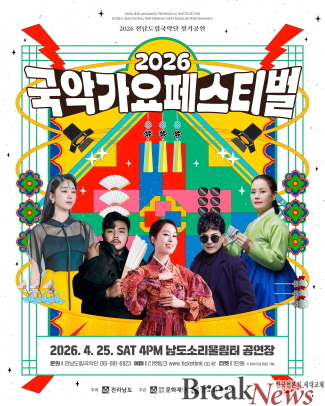
▲ 김수영의 전통춤 ‘宇峰, 그 춤길을 걷다’ 포스터 © 이일영 칼럼니스트 |
2026년 2월 27일 국립국악원 풍류사랑방에서는 오랜 전통의 맥을 호흡하는 뜻깊은 공연 김수영 전통 춤꾼의 ‘宇峰, 그 춤 길을 걷다’가 펼쳐진다. 이 공연은 한 예인이 자신의 몸을 통해 스승의 예술혼을 이어가며 동시에 자신의 춤 길을 열어가겠다는 소중한 다짐의 장이다.
‘우봉(宇峰)’은 한국 춤의 정수로 평가받는 이매방(宇峰) 명인의 호(號)다. 명인은 80여 년 넘게 승무와 살풀이라는 한국 전통춤의 정수를 몸으로 불태운 예술인이었다. 특히 명인의 춤은 남도 시나위의 즉흥적 가락 속에 구조적 질서를 찾아내어 정중동(靜中動)의 미학으로 정립한 치열하게 우리의 것을 추구하였다. 곡선의 흐름 속에 사선으로 이동하는 몸짓과 반 박자 단위로 대응하는 장단이 어우러진 명인의 춤은 정(靜) 속에서도 움직이고, 동(動) 속에서도 숨을 고르는 민족의 정한을 온몸으로 구현한 절창의 세계였다.
김수영은 바로 그 몸짓과 정신을 이어받았다. 나아가 호흡과 수련의 시간을 더해 자신의 세계를 구축해 온 그는 스승의 춤을 지탱하는 정신의 구조를 오늘의 춤으로 다시 빚어내는 계승자다. 이번 공연은 그 여정의 기록이며 동시에 선언이다.
스승의 춤을 잇는 몸짓 - 김수영이 말하는 사사 10년
김수영은 국립국악고등학교에 입학하여 신입생 환영 연주회에서 살풀이춤을 보고서 이 춤을 꼭 배워야겠다는 생각을 거머쥐어 전통무용을 전공하였다. 그 후 국악원 강습회와 선배 언니를 통해 살풀이춤을 배웠다. 궁중무를 하면서도 그 매력에서 헤어나지 못해 시대를 관통한 예인 이애주 선생님에게서 한영숙류 살풀이를 배우다가 이매방 선생님을 찾아갔던 날을 2005년, 7월로 기억한다. 살풀이춤을 꼭 배워야겠다는 생각은 단순한 동경이 아니었다.
사사 10년 동안 그녀는 살풀이가 권번에서 갈고닦은 정한의 춤이며 승무는 수행의 호흡으로 완성되는 무아의 춤이라는 두 춤의 미학과 정신세계를 일깨웠다. 김수영 춤꾼은 스승의 춤이 두 세계를 모두 품고 있었기에 전무후무하다고 말한다. 그녀가 스승의 춤에 담긴 정신과 호흡을 매만져 온 사사 10년은 이 땅의 전통적인 몸짓을 향한 여정이었다.
김수영 춤의 핵심 - 발의 디딤, 원형 지향의 상체, 붓이 되는 손끝
김수영이 스승 이매방 명인에게서 공부한 춤의 정수는 크게 세 단락으로 살펴진다. 발바닥을 비비며 디딤을 놓는 기법은 땅과 몸을 연결하며 장단의 결을 바닥에서부터 읽어낸다. 나아가 한 발을 중심으로 상체와 두 팔이 원형을 그리는 몸짓은 직선이 아닌 원형의 세계관이 몸의 선을 만든다. 이는 마침내 손끝은 붓이 되어 머리와 꼬리를 가진 몸짓의 선을 그려가는 숨결이 된다. 이는 단순한 기술적 설명을 넘어 김수영 춤의 정체성이다. 그녀의 말처럼 손끝의 붓질은 점과 점을 잇지 않고 순간과 순간을 잇는다. 바로 그 간극(間隙)에서 스승의 호흡과 미학을 오롯하게 품고 있다.
김수영 춤꾼의 ‘宇峰, 그 춤 길을 걷다’ 공연은 스승 이매방 춤의 주요한 작품을 재현한다. 각 작품에서 스승의 춤이 품은 미학을 바탕으로 새롭게 구성된 계승의 숨결을 오롯하게 펼쳐낸다.
전승의 칼끝, 스승의 호흡을 잇다 - 우봉 이매방류 검무(재구성: 김수영, 출연: 김수영, 노은실, 원선애)
고(故) 우봉 이매방 선생의 검무는 조부인 이대조류의 춤 맥을 잇고 있는 호남 지역 검무이다. 이 검무는 광주 호남권을 중심으로 전승되어 구한말부터는 이 지역의 명무로 이름난 이대조, 박영구, 이창조 등에서 전승되어 오다가 이매방 명인으로 이어졌다. 검무의 장단 구조는 염불, 타령, 잦은 타령, 당악으로 박진감 있는 리듬과 화려한 검(劍)의 놀림이 신명의 정수를 펼쳐낸다. 김수영 춤꾼은 이매방류 검무의 특징적인 춤사위인 왁대사위, 쟁기사위, 연풍대, 쌍오리사위에 담긴 특성을 중시하였다. 교방 검무의 형식과 동행하면서도 호남 지역의 농경 문화가 반영된 상체의 유연한 춤사위가 품은 섬세한 감성을 마치 한 폭의 그림처럼 구성한 것이다.
초심의 문을 열다 – 우봉 이매방류 입춤 (재구성: 김수영, 출연: 정은파, 김민성, 오한별)
전통춤의 첫 문을 여는 입춤은 가장 기본적인 몸의 중심과 품세를 드러내는 작품이다. 절제된 발디딤과 손끝의 작은 변화만으로도 춤의 품격이 드러나기 때문에 단순함 속에서 가장 큰 집중력을 요구한다. 이 작품은 스승에게서 배웠던 기본의 시간을 상징한다. 예(禮)를 통해 몸을 세우고, 품(品)을 통해 마음을 다듬었던 초심의 순간을 무대에서 마주한다. 이 춤은 전통의 뿌리를 확인하고 그 바탕 위에서 다음 단계로 나아가는 전승자의 태도를 담은 춤이다. 단순한 동작 속에서 고도의 집중을 요구하는 스승에게서 배운 ‘기본기(基本技)’의 시간 속에서 몸을 세우고 마음을 다스리는 초심의 가짐으로 무대를 열어간다.
스승의 길을 지나, 나의 호흡으로 피어나다 - 우봉 이매방류 살풀이춤 (출연: 김수영, 정은파, 김민성)
살풀이춤은 어원에서 알 수 있듯이 ‘액과 흉살을 푼다’라는 뜻으로 전통 무속에서 그 기원을 찾게 된다. 이매방류 살풀이춤은 호남 기방 예술의 계보를 잇는 대표적인 춤으로 정중동(靜中動)의 미학 속에 맺고 푸는 기법이 특징이다. 흰색 수건을 들고 희로애락이 넘실대는 세상을 넘나들며 애간장이 녹아드는 교태의 몸짓을 형체가 아닌 질박한 감성으로 드러내야 하는 고난도의 춤이다. 애잔한 내면의 세계로 이끄는 장단의 변화 속에서 다채로운 표현이 어우러지는 춤은 김수영의 몸짓이 그려가는 숨결의 미학에서 주시해야 할 내용이 많다. 김수영 춤꾼은 스승이 중시한 정한과 신명이 어우러진 춤의 정신성을 그림자처럼 그려낸다. 특히 수건을 당기고 걸치며 떨어뜨리고 주워 올리는 휘어짐과 떨어짐에서 맺고 푸는 감정의 선이 그림처럼 섬세하다.
 ▲ 김수영의 전통춤 ‘宇峰, 그 춤길을 걷다’ 출연진 © 이일영 칼럼니스트 |
이어지는 프로그램 숨을 고르고, 마음을 잇는 시간 - ‘영산, 상령산’ (출연: 박영기) 은 특별하다.
영산회상은 ‘영산회상불보살’이라는 7글자를 가진 불교음악이었다. 차츰 세속화되면서 노래는 없어지고 상령산에서 여러 파생곡이 만들어져 9곡 모음곡인 현악영산회상이 된다. 현악영산회상은 이조 변조되어 4도 낮은 평조회상과 관악영상회상으로 발전되었다. 오늘 연주되는 ‘영산, 상령산’은 영산이라는 두 글자를 노래하고, 이어서 평조회상 중 ‘상령산’을 연주한다. 연주자인 피리의 명인 박영기 예인은 김수영 춤꾼의 부군이다. 나아가 자녀인 박새은 양과 박새한 군이 피리를 전공한 연주자로 어머니의 공연에 음악 연주자로 참여하고 있다. 너무나 소중한 전통 예인 가족의 수장인 박영기 명인이 부인 김수영 춤꾼의 공연에서 ‘숨을 고르고, 마음을 잇는 시간’으로 들려주는 음악 또한, 쉽게 접할 수 없는 선물이다.
 ▲ 김수영의 전통춤 ‘宇峰, 그 춤길을 걷다’ 출연진 © 이일영 칼럼니스트 |
수행의 길, 날개를 얻다 - 나비춤(안무: 김수영, 출연: 진공스님, 노은실, 오한별, 원선애 / 승무: 김수영
승무는 한국 전통춤 가운데 고도의 기술과 내공을 요구하는 춤으로 예술성과 격조가 매우 높아 민속춤의 정수이며 한국 춤의 백미(白眉)로 일컬어진다. 승무의 미적 핵심은 장삼(長衫)을 허공에 휘날리며 추는 유장하고 신비로운 춤사위 속에 수행이라는 불교적 철학이 깃들어 있다. 장삼의 긴 소매가 공간을 가르며 빚어내는 선들은 중생의 번뇌를 장삼 자락을 걷어 올리는 동작은 집착을 내려놓는 해탈의 과정을 은유적으로 형상화한다.
공연의 대미를 장식하는 ‘수행의 길, 날개를 얻다’ 작품은 승무의 정적이고 내면적인 수행의 세계가 나비춤의 경쾌하고 초월적인 비상(飛翔)의 이미지와 어우러지는 특별한 무대이다. 불교의 장엄한 의식에서 비롯된 화청(和請)의 엄숙한 소리 위에 나비춤의 해맑은 기운이 더해진다. 나비가 꽃과 세상을 자유롭게 오가듯 이 땅 위의 춤은 무거운 속세와 맑은 깨달음 사이를 끊임없이 넘나드는 영혼의 여정을 펼쳐 보인다.
무공 스님의 장엄한 화청(和請)이 무대에 흐르면 진공 스님의 나비춤과 노은실, 오한별, 원선애 춤꾼들이 나비의 형상으로 화답한다. 그리고 안무자이자 승무를 직접 추는 김수영 춤꾼은 그 모든 감응의 중심에서 긴 장삼을 휘날리며 수행의 정점을 보여준다. 이는 고요한 수행을 통해 길을 찾고 그 길 위에서 마침내 자유의 날개를 얻는 과정을 상징한다. 전통의 바탕에 새로운 호흡과 해석을 얹어 법고창신의 미학을 추구하였다.
김수영 춤꾼의 이번 공연은 스승의 숨결을 잇는 전승의 무대인 동시에 한 예술가가 살아온 치열한 시간이 빚어낸 승화의 무대다. 2월의 끝자락, 우리는 가장 한국적인 몸짓이 그려내는 영혼의 여정을 만나게 될 것이다. artwww@naver.com
출연진
김수영. 박영기. 정은파. 노은실. 김민성. 원선애. 오한별. 박새은. 김성현. 임도경. 이민후. 강병하. 윤 겸. 신해랑. 박새한. 진공스님. 사회: 하주화. 무대감독: 유호철. 조명감독: 김민수. 기획및 연출: 김수영. 진행: 박새은. 영상및 사진: 백종민. 디자인: 강선미. 김로운
#김수영 #우봉그춤길을걷다 #이매방 #국립국악원 #풍류사랑방 #박영기명인 #승무 #살풀이춤 #이매방류검무 #입춤 #이일영칼럼
필자: 이일영
한국미술센터 관장. 칼럼니스트. 시인
 ▲ 필자: 이일영 ©이일영 칼럼니스트 |
*아래는 위 기사를 '구글 번역'으로 번역한 영문 기사의 [전문]입니다. '구글번역'은 이해도 높이기를 위해 노력하고 있습니다. 영문 번역에 오류가 있을 수 있음을 전제로 합니다.<*The following is [the full text] of the English article translated by 'Google Translate'. 'Google Translate' is working hard to improve understanding. It is assumed that there may be errors in the English translation.>
On February 27, 2026, the National Gugak Center's Pungryu Sarangbang will present "Ubong, Walking the Path of Dance," a meaningful performance by traditional dancer Kim Su-young, breathing life into a long tradition. This performance is a precious pledge for an artist to continue his master's artistic spirit through his own body while simultaneously forging his own path in dance.
"Ubong" is the pen name of Master Lee Mae-bang, considered the quintessence of Korean dance. For over 80 years, Master Lee has embodied the essence of traditional Korean dance, including seungmu and salpuri. Master Lee's dance, in particular, has found structural order within the improvisational melodies of Namdo sinawi, establishing the aesthetic of jeongjungdong (movement in stillness), a fierce pursuit of Korean identity. The master's dance, a fusion of diagonal movements within the flow of curves and rhythms that corresponded in half-beat increments, was a world of exquisite singing that embodied the Korean spirit of movement in stillness and stillness in movement.
Kim Soo-young inherited these very gestures and spirit. Furthermore, by adding time for breathing and training, he built his own world. He is a successor who reshapes the spiritual structure that underpinned his master's dance into today's dance. This performance is both a record of that journey and a declaration.
Gestures Carrying on the Master's Dance - Kim Soo-young's 10 Years of Apprenticeship
Kim Soo-young entered the National Gugak High School and, after witnessing Salpuri dance at a freshman welcome concert, became determined to learn this dance. She majored in traditional dance. She later learned Salpuri dance through workshops at the Gugak Center and from her senior. Even while performing court dance, she couldn't shake the allure of it, so she studied Han Yeong-suk-style Salpuri under the time-honored artist Lee Ae-ju. She then visited Master Lee Mae-bang in July 2005. The desire to learn Salpuri dance wasn't a simple yearning.
During her ten years of apprenticeship, she awakened the aesthetics and spiritual world of two dances: Salpuri, a dance of jeonghan honed in Gwonbeon, and Seungmu, a dance of selflessness perfected through the breath of practice. Dancer Kim Soo-young says her teacher's dance is unparalleled because it embraces both worlds. The ten years she spent apprenticing with her teacher, honing the spirit and breath of his dance, were a journey toward the traditional gestures of this land.
The Core of Kim Soo-young's Dance - Footwork, Circular Upper Body, and Fingertips That Become Brushes
The essence of the dance Kim Soo-young learned from Master Lee Mae-bang can be broadly categorized into three sections. The technique of rubbing the soles of the feet together to place a footstep connects the body to the ground, interpreting the rhythmic texture from the ground. Furthermore, the gesture of drawing a circle with the upper body and arms around one foot demonstrates a worldview of circularity, not linearity, that creates the body's lines. Ultimately, the fingertips become brushes, drawing the lines of gesture with a head and a tail, becoming the breath of life. This goes beyond mere technical explanation and is the very essence of Kim Soo-young's dance. As she says, the brushstrokes of her fingertips do not connect dots, but moments. It is in this gap that the master's breath and aesthetics are fully embodied.
Kim Soo-young's performance of "Ubong, Walking the Path of Dance" recreates key works by her master, Lee Mae-bang. Each piece fully unfolds the breath of inheritance, newly constructed based on the aesthetics of her master's dance.
The Edge of a Traditional Sword, Carrying on the Master's Breath - Ubong Lee Mae-bang's Sword Dance (Reconstructed by Kim Soo-young, Cast: Kim Soo-young, Noh Eun-sil, Won Seon-ae)
The sword dance of the late Ubong Lee Mae-bang is a Honam region sword dance that carries on the tradition of his grandfather, Lee Dae-jo. This dance was centered around the Gwangju-Honam region, and from the late Joseon Dynasty onward, it was passed down through renowned local dancers such as Lee Dae-jo, Park Yeong-gu, and Lee Chang-jo, before being passed down to Master Lee Mae-bang. The rhythmic structure of the sword dance, comprised of chanting, taryeong, frequent taryeong, and dangak, combines with the dynamic rhythm and dazzling sword movements to create the essence of exhilaration. Dancer Kim Soo-young emphasized the characteristics of the signature movements of the Lee Mae-bang style: the waksae (swaying dance), the jaenggi (swaying dance), the yeonpungdae (swaying dance), and the ssangori (swaying dance). While incorporating the form of Gyobang Geommu, the dance reflects the agricultural culture of the Honam region, and the delicate sensibility of the flexible upper body movements is depicted like a painting.
Opening the Door to Beginner's Mind – Ubong Lee Mae-bangryu Ipchum (Reconstructed by Kim Soo-young, Performers: Jeong Eun-pa, Kim Min-seong, Oh Han-byeol)
Ipchum, the first step into traditional dance, is a piece that reveals the most fundamental body balance and poise. Because the elegance of the dance is revealed through restrained footwork and subtle changes in the fingertips, it demands the utmost concentration amidst its simplicity. This piece symbolizes the time spent learning from the master. The stage presents the moment of beginning, when the body is steadfast through courtesy (禮) and the mind is refined through pom (意). This dance embodies the attitude of a successor who confirms the roots of tradition and, building upon that foundation, advances to the next level. Within the simple movements, the master demands intense concentration, and the performance opens with the "basic skills" learned from the master, a time of steadfastness and discipline.
Following the Master's Path, Blossoming with My Breath - Ubong Imaebangryu Salpuri Dance (Performance: Kim Soo-young, Jeong Eun-pa, Kim Min-seong)
As its etymology suggests, Salpuri Dance means "relieving misfortune and evil spirits," and traces its origins to traditional shamanism. Imaebangryu Salpuri Dance, a representative dance that carries on the lineage of the Honam gisaeng house art, is characterized by the aesthetics of jeongjungdong (stillness in motion) and the techniques of tying and untying. Holding a white towel, the dancer navigates a world of joy, anger, sorrow, and pleasure, expressing a coquettishness that melts the heart, not through mere physicality, but through simple emotions. The dance, which blends diverse expressions within rhythmic changes that lead to a sorrowful inner world, offers much to be admired for in the breathy aesthetics of Kim Soo-young's movements. Kim Soo-young, a dancer, like a shadow, embodies the spirit of dance, a blend of jeonghan and exhilaration, which her master cherished. In particular, the emotional lines that connect and untie through the bending and falling of the towel—pulling, hanging, dropping, and picking it up—are as delicate as a painting.
The following program, "Yeongsan, Sangnyeongsan" (featuring Park Yeong-gi), a time to catch one's breath and connect hearts, is particularly special.
Yeongsan Hoesang was a Buddhist piece with seven characters, "Yeongsan Hoesangbul Bodhisattva." As secularization gradually took hold, the song disappeared, and various derivative pieces were created from Sangnyeongsan, forming the nine-piece collection Yeongsan Hoesang in strings. The string Yeongsan Hoesang was modulated a fourth lower into the pyeongjo Hoesang and the wind instrument Yeongsan Yeongyeong Hoesang. Today's performance of "Yeongsan, Sangnyeongsan" sings the two characters "Yeongsan," followed by the "Sangnyeongsan" section of the pyeongjo Hoesang. The piri player, master piri player Park Yeong-gi, is the husband of dancer Kim Su-yeong. Furthermore, their children, Park Sae-eun and Park Sae-han, both piri majors, participate in their mother's performances as musicians. The music that Master Park Young-gi, the head of a precious family of traditional artists, brings to life in his wife, dancer Kim Su-yeong's performance, is a rare gift, a time to "catch your breath and connect with your heart." The Path of Practice, Gaining Wings - Butterfly Dance (Choreography: Kim Soo-young, Cast: Monk Jin Gong, Noh Eun-sil, Oh Han-byeol, Won Seon-ae / Seungmu: Kim Soo-young)
Seungmu, a traditional Korean dance, demands advanced technique and inner strength. Its artistry and elegance are so profound that it is considered the essence of folk dance and the pinnacle of Korean dance. The aesthetic core of Seungmu lies in the Buddhist philosophy of spiritual practice, embedded in the graceful and mystical movements of the long robe, fluttering in the air. The long sleeves of the robe cut through space, creating lines that metaphorically symbolize the suffering of sentient beings, while the movement of lifting the hem of the robe metaphorically symbolizes the process of liberation through letting go of attachments.
The finale of the performance, "The Path of Practice, Gaining Wings," offers a unique experience, combining the still, inner world of Seungmu with the lively and transcendental flight of Butterfly Dance. This is the stage. The solemn sounds of the Hwacheong (harmony request), originating from a solemn Buddhist ritual, are complemented by the pure energy of the butterfly dance. Just as a butterfly freely moves between flowers and the world, the dance on this earth unfolds the spiritual journey, constantly moving between the burden of the secular world and clear enlightenment.
As Monk Mugong's majestic Hwacheong (harmony invitation) flows across the stage, Monk Jin-gong's butterfly dance and dancers Noh Eun-sil, Oh Han-byeol, and Won Seon-ae respond with butterfly forms. At the center of all this emotion, choreographer and monk dancer Kim Su-yeong, with her long robe fluttering, exemplifies the pinnacle of her practice. This symbolizes the process of finding a path through quiet practice and ultimately gaining wings of freedom along the way. By adding fresh breath and interpretation to the foundation of tradition, she pursues the aesthetics of dharma innovation.
Dancer Kim Su-yeong's performance is both a stage for the transmission of her master's legacy and a stage for the sublimation of an artist's intense journey. At the end of February, we will encounter a spiritual journey depicted through the most quintessentially Korean gestures. artwww@naver.com
Cast
Kim Soo-young, Park Young-ki, Jeong Eun-pa, Noh Eun-sil, Kim Min-seong, Won Seon-ae, Oh Han-byeol, Park Sae-eun, Kim Seong-hyeon, Im Do-kyung, Lee Min-hu, Kang Byeong-ha, Yoon Kyeom, Shin Hae-rang, Park Sae-han, Venerable Jin Gong. Host: Ha Ju-hwa. Stage Director: Yoo Ho-cheol. Lighting Director: Kim Min-soo. Planning and Direction: Kim Soo-young. Host: Park Sae-eun. Video and Photography: Baek Jong-min. Design: Kang Seon-mi, Kim Ro-woon
#Kim Soo-young #Walking the Ubong Dance Path #Lee Mae-bang #National Gugak Center #Pungryu Sarangbang #Master Park Young-ki #Seungmu #Salpuri Dance #Lee Mae-bang Sword Dance #Ipchum #Lee Il-young Column
Author: Lee Il-young
Director of the Korean Art Center. Columnist. Poet