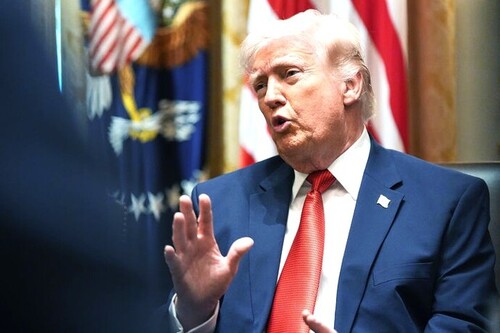
▲ 도널드 트럼프 미국 대통령이 7월 3일(현지시간) 미 메릴랜드주 앤드루스합동기지에서 대통령 전용기 에어포스원 탑승 전 취재진 질문에 답변하고 있다. ©AP/뉴시스 |
브레이크뉴스 정명훈 기자= 도널드 트럼프 미국 행정부가 한국에 25%의 상호관세 통보한 것과 관련, 외신들은 협상이 지지부진했기 때문이라고 원인을 분석했다.
7일(현지 시간) 뉴욕타임스(NYT) 보도에 따르면 미 행정부는 한국과의 협상이 원하는 속도보다 더디게 진행되고 있다고 생각하고 있다면서 도널드 트럼프 대통령이 여전히 자동차, 철강, 전자제품 등 한국의 주요 대미 수출 품목에 높은 관세로 위협하고 있다고 전했다.
파이낸셜타임스(FT)도 한국과의 관세 협상은 윤석열 전 대통령 탄핵 이후 정치 혼란으로 지연됐다면서 이재명 정부가 출범했지만 협상에는 충분한 시간이 없었다고 보도했다. 그러면서 남은 기간 상호이익에 기반한 협정을 위해 협상이 가속화될 것이라고 전망했다.
앞서 트럼프 행정부는 지난 4월 상호관세 부과를 90일간 유예하며 이달 9일까지 협상 기한을 줬으나, 각국과 협상이 지지부진하자 14개 국가들에 최고 40%의 관세를 8월 1일부터 부과하겠다고 통보했다.
한국에는 25%의 관세 부과를 예고했고, 그 전에 미국과 새로운 무역협정을 체결하지 않으면 이 관세는 그대로 적용된다.
한국과 미국은 지난 2012년 한미 자유무역협정(FTA)에 따라 대부분의 상품에 무관세를 적용했으나, 트럼프 대통령은 한국이 미국을 상대로 큰 이익을 보고있다며 고율 관세가 필요하다는 입장이다.
아시아소사이어티 정책연구소의 웬디 커틀러 부소장도 "반도체, 에너지, 칩 제조 등에서 미국과 긴밀히 협력해온 동맹국에까지 고율의 관세를 부과하는 것은 납득하기 어렵다"며 "이미 FTA를 통해 미국산 수입품에 관세를 거의 매기지 않는 한국으로선 추가 양보 여지도 크지 않다"고 지적했다.
미국은 지난해 한국에서 1316억 달러(약 180조2600억원)를 수입했는데, 주요 수입 품목은 반도체(85억 달러), 컴퓨터 부품(74억 달러), 가전제품(32억 달러) 등이었다.
대통령실은 한미 통상 현안 대책회의를 통해 대응 방안을 모색하고 있다. 위성락 국가안보실장과 마코 루비오 미 국무장관 겸 국가안보보좌관도 상호관세 부과 전까지 합의를 위해 긴밀히 소통하기로 했다.
*아래는 위 기사를 '구글 번역'으로 번역한 영문 기사의 [전문]입니다. '구글번역'은 이해도 높이기를 위해 노력하고 있습니다. 영문 번역에 오류가 있을 수 있음을 전제로 합니다.<*The following is [the full text] of the English article translated by 'Google Translate'. 'Google Translate' is working hard to improve understanding. It is assumed that there may be errors in the English translation.>
Trump, Why Did He Notify Korea of High Tariffs? "Negotiations Are Stagnant"
Regarding the fact that the US Donald Trump administration notified Korea of a 25% reciprocal tariff, foreign media outlets analyzed that the reason was because negotiations were stagnant.
According to a New York Times (NYT) report on the 7th (local time), the US administration believes that negotiations with Korea are progressing more slowly than desired, and that President Donald Trump is still threatening Korea's major export items to the US, such as automobiles, steel, and electronics, with high tariffs.
The Financial Times (FT) also reported that tariff negotiations with Korea were delayed due to political turmoil following the impeachment of former President Yoon Seok-yeol, and that even though the Lee Jae-myung administration was launched, there was not enough time for negotiations. It also predicted that negotiations would accelerate for the remaining period to reach an agreement based on mutual benefits.
The Trump administration previously postponed the imposition of reciprocal tariffs for 90 days in April and gave negotiations until the 9th of this month, but as negotiations with each country stalled, it notified 14 countries that it would impose tariffs of up to 40% starting August 1.
It announced a 25% tariff on Korea, and if a new trade agreement is not signed with the United States before then, the tariffs will be applied as is.
Korea and the United States applied tariff-free tariffs on most products under the Korea-U.S. Free Trade Agreement (FTA) in 2012, but President Trump claims that high tariffs are necessary, saying that Korea is benefiting greatly from the United States.
Wendy Cutler, vice president of the Asia Society Policy Institute, also pointed out that “it is difficult to understand imposing high tariffs on allies that have been working closely with the United States in semiconductors, energy, and chip manufacturing,” and “Korea, which already imposes almost no tariffs on U.S. imports through the FTA, does not have much room for additional concessions.”
Last year, the United States imported $131.6 billion (approximately KRW 180.26 trillion) from Korea, with major import items including semiconductors ($8.5 billion), computer parts ($7.4 billion), and home appliances ($3.2 billion).
The Office of the President is seeking response measures through a meeting to address pending trade issues between Korea and the United States. National Security Director Wi Seong-rak and U.S. Secretary of State and National Security Advisor Marco Rubio also agreed to communicate closely to reach an agreement before imposing reciprocal tariffs.