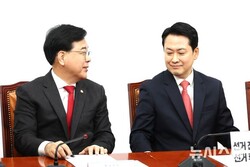
▲ 최은석, 김승수, 권영진, 강대식, 이인선, 주호영, 윤재옥, 추경호, 김상훈 의원, 행정통합 관련 긴급 기자회견 ©진예솔 기자 |
【브레이크뉴스】박영재 기자=대한민국 국회 국회 법제사법위원회가 대구·경북 행정통합특별법을 보류했다. 이미 국회 행정안전위원회에서 여야 합의로 통과된 법안이다. 반면 광주·전남 통합특별법은 일사천리로 처리됐다. 같은 절차였지만 결론은 달랐다. 이쯤 되면 묻지 않을 수 없다. 국회의 기준은 무엇인가.
보수·진보를 가리지 않고 주요 언론은 이번 결정을 정면 비판했다. 조선일보는 사설에서 “체계·자구 심사 권한을 넘어 정책의 생사를 가르는 ‘상원’처럼 군림한다”고 꼬집었다. 중앙일보도 “지역 통합 문제를 정략적 카드로 활용하는 순간, 국회는 균형발전을 말할 자격이 없다”고 비판했다. 동아일보 역시 “상임위 합의안을 법사위가 가로막는 구조가 반복된다면 입법 신뢰는 무너진다”고 지적했다.
진보 성향 매체도 결이 다를 뿐 문제의식을 나타냈다. 한겨레는 “행정통합은 충분한 사회적 합의가 선행돼야 한다”면서도 “법사위가 정치적 판단으로 일정을 좌우하는 관행은 다시 검토해야 한다”고 했다. 경향신문도 “동일 기준을 적용하지 않으면 형평성 논란은 피할 수 없다”고 경고했다.
결국 쟁점은 하나로 귀결된다. 왜 광주·전남은 되고 대구·경북은 안 되는가. ‘지역 내 이견’과 ‘당론 미정’이라는 설명은 원론일 뿐이다. 같은 조건이라면 같은 잣대를 적용해야 한다는 상식적 요구에 답하지 못한 국회의 모습이다.
대구·경북 지역 언론의 반응은 더 직설적이다. 매일신문은 사설에서 “행안위 합의까지 끝난 법안을 법사위가 멈춰 세운 것은 정치적 판단 외에 설명이 어렵다”고 비판했다. 영남일보는 “광주·전남과의 비교 구도를 국회 스스로 만들었다”며 “형평성 시비를 자초한 결정”이라고 했다. 대구일보는 “지역균형발전을 말하면서 특정 지역만 선별적으로 통과시키는 건 모순”이라고 지적했다.
경북 지역 언론도 가세했다. 경북일보는 “행정통합 논의가 정쟁의 볼모가 돼선 안 된다”고 경고했고, 대경일보는 “통합 논의의 본질은 행정 효율과 미래 전략이지 정치적 셈법이 아니다”라고 비판했다.
지역 언론의 공통된 정서는 분명하다. ‘또다시 대구·경북이 후순위로 밀린 것 아니냐’는 박탈감이다. 이런 감정이 쌓이면 통합 논의는 정책이 아니라 정체성의 문제가 된다.
행정통합에 대한 찬반은 있을 수 있다. 충분한 주민 설득과 사회적 합의가 필요하다는 주장도 타당하다. 그러나 그 논의는 공개적이고 일관된 기준 위에서 이뤄져야 한다. 이미 지자체장 합의와 의회 동의라는 법적 요건을 충족했다는 주장에 대해, 법사위는 명확한 법리와 근거로 답해야 한다.
지금처럼 설명 없는 보류가 이어진다면, 국회는 스스로 지역 대결 구도를 만들고 있다는 비판에서 자유로울 수 없다. 대구·경북과 광주·전남을 경쟁 구도로 세워 놓고 ‘균형’을 말하는 건 지역민들을 개 돼지로 보는 것과 다를바 없다. 이미 행정통합이 행정 효율이라는 본질을 넘어 이미 지역 정치 감정 싸움으로 번지고 있다.
정치는 타협의 예술이지만, 원칙 없는 타협은 거래일 뿐이다. 이번 임시국회에서 대구 행정통합특별법을 어떻게 처리하느냐는 단지 한 도시의 문제가 아니라 대한민국 국회가 지역을 줄 세우는 기관인지, 원칙을 세우는 기관인지 스스로 증명하는 시험대가 될 것이다.
정치가 원칙을 잃는 순간, 지역은 등을 돌린다. 대한민국 국회(법사위)가 새겨 들어야할 대목이다.
<구글 번역으로 번역한 영문 기사의 전문 입니다. 번역에 오류가 있을 수 있음을 밝힙니다.>
[Break News] Reporter Park Young-jae = The National Assembly's Legislation and Judiciary Committee has put on hold the Daegu Administrative Integration Special Act. The bill had already passed the National Assembly's Public Administration and Security Committee with bipartisan agreement. In contrast, the Gwangju-Jeonnam Integration Special Act was swiftly passed. While the procedures were the same, the conclusions were different. At this point, the question becomes: What are the National Assembly's standards?
Major media outlets, both conservative and progressive, directly criticized this decision. The Chosun Ilbo criticized the decision in an editorial, saying, "It goes beyond the authority to review systems and language, and acts like an upper house that determines the life and death of policies." The JoongAng Ilbo also criticized, saying, "The moment regional integration is used as a political tactic, the National Assembly loses the right to talk about balanced development." The Dong-a Ilbo also pointed out, "If the Legislation and Judiciary Committee repeatedly blocks standing committee agreements, trust in the legislature will collapse."
Progressive media outlets also expressed concern, albeit with different perspectives. The Hankyoreh stated, "Administrative integration must be preceded by sufficient social consensus," but added, "The practice of the Legislation and Judiciary Committee swaying the schedule based on political judgments must be reexamined." The Kyunghyang Shinmun also warned, "If the same standards are not applied, controversy over fairness is inevitable."
Ultimately, the issue boils down to one thing: why is Gwangju and South Jeolla Province allowed, but Daegu is not? The explanations of "regional differences" and "unclear party positions" are merely platitudes. The National Assembly has failed to address the common-sense demand that equal standards should be applied under equal conditions.
The response from local media outlets in Daegu and North Gyeongsang Province was even more direct. The Maeil Shinmun criticized in an editorial, "The Legislation and Judiciary Committee's suspension of a bill already agreed upon by the Public Administration and Security Committee is difficult to explain beyond political judgment." The Yeongnam Ilbo stated, "The National Assembly itself created a comparative framework with Gwangju and South Jeolla Province," and that this decision "invited controversy over fairness." The Daegu Ilbo criticized, "It is contradictory to talk about balanced regional development while selectively passing a bill for a specific region."
Local media outlets in Gyeongbuk Province also joined in. Gyeongbuk Ilbo warned, "The administrative integration discussion should not be used as a pretext for political strife," while Daegyeong Ilbo criticized, "The essence of the integration discussion is administrative efficiency and future strategy, not political calculations."
The common sentiment among local media outlets is clear: a sense of deprivation, a sense that Daegu and Gyeongbuk have once again been relegated to the back burner. If this sentiment builds, the integration discussion becomes a matter of identity rather than policy.
There may be pros and cons of administrative integration. The argument that sufficient public persuasion and social consensus are necessary is valid. However, such discussions must be conducted openly and based on consistent standards. The Legislation and Judiciary Committee must respond with clear legal principles and evidence to the argument that the legal requirements of agreement between local government heads and council approval have already been met.
If the current unexplained delay continues, the National Assembly will not be free from criticism that it is creating a regional conflict. Talking about "balance" while setting Daegu, Gwangju, and South Jeolla Province in competition is no different from treating local residents like pigs.
Politics is the art of compromise, but compromise without principles is nothing more than a deal. How the Daegu Special Administrative Integration Act is handled in this extraordinary session of the National Assembly is not simply a matter for one city; it will be a test of whether the National Assembly of the Republic of Korea is an institution that prioritizes regionalism or one that upholds principles.
The moment politics loses its principles, the regions turn their backs. This is something the National Assembly of the Republic of Korea (Legislative and Judiciary Committee) must take to heart.
원본 기사 보기:브레이크뉴스 대구경북