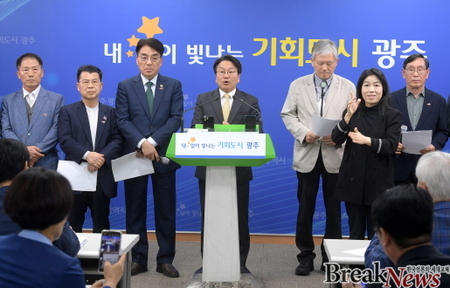
▲ 경상남도와 부산광역시는 14일 국회에서 ‘지방분권형 행정통합’을 선언하며 「경남부산통합특별시 설치 및 경제·산업수도 조성을 위한 특별법」을 발의했다. |
[브레이크뉴스=이성용 기자] 수도권 일극 체제에 맞서 대한민국 남부권의 새로운 심장이 될 ‘경남부산통합특별시’가 마침내 법적 기반을 갖추기 위한 첫발을 뗐다. 경상남도와 부산광역시는 14일 국회에서 결연한 의지로 '지방분권형 행정통합'을 선언하며, 지역의 생존을 건 승부수를 던졌다.
■ "중앙정부 하부기관 탈피"… 628조에 담긴 '지방정부'의 꿈
이성권 국회의원이 대표 발의하고 영남권 의원들이 대거 참여한 「경남부산통합특별시 설치 및 경제·산업수도 조성을 위한 특별법」은 그 규모부터 압도적이다. 총 6편 628조로 구성된 이 법안은 중앙정부의 지시를 받는 하부 기관이 아닌 '스스로 운명을 결정하는 완전한 지방정부'를 지향한다.
이번 법안은 그동안 서울에 집중됐던 권력과 자본을 지역으로 되돌려 놓기 위한 '권력 이양의 설계도'라는 평가다. 특히 통합특별시가 조례를 통해 조직과 정원을 자율적으로 설계하고 독자적인 입법권을 행사하도록 한 점은 대한민국 헌정 사상 유례없는 파격적인 조치다.
■ '돈과 칼'을 지역으로… 5대 핵심 권한 확보 전략
양 시·도가 밝힌 특별법의 핵심은 재정과 인허가권의 완전한 회복이다.
1. 8조 원의 '자주 재원' 확보 (재정 분권)
현재 7.5 대 2.5인 국세와 지방세 비율을 6 대 4까지 조정한다. 법인세 30%와 부가가치세 5% 등을 지방세로 전환해 매년 8조 원 이상의 예산을 중앙정부 눈치 보지 않고 지역 현안에 즉각 투입할 수 있는 구조를 만든다.
2. 대통령령 넘어선 '자치입법권'
더 이상 대통령령에 종속되지 않는다. 행정기구와 공무원 정원을 통합특별시 조례로 직접 결정하며, 지역 특화 정책을 위한 실질적인 입법권을 명문화해 '지방 주도 성장'의 기틀을 닦는다.
3. '골든타임' 사수하는 행정 간소화
우주항공 등 11개 초광역 핵심 사업에 대해 '예비타당성 조사 면제'라는 파격 카드를 꺼냈다. 중앙의 복잡한 승인 절차 때문에 사업 추진 시기를 놓치는 악순환을 끊겠다는 의지다.
4. 기업이 찾아오는 '전략산업 전권'
경제자유구역과 투자진흥지구의 지정·관리권을 시장이 직접 행사한다. 특히 우주항공과 해양물류 분야는 국가가 인프라를 우선 조성하도록 의무화해 세계적 기업 유치를 위한 최적의 환경을 조성한다.
5. 토지 규제 혁파와 핵심 인프라 관리
개발제한구역(GB)의 해제 권한을 지역으로 가져와 맞춤형 개발을 앞당긴다. 또한 가덕도신공항과 부산항의 관리권을 확보해 지역이 주도하는 물류 대동맥 시대를 열 계획이다.
이날 현장에서 양 시·도는 "수도권 일극 체제 타파와 지역 소멸 극복을 위한 유일한 해법은 행정통합"임을 거듭 강조했다. 이번 특별법 발의는 경남과 부산이 하나의 경제권이자 행정권으로 묶여 수도권에 대응하는 '남부권 거점'으로 거듭나겠다는 선전포고다.
박완수 경남도지사는 “이번 특별법 발의는 통합기본법 제정에 대한 정부의 응답만을 기다리며 골든타임을 허비할 수 없어 발의하는 것”이라며, “오늘 발의한 이 특별법이 대한민국 지방분권형 행정통합의 새로운 표준이 되도록 정부와 여당이 결단에 나서야 한다”라고 강조했다.
또한, “권한과 예산의 이양 없는 이름만 특별한 메가시티라는 특별연합으로는 지금의 위기를 절대 극복할 수 없다” 라며, “ 이 위기를 뚫고 나갈 유일한 방법은 바로 ‘지방분권형 행정통합’ 임을” 밝혔다.
한편, 양 시·도는 이번 특별법안을 바탕으로 시·도민 대상 공론화 과정을 거친 뒤, 주민투표를 통해 최종적인 도민의 뜻을 확인하고 2028년 통합을 목표로 총력을 다할 예정이다.
아래는 위 기사를 '구글 번역'으로 번역한 영문 기사의 [전문]입니다. '구글번역'은 이해도 높이기를 위해 노력하고 있습니다. 영문 번역에 오류가 있을 수 있음을 전제로 합니다.
Below is the [full text] of the English article translated using ‘Google Translate’.‘Google Translate’ is working to increase understanding.It is assumed that there may be errors in the English translation.
Gyeongnam and Busan Propose Special Act on Integrated Special City Containing '628 Articles'
Joint Press Conference at the National Assembly… Declaring a 'Complete Local Government' Free from Central Government Control
The 'Gyeongnam-Busan Integrated Special City,' set to become the new heart of South Korea's southern region in defiance of the capital-centric system, has finally taken its first step toward establishing a legal foundation. On the 14th, Gyeongsangnam-do and Busan Metropolitan City declared a 'decentralized administrative integration' with resolute determination at the National Assembly, throwing down a gamble for the region's survival.
■ "Breaking Away from Central Government Subordinates"… The Dream of a 'Local Government' Embodied in 628 Articles
The "Special Act on the Establishment of the Gyeongnam-Busan Integrated Special City and the Creation of an Economic and Industrial Capital," introduced by Representative Lee Seong-kwon and supported by a large number of lawmakers from the Yeongnam region, is overwhelming in scale. Composed of a total of 6 parts and 628 articles, this bill aims for a 'complete local government that determines its own destiny,' rather than a subordinate agency receiving instructions from the central government.
This bill is being evaluated as a "blueprint for the transfer of power" designed to return the power and capital that have long been concentrated in Seoul back to the regions. In particular, the provision allowing the unified special city to autonomously design its organization and staffing levels through ordinances and to exercise independent legislative power is an unprecedented and groundbreaking measure in the constitutional history of the Republic of Korea.
■ Bringing 'Money and Swords' to the Regions… Strategies for Securing 5 Key Authority Points
The core of the special act, as announced by both cities and provinces, is the complete restoration of fiscal and licensing authority.
1. Securing 8 Trillion Won in 'Autonomous Revenue' (Fiscal Decentralization)
The ratio of national to local taxes, currently 7.5 to 2.5, will be adjusted to 6 to 4. By converting the 30% corporate tax and 5% value-added tax into local taxes, a structure will be created that allows for the immediate injection of over 8 trillion won annually into local issues without having to worry about the central government.
2. 'Autonomous Legislative Power' Beyond Presidential Decrees
It will no longer be subordinate to presidential decrees. The administrative organization and the number of civil servants will be directly determined through the Integrated Special City Ordinance, and substantial legislative power for region-specific policies will be codified to lay the foundation for "locally-led growth."
3. Administrative Simplification to Secure the "Golden Time"
A bold move has been made to exempt 11 key super-regional projects, including aerospace, from preliminary feasibility studies. This demonstrates a determination to break the vicious cycle of missing project implementation timing due to complex central approval procedures.
4. "Full Authority for Strategic Industries" to Attract Companies
The mayor will directly exercise the authority to designate and manage Free Economic Zones and Investment Promotion Districts. In particular, for the aerospace and maritime logistics sectors, the central government will be mandated to prioritize infrastructure development, thereby creating an optimal environment for attracting world-class companies.
5. Dismantling Land Regulations and Managing Core Infrastructure
The authority to lift restrictions on Greenbelt (GB) will be transferred to the local level to accelerate customized development. Furthermore, by securing management rights for the Gadeokdo New Airport and Busan Port, the plan is to usher in an era of regionally-led logistics arteries. At the site that day, both cities and provinces repeatedly emphasized that "administrative integration is the only solution to dismantle the unipolar system of the capital region and overcome regional decline." The proposal of this special act is a declaration that Gyeongnam and Busan will be united as a single economic and administrative zone to be reborn as a "southern hub" capable of challenging the capital region.
Gyeongnam Governor Park Wan-soo stated, "We are proposing this special act because we cannot waste this golden time merely waiting for the government's response regarding the enactment of a basic law on integration." He emphasized, "The government and the ruling party must take decisive action to ensure that this special act proposed today becomes the new standard for decentralized administrative integration in South Korea."
Furthermore, he declared, "We absolutely cannot overcome the current crisis with a 'special union' that is special only in name—a 'megacity'—without the transfer of authority and budget." He asserted that "the only way to break through this crisis is precisely through 'decentralized administrative integration.'" Meanwhile, based on this special bill, both cities and provinces plan to go through a public deliberation process targeting their residents, confirm the final will of the residents through a referendum, and make every effort toward integration in 2028.
원본 기사 보기:브레이크뉴스경남