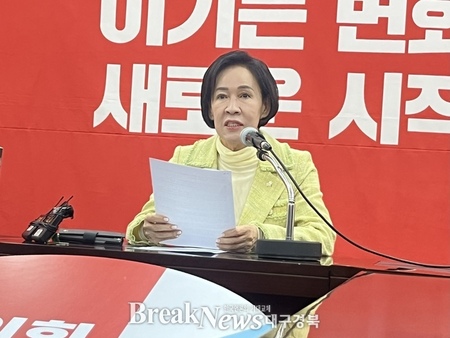
▲ 진선미 더불어민주당 의원이 6일 오전 10시 국회 의원회관 제4간담회실에서 열린 'AI 디지털교과서 국회 집중진단' 토론회에 참석해 발언을 하고 있다. ©브레이크뉴스 |
브레이크뉴스 정명훈 기자= 진선미 더불어민주당 의원이 6일 오전 10시 국회 의원회관 제4간담회실에서 김영호 교육위원장과 고민정·문정복·김문수·김준혁·백승아·정을호 국회의원, 포럼 사의재와 함께 'AI 디지털교과서 국회 집중진단' 토론회를 개최했다.
이번 토론회는 2025년 도입 예정인 AI 디지털교과서 정책에 대한 기대 및 우려를 심도 깊게 논의하기 위해 마련됐다.
반상진 전북대 교육학과 교수가 좌장을 맡아 토론회를 진행했다.
맹성현 KAIST 전산학부 교수는 ‘AI 디지털교과서 현황 및 관련 이슈’를 발표하며 “당장 내년부터 AI 디지털교과서를 도입하겠다고 하는데, 조금의 문제라도 발생하면 되돌릴 수 없기 때문에, 매우 정밀하게 계획을 세워서 진행해야 한다”며 “AI 디지털교과서를 직접 사용할 학생과 교사의 반응을 분석하여 전문가가 재검토하는 과정이 필요하다”고 주장했다. 그러면서 “제도 시행 전 학생과 교사, 학교시설, 운영 예산 등이 제대로 준비가 되었는지 상황점검이 필요해 현 상황에서 2025년 AI 디지털교과서 도입은 시기상조”라고 강조했다.
이광호 전 국가교육회의 단장은 ‘역대 정부 디지털 교육혁신 흐름과 성찰’을 발제하며 “개인정보보호 명분으로 NEIS(National Education Information System)서버를 각 교육청별로 분산하여 운영하고 있으며, 문재인 정부에서 도입했던 K-에듀통합플랫폼 시스템이 윤석열 정부 이후 중단되어 교육청별로 온라인 학슴 플랫폼을 각기 개발하고 있다”며 “기존 시스템이 파편화되어 있는 상황에서, 이를 개선하지 않은 채 새로운 시스템이 또 들어오는 것은 문제가 있다”고 지적했다. 이어 “안정적인 시스템(온라인 플랫폼)을 어떻게 구축하여 교육 현장의 혼란을 줄이면서 미래교육으로 나가갈 것인지에 대한 고민이 필요하다”고 주장했다.
 ▲ 'AI 디지털교과서 국회 집중진단' 토론회 참석자들이 기념촬영을 하고 있다. © 브레이크뉴스 |
토론을 맡은 김차영 참쌤스쿨 대표이자 경기실천교육 교사모임 회장(초등학교)은 “수업할 때 하나의 주제를 가지고 국어, 사회 등 여러 가지 과목에서 수업을 진행하는 경우가 많은데, AI 디지털교과서를 활용해서 이러한 통합교육이 가능할지 의문”이라며 “AI 디지털교과서로 인해 통합교육보다는 분절교육이 될 것 같다”고 주장했다. 또한 “아이들이 전학을 가거나, 진학을 했을 때 AI 디지털교과서에 있는 개인 데이터의 이관이 어려울 것 같다”며 “AI 디지털교과서는 자기주도적으로 보이는 주입식 교육인데 이를 위해 몇조의 예산을 사용하는 것이 옳은지 의문이 든다”고 밝혔다.
백승진 교육정책디자인 연구소 정책위원장(고교 교사)은 토론을 통해 “AI 디지털교과서를 활용하여 수업하게 된다면, 교사는 교실을 돌아다니며 아이들과 소통하는 것이 아니라 대시보드 앞에서 아이들의 데이터를 계속 모니터링하면서 수업을 해야 한다”며 “사범대를 다닐 때 수업은 교사와 학생이 소통하면서 만들어 가는 것이라고 배웠는데, AI 디지털교과서는 교사와 아이들의 소통을 막을 것이다”라고 우려했다.
이경전 경희대 경영대학 교수는 “AI 디지털교과서가 처음에 문제가 있어도 고치면서 활용하면 된다”며 “AI 디지털교과서가 가난하고 열정이 적은 아이들, 성과가 낮은 아이들에게 큰 도움을 줄 것”이라고 주장했다. 또한 “이미 사교육에서 검증이 되었는데, 공교육으로 하지 말자는 것은 무리”라며 “전면도입이나 선택도입이냐의 문제가 남은 것 같다”고 밝혔다.
토론회를 주최한 진선미 의원은“AI 디지털교과서 도입과 관련되어 논란이 많다”며 “세계 최초를 주장하며 속도전을 할 것이 아니라, 신중하고 치밀한 검토와 충분한 사회적 합의가 필요하다”며 “오늘 토론회에서 나온 다양한 의견을 정책에 반영할 수 있도록 노력하겠다”고 강조했다.
*아래는 위 기사를 '구글 번역'으로 번역한 영문 기사의 [전문]입니다. '구글번역'은 이해도 높이기를 위해 노력하고 있습니다. 영문 번역에 오류가 있을 수 있음을 전제로 합니다.<*The following is [the full text] of the English article translated by 'Google Translate'. 'Google Translate' is working hard to improve understanding. It is assumed that there may be errors in the English translation.>
Rep. Jin Seon-mi: "AI Digital Textbooks Should Not Be Pushed Through in a Speed Battle"
On the 6th at 10 AM, Rep. Jin Seon-mi of the Democratic Party of Korea held a discussion on 'AI Digital Textbooks in the National Assembly Intensive Diagnosis' with Education Commission Chairman Kim Young-ho, National Assembly members Ko Min-jeong, Moon Jeong-bok, Kim Moon-soo, Kim Jun-hyeok, Baek Seung-ah, and Jeong Eul-ho, and Forum Sa-ui-jae in the 4th meeting room of the National Assembly Members' Hall.
This discussion was organized to deeply discuss expectations and concerns about the AI digital textbook policy scheduled for introduction in 2025.
Professor Ban Sang-jin of the Jeonbuk National University Department of Education served as the moderator and led the discussion.
Professor Maeng Seong-hyeon of the Department of Computer Science at KAIST presented “Current Status of AI Digital Textbooks and Related Issues,” and argued, “They say they will introduce AI digital textbooks starting next year, but if even the slightest problem arises, it cannot be reversed, so we need to make very precise plans and proceed,” and “We need to analyze the responses of students and teachers who will directly use AI digital textbooks and have experts reexamine them.” He also emphasized, “Before implementing the system, we need to check whether students, teachers, school facilities, and operating budgets are properly prepared, so it is premature to introduce AI digital textbooks in 2025 under the current situation.” Former Director of the National Education Council Lee Gwang-ho presented “The Flow of Digital Education Innovation and Reflection of Past Governments” and said, “The NEIS (National Education Information System) server is being operated separately by each office of education under the pretext of protecting personal information, and the K-Edu Integrated Platform System introduced by the Moon Jae-in government was discontinued after the Yoon Seok-yeol government, so each office of education is developing its own online learning platform.” He pointed out, “In a situation where the existing system is fragmented, it is problematic to introduce a new system without improving it.” He continued, “We need to think about how to build a stable system (online platform) to reduce confusion in the educational field and move toward future education.”
Kim Cha-young, CEO of Chamsaem School and president of the Gyeonggi Practical Education Teachers’ Association (elementary school), who was in charge of the discussion, said, “There are many cases where classes are conducted on one topic in various subjects such as Korean and social studies, but it is questionable whether this type of integrated education is possible using AI digital textbooks,” and argued, “It seems that AI digital textbooks will lead to segmented education rather than integrated education.” He also said, “It seems like it will be difficult to transfer personal data in AI digital textbooks when children transfer or advance to another school,” and “AI digital textbooks are spoon-fed education that seems self-directed, so I wonder if it is right to spend several trillion won on this.”
Baek Seung-jin, policy director of the Education Policy Design Research Institute (high school teacher), expressed concern during the discussion, saying, “If AI digital textbooks are used in classes, teachers should not walk around the classroom and communicate with students, but should continuously monitor the students’ data in front of the dashboard while teaching.” He added, “When I was in teacher’s college, I learned that classes are created through communication between teachers and students, but AI digital textbooks will block communication between teachers and students.”
Lee Gyeong-jeon, professor of business administration at Kyunghee University, argued, “Even if there are problems with AI digital textbooks at first, they can be fixed and utilized,” and “AI digital textbooks will be of great help to poor, less passionate, and low-achieving children.” He also said, “It has already been verified in private education, so it is unreasonable to say that it should not be implemented in public education,” and “It seems that the remaining issue is whether it should be fully introduced or selectively introduced.” Rep. Jin Seon-mi, who hosted the discussion, said, “There is a lot of controversy related to the introduction of AI digital textbooks,” and “Rather than claiming to be the first in the world and rushing to do it, we need careful and meticulous review and sufficient social consensus,” and emphasized, “I will try to reflect the various opinions from today’s discussion in policy.”