▲필자/ 권기식 한중도시우호협회장(황하강 앞). ©브레이크뉴스 |
비행기는 지난 3월26일 자정이 넘어 중국 허난(河南)성 정저우(鄭州) 공항에 도착했다. 늦은 시간인데도 초청기관인 정저우시 공공관계협회 돤위창(段玉强)회장과 한중도시우호협회 중국 자문위원인 리춘푸(李春福) 하남재경정법대 교수가 마중을 나왔다. 돤 회장의 안내로 정저우시 신개발구에 위치한 하남수리대학내 쉐이위안(水園)호텔에 여장을 풀었다.
지난 3월26일 조찬을 돤 회장과 함께 한 뒤 곧바로 중국주방문화박물관을 방문했다. 3층짜리 박물관 앞에 팡쉐위안(庞学元) 설립자와 부인인 리뎬핑(李電萍) 박물관장 등 20여 명이 기다리고 있었다. 중국 유명 가구회사인 대신(大信)주방가구 회장을 맡고 있는 팡 설립자는 이 박물관이 중국 최대 민영박물관이며, 6개 전시관에 1만여점의 유물을 전시하고 있다고 말했다. 그의 안내로 고대부터 현대에 이르는 중국의 주방문화를 견학했다. 옛날 청동솥과 찜기 등 다채로운 유물들이 시대별로 전시되어 있었다. 전 중국에서 유명한 주방 전문 박물관인 탓에 학생들의 방문이 많다고 한다. 중국중앙텔레비전(CCTV) 1채널에서 5분간 보도한 적도 있다고 한다. 수천점의 아프리카 유물이 전시된 아프리카관도 눈길을 끌었다.
 ▲ 황하박물관(중앙이 권기식 회장). ©브레이크뉴스 |
 ▲ 용문석굴. ©브레이크뉴스 |
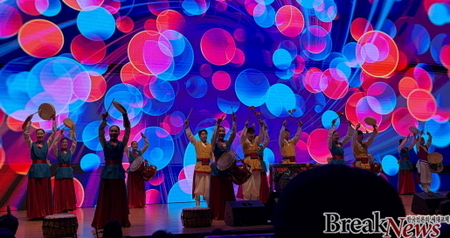
 ▲ 중국 가수. ©브레이크뉴스 |
박물관 3층 회의실에서 정저우시 공공관계협회,중국주방문화박물관과 교류 업무협약을 체결했다. 이후 20여명이 오찬을 함께하며 담소를 나누었다. 팡 회장은 대신가구의 출발이 한국 지인 때문에 이루어진 것이라며 한국과의 각별한 인연을 강조했다. 필자가 김대중 대통령의 비서였다는 말을 듣고 초창기 자신의 사업을 도와준 카이펑시 국장의 이름도 김대중 대통령과 동명이인이었다며 인연을 강조했다. 흔쾌히 한중도시우호협회 허난성 지회장을 맡겠다고 했다.
오후에 상치응용기술대학(총장 허하이펑賀海鵬)을 방문했다. 상치대학과 응용기술대학 등 2개의 대학이 융합돼 운영되는 민간대학이었다. 2013년 설립된 취업 특화 대학으로 100만평의 부지에 중앙도서관과 8개 단과대학이 들어서있다. 교수 1천명과 학생 1만6천명이 재학 중이다. 현대식 도서관에는 학생들이 취업을 위해 열심히 공부하고 있었다. 학생들에게 한중 교류의 가치를 얘기했더니 박수를 쳤다. 중의학 교수의 안내로 중의학박물관을 둘러봤다. 중의학의 역사와 약재 표본실 등이 잘 갖추어져 있었다. 예술대학에서는 당송 시기 진품 도자기가 전시된 작업실이 눈길을 끌었다.
대학 총창실에서 열린 명예 교수 위촉식에 참석했다. 허 총장은 "한중 교류 지도자인 권기식 회장을 명예교수로 모시게 된 것이 기쁘다"고 말했다. 서예가이기도 한 허 총장은 필자에게 '만고장춘(萬高長春)'이라는 갑골문 상형문자 서예작품을 선물했다. 이후 허 총장, 돤위창 정저우시 공공관계협회 회장 등과 정저우시 제일루(弟一樓) 중식당에서 오찬을 함께하며 한중 대학 교류 등에 대해 담소를 나누었다.
저녁에는 허난성 전통음식점으로 이동해 정저우시 공공관계협회 초청 환영 만찬에 참석했다. 한중 교류에 대해 대담하던 중 허난성 전통 노래를 부르는 가수가 화려한 경극 복장을 하고 들어와 노래를 불렀다. 협회에서 허난 전통문화 체험을 위해 준비한 이벤트였다. 애조띤 노래의 선율과 춤이 인상적이었다. 천년을 건너 북송 시기로 간 느낌이었다.
지난 3월28일 아침 일찍 북송의 수도였던 카이펑(開封)으로 갔다. 리춘푸 교수 등이 동행했다. 정저우시에서 캉이펑까지는 차량으로 한시간 남짓 걸렸다.
최초의 불교사원인 바이마쓰(白馬寺)를 방문했다. 평일인데도 관광객과 참배객들로 붐볐다. 서유기의 모델인 현장(玄壯)법사가 백마로 불경을 갖고왔다는 데서 사찰이름이 유래했다고 한다. 사찰 앞에서 백마를 타니 서역에서 불경을 갖고 돌아오는 현장법사의 마음이 느껴졌다.
개봉부에 이르니 수많은 관광객들로 붐볐다. 포청천(包靑天ㆍ본명包拯)은 엄정하고 공평한 관리의 표상이었다. 안후이(安徽) 출신인 그는 북송 시기 수도인 개봉부윤(서울시장에 해당)으로 부임해 애민(愛民)과 엄정한 판결로 백성의 신뢰를 얻었다. 관리는 호랑이 작두로, 평민은 개 작두로 처형했다고 한다. 포청전은 한국에도 잘 알려진 역사인물이다. 드라마로도 방영되었다. 필자의 정치 동반자였던 문희상 전 국회의장의 별명이 포청천이었다. 지금 한국에서 벌어지는 검찰과 사법의 문제를 보면 엄정하고 청빈한 관리에 대한 백성의 갈망은 동서고금에 동일한 듯 하다. 포청천의 공직 정신을 한국의 공직자들이 꼭 배우기 바라는 마음이 들었다.
정저우시로 돌아와 정저우시 공공관계협회 부비서장인 류메이(劉美) 대표의 초청으로 그의 사무실에 마련된 식당에서 만찬을 함께했다. 류 대표의 개인 요리사가 만든 허난요리가 일품이었다. 류 대표는 의료 마사지와 의약품을 제조 판매하는 기업을 운영하는 여성기업인이다. 그는 여장부라고 할 정도로 쾌활했다.
지난 3월28일 오전 방문한 뤄양(洛陽)은 동주와 후한, 육조시대의 옛 수도이다. 또한 중국 유일의 여황제(女黃帝)인 측천무후(則天武后, 624년~705년)의 꿈과 삶이 깃든 곳이다. 측천무후는 상인의 딸로 태어나 궁녀로 입궁해 당 태종과 당 고종 두 황제의 부인으로 권력을 행사하다 스스로 당(唐)나라를 폐하고 무주(武州)를 건국한 여걸이다.
 ▲ 포청천 복장을 한 권기식 회장. ©브레이크뉴스 |
 ▲만고장춘이란 글씨를 써준 허하이펑 총장(오른쪽). 권기식 회장(왼쪽). ©브레이크뉴스 |
 ▲ 상치응용기술대학 학생들과 대화하는 권기식 회장(왼쪽에서 2번째). ©브레이크뉴스 |
 ▲ 상치응용기술대학 중앙도서관. ©브레이크뉴스 |
 ▲중국 주방문화박물관 앞 한중 관계자들. ©브레이크뉴스 |
당 고종 이치(李治)가 측천무후를 너무 사랑한 나머지 측천무후를 닮은 대불을 조성하게 했다는 용문석굴(龍門石窟)을 방문했다. 황하강 지류인 이수(伊水)를 따라 강 양쪽에 조성된 수천기의 동굴불상이 장관이었다. 특히 당 고종이 측천무후를 위해 조성한 봉선사동(奉先寺洞) 비로자나불이 압권이었다. 사랑하는 여인을 위해 석굴불상을 조성한 당 고종은 로맨티스트였던 듯 하다.
지난 3월29일 오전 정저우시 황하박물관을 방문했다. 황하는 중국에서 장강(長江) 다음으로 큰 강이지만 중국 문명의 뿌리이자 어머니의 강이다. 역대 중국 왕조들은 황하의 치수를 가장 중시했으며, 마오쩌둥 주석부터 시진핑 주석까지 현대 중국의 지도자들도 황하의 치수를 매우 중시했다. 시진핑 주석이 여러차례 황하의 치수를 현장지도한 것도 황하의 중요성을 말해준다. 박물관은 고대부터 현대에 이르는 황하의 치수 역사를 잘 보여주었다. 주기적으로 물난리를 겪던 황하는 이제 중원의 식수와 문화ㆍ산업자원으로 거듭났다. '물을 다스리는 자가 천하를 다스린다'는 말이 떠올랐다. 5천년 중국 문명을 안고 미래로 흐르는 강, 그것이 황하이다.
 ▲필자/권기식 한중도시우호협회장. 칼럼니스트. © |
*필자/권기식 한중도시우호협회장. 칼럼니스트.
*아래는 위 기사를 '구글 번역'으로 번역한 영문 기사의 [전문]입니다. '구글번역'은 이해도 높이기를 위해 노력하고 있습니다. 영문 번역에 오류가 있을 수 있음을 전제로 합니다.<*The following is [the full text] of the English article translated by 'Google Translate'. 'Google Translate' is working hard to improve understanding. It is assumed that there may be errors in the English translation.>
[On-Site Report from China] Visiting Henan Province, the Root of Chinese Civilization!
Henan: A Land of Hope Where Pride in History and Efforts for Economic Development Coexist
- Columnist Kwon Ki-sik
The plane arrived at Zhengzhou Airport in Henan Province, China, just after midnight on the 26th. Despite the late hour, Duan Yuqiang, President of the Zhengzhou Public Relations Association (the inviting organization), and Li Chunfu, a professor at Henan University of Finance, Economics, and Law and a Chinese advisor to the Korea-China City Friendship Association, came out to greet me. Guided by President Duan, I settled into the Shuiyuan Hotel, located within Henan University of Water Conservancy in the Zhengzhou New Development Zone.
After having breakfast with President Duan on March 26th, I immediately visited the Chinese Kitchen Culture Museum. About 20 people, including founder Pang Xueyuan and his wife, museum director Li Dianping, were waiting in front of the three-story museum. Founder Pang, who serves as the chairman of the famous Chinese furniture company Daxin Kitchen Furniture, stated that this is China's largest private museum, displaying over 10,000 artifacts across six exhibition halls. Under his guidance, we toured China's kitchen culture spanning from ancient times to the modern era. A diverse array of artifacts, such as ancient bronze cauldrons and steamers, were displayed chronologically. It is said that the museum attracts many student visitors because it is a renowned kitchen specialty museum throughout China. It was also mentioned that the museum was once featured in a five-minute report on Channel 1 of China Central Television (CCTV). The Africa Hall, displaying thousands of African artifacts, also caught our eye.
We signed an exchange agreement with the Zhengzhou Municipal Public Relations Association and the China Kitchen Culture Museum in the conference room on the third floor of the museum. Afterward, the 20 people shared lunch and engaged in conversation. Chairman Pang emphasized his special ties with Korea, stating that Daeshin Furniture was founded thanks to a Korean acquaintance. Upon hearing that I had served as President Kim Dae-jung's secretary, he highlighted the connection by pointing out that the director of Kaifeng City who had assisted him with his business in its early days shared the same name as President Kim. He readily agreed to serve as the chairman of the Henan branch of the Korea-China City Friendship Association.
In the afternoon, I visited Shangqi University of Applied Technology (President He Haifeng). It is a private university operating as a merger of two institutions: Shangqi University and the University of Applied Technology. Established in 2013 as a university specializing in employment, it houses a central library and eight colleges on a 1 million-pyeong site. It currently has 1,000 professors and 16,000 students enrolled. In the modern library, students were diligently studying to secure employment. When I spoke to the students about the value of Korea-China exchange, they applauded. Guided by a professor of Traditional Chinese Medicine, I toured the Museum of Traditional Chinese Medicine. The museum was well-equipped with exhibits on the history of Traditional Chinese Medicine and a medicinal herb specimen room. At the College of Arts, a studio displaying authentic ceramics from the Tang and Song dynasties caught my eye.
I attended the honorary professor appointment ceremony held in the university president's office. President He said, "I am pleased to welcome Chairman Kwon Ki-sik, a leader in Korea-China exchange, as an honorary professor." President He, who is also a calligrapher, presented me with a calligraphy piece featuring the oracle bone script pictograph "Wango Changchun" (Eternal Highness, Eternal Spring). Afterward, I had lunch with President He, Duan Yuchang, Chairman of the Zhengzhou Public Relations Association, and others at the Zhengzhou First Building Chinese restaurant, where we chatted about Korea-China university exchanges.
In the evening, we moved to a traditional Henan restaurant to attend a welcome banquet hosted by the Zhengzhou Public Relations Association. While discussing Korea-China exchange, a singer performing traditional Henan songs entered wearing a splendid Peking Opera costume and performed. It was an event prepared by the association to provide an experience of Henan traditional culture. The melancholic melodies of the songs and the dances were impressive. It felt as though I had traveled across a thousand years to the Northern Song Dynasty.
Early in the morning on March 28, I went to Kaifeng, the former capital of the Northern Song Dynasty. Professor Li Chunfu and others accompanied me. It took a little over an hour by car from Zhengzhou to Kaifeng.
I visited Baima Temple, the first Buddhist temple in Korea. Even though it was a weekday, it was bustling with tourists and pilgrims. It is said that the temple's name originated from the legend that Xuanzang, the model for the character in *Journey to the West*, brought Buddhist scriptures on a white horse. Riding a white horse in front of the temple, I could feel the spirit of Xuanzang returning from the Western Regions with the scriptures.
Upon arriving in Kaifeng, the city was crowded with countless tourists. Bao Qingtian (real name Bao Zheng) was the epitome of a strict and impartial official. Born in Anhui, he served as the Prefect of Kaifeng (equivalent to the Mayor of Seoul), the capital of the Northern Song Dynasty, where he earned the people's trust through his love for the populace and strict judgments. It is said that he executed officials with a tiger guillotine and commoners with a dog guillotine. Bao Qing is a historical figure well-known in Korea as well, and the story has even been adapted into a drama. Former National Assembly Speaker Moon Hee-sang, a political partner of mine, was nicknamed Bao Qingtian. Looking at the issues currently unfolding within the prosecution and judiciary in Korea, it seems the people's yearning for strict and incorruptible officials is the same across all times and places. I felt a strong desire for Korean public officials to learn Bao Qingtian's spirit of public service.
Upon returning to Zhengzhou, I had dinner with Representative Liu Mei, Deputy Secretary-General of the Zhengzhou Public Relations Association, at the invitation of her at the dining room in her office. The Henan cuisine prepared by Representative Liu's personal chef was exquisite. Representative Liu is a female entrepreneur who runs a company that manufactures and sells medical massage and pharmaceuticals. She was so cheerful that she could be called a woman of great character.
Luoyang, which I visited on the morning of March 28, is the ancient capital of the Eastern Zhou, Later Han, and Six Dynasties periods. It is also the place where the dreams and life of Wu Zetian (624–705), China's only female emperor, are enshrined. Wu Zetian was a remarkable woman who was born the daughter of a merchant, entered the palace as a court lady, wielded power as the wife of two emperors—Tang Taizong and Tang Gaozong—before unilaterally abolishing the Tang dynasty and founding the Wuzhou dynasty.
I visited the Longmen Grottoes, where it is said that Emperor Tang Gaozong Li Zhi loved Wu Zetian so much that he commissioned the creation of a giant Buddha statue resembling her. The thousands of cave Buddha statues carved into both sides of the Yi River, a tributary of the Yellow River, were a magnificent sight. The highlight was the Vairocana Buddha in the Fengxian Temple Cave, commissioned by Emperor Gaozong of the Tang Dynasty for Empress Wu Zetian. Emperor Gaozong, who commissioned a stone cave Buddha statue for the woman he loved, seems to have been quite the romantic.
On the morning of March 29, I visited the Yellow River Museum in Zhengzhou. Although the Yellow River is the second largest river in China after the Yangtze River, it is the root of Chinese civilization and the mother river. Successive Chinese dynasties placed the utmost importance on flood control, and modern Chinese leaders, from Chairman Mao Zedong to President Xi Jinping, have also placed great importance on it. The fact that President Xi Jinping has inspected flood control efforts on the Yellow River on several occasions speaks to its significance. The museum showcased the history of Yellow River flood control from ancient times to the modern era. The Yellow River, which once suffered periodic flooding, has now been reborn as a source of drinking water, cultural resources, and industrial assets for the Central Plains. The saying "He who controls the water controls the world" came to mind. A river flowing into the future, embracing 5,000 years of Chinese civilization—that is the Yellow River.
*Author: Kwon Ki-sik, President of the Korea-China City Friendship Association. Columnist.