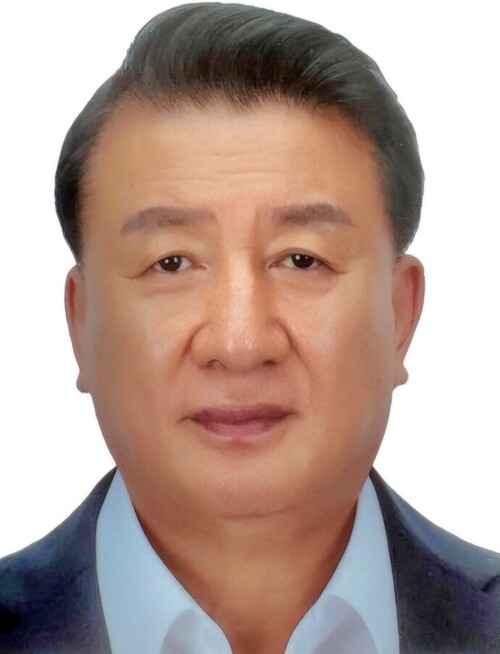
▲ 연구를 수행한 이진호 교수와 김경식 박사과정생. (가운데) 유기 및 페로브스카이트 태양전지 모듈의 사전 패터닝 및 후처리 패터닝 공정 개략도. (오른쪽) 모듈 설계 및 공정 최적화를 위한 AI머신러닝 기반 통합 워크플로우.(사진제공:인천대학교) © 박상도 기자 |
(브레이크뉴스인천 박상도 기자) 인천대학교가 6일, 물리학과 이진호 교수 연구팀이 유기 태양전지와 페로브스카이트 태양전지의 대면적화를 위한 모듈 디자인 및 패터닝 기술의 발전 방향을 집대성한 논문을 발표했다고 밝혔다.
인천대에 따르면, 이번 연구는 에너지·환경 분야 세계 최고 권위지인 ‘에너지 앤 인바이런멘탈 사이언스(Energy & Environmental Science, IF: 31, JCR 상위 0.4%)’지에 3월 19일자 온라인 판에 게재됐으며, 한국화학연구원 전남중 박사, 홍순일 박사 연구팀과 공동으로 수행했다(논문명: Review of module designs for organic and perovskite solar cells).
현재 유기 및 페로브스카이트 태양전지는 실험실 수준의 소면적 셀에서 각각 19.2%와 27.0%라는 높은 효율을 달성했으나, 상업화를 위한 대면적 모듈(>10 cm2) 제작 시 효율이 20~30% 급격히 저하되는 ‘Cell-to-Module’ 효율 격차가 가장 큰 걸림돌이었다.
이진호 교수팀은 이러한 문제를 해결하기 위해 필수적인 모듈 구조 설계와 정밀 패터닝 기술을 체계적으로 분석했다.
연구팀은 특히 가장 지배적인 패터닝 기술인 레이저 스크라이빙(Laser Scribing)의 메커니즘을 심도 있게 분석했다.
레이저 스크라이빙은 비접촉 방식으로 95% 이상의 높은 기하학적 충진율(GFF)을 가능케 하지만, 공정 중 발생하는 열 영향부(HAZ)로 인한 성능 저하 문제가 존재한다.
이에 연구팀은 극초단 레이저 활용뿐만 아니라, 열 손상을 원천적으로 차단할 수 있는 ‘P2-free’ 자기정렬 구조와 in-situ(실시간) 전기화학적 패터닝 등 혁신적인 대안들을 제시했다.
또한, 최근 주목받고 있는 인공지능(AI) 및 머신러닝 기술을 태양전지 제조 공정에 도입하는 전략을 비중 있게 다뤘다.
AI를 통해 방대한 재료 조합을 스크리닝하고 복잡한 공정 변수를 최적화함으로써 차세대 태양전지의 효율과 안정성을 동시에 확보할 수 있는 스마트 제조 플랫폼의 비전을 제시했다.
인천대 이진호 교수는 “이번 논문은 차세대 태양전지가 실험실을 넘어 실제 우리 삶의 에너지원으로 자리 잡기 위해 반드시 넘어야 할 ‘대면적화’라는 기술적 장벽에 대해 명확한 청사진을 제시한 것”이라며, “특히 AI 기술과의 융합은 제조 공정의 효율성을 극대화하여 차세대 태양광 시장의 판도를 바꿀 핵심 열쇠가 될 것”이라고 말했다.
이번 연구는 과학기술정보통신부 산하 한국연구재단(NRF)의 중견연구자지원사업 및 산업통상자원부 산하 한국에너지기술평가원(KETEP)의 에너지인력양성사업의 지원을 받아 수행됐다.
*아래는 위 기사를 ‘구글 번역’으로 번역한 영문 기사의 [전문]입니다.‘구글번역’은 이해도 높이기를 노력하고 있습니다. 영문 번역에 오류가 있을 수 있음을 전제로 합니다.<*Below is the [full text] of the English version of the article above, translated using 'Google Translate'. 'Google Translate' strives to improve comprehension. It is assumed that there may be errors in the English translation.>
Incheon National University Professor Jin-ho Lee's Research Team Presents Strategies for Modular Design, Patterning, and AI Utilization for Organic and Perovskite Solar Cells
-Break News Incheon Park Sang-do Reporter
Incheon National University announced on the 6th that a research team led by Professor Jin-ho Lee of the Department of Physics has published a paper summarizing the development directions of module design and patterning technologies for the large-area fabrication of organic and perovskite solar cells.
According to Incheon National University, this research was published in the online edition on March 19 in *Energy & Environmental Science* (IF: 31, top 0.4% of JCR), a world-leading journal in the energy and environment fields, and was conducted jointly with the research team of Dr. Jeon Nam-jung and Dr. Hong Soon-il from the Korea Research Institute of Chemical Technology (Paper title: Review of module designs for organic and perovskite solar cells).
Currently, organic and perovskite solar cells have achieved high efficiencies of 19.2% and 27.0%, respectively, in small-area cells at the laboratory level. However, the biggest obstacle has been the "cell-to-module" efficiency gap, where efficiency drops sharply by 20–30% when fabricating large-area modules (>10 cm²) for commercialization.
Professor Lee Jin-ho's team systematically analyzed the module structure design and precision patterning technologies essential to solving this problem.
The research team conducted an in-depth analysis of the mechanism of laser scribing, the most dominant patterning technology.
While laser scribing enables a high Geometric Fill Factor (GFF) of over 95% through a non-contact method, it faces performance degradation issues caused by the Heat-Affected Zone (HAZ) generated during the process.
In response, the team proposed innovative alternatives, including not only the use of ultrashort lasers but also ‘P2-free’ self-aligned structures capable of fundamentally blocking thermal damage and in-situ (real-time) electrochemical patterning.
Furthermore, the study placed significant emphasis on strategies for introducing recently trending artificial intelligence (AI) and machine learning technologies into solar cell manufacturing processes.
By utilizing AI to screen vast material combinations and optimize complex process parameters, the team presented a vision for a smart manufacturing platform capable of simultaneously securing the efficiency and stability of next-generation solar cells.
"This paper presents a clear blueprint for the technical barrier of 'large-area fabrication,' which must be overcome for next-generation solar cells to move beyond the laboratory and establish themselves as an energy source for our daily lives," said Professor Jin-ho Lee of Incheon National University. "In particular, the convergence with AI technology will maximize the efficiency of the manufacturing process and become a key factor in changing the landscape of the next-generation solar market."
This research was conducted with support from the Mid-Career Researcher Support Program of the National Research Foundation of Korea (NRF) under the Ministry of Science and ICT and the Energy Workforce Development Program of the Korea Energy Technology Evaluation Institute (KETEP) under the Ministry of Trade, Industry and Energy.
원본 기사 보기:ebreaknews.com