홍준표는 민주당 대구시장 후보로 출마한 김부겸 전 국무총리를 공개적으로 지지했다. 그리고 곧바로 청와대에서 이재명과 마주 앉았다. 이것은 우연한 동선이 아니다. 정치적 선택이고, 그 선택의 방향은 분명하다.
사람은 떠날 때가 아름다워야 한다. 홍준표는 보수정당에서 원내대표, 당대표, 대선후보를 거친 5선 의원이었고, 재선 경남지사와 대구시장까지 지냈다. 이 정도면 대통령을 제외하고 한 정치인이 누릴 수 있는 거의 모든 것을 경험한 셈이다. 물론 개인의 능력도 있었을 것이다. 그러나 그것이 전부는 아니다. 보수정당이라는 구조가 있었기에 가능한 경로였다. 그 점에서 그는 보수정당에 빚진 사람이다.
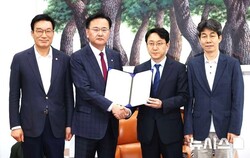
 ▲ 이재명 더불어민주당 대표가 지난 2023년 5월10일 오후 대구시청 산격청사를 찾아 홍준표 대구시장(왼쪽)과 면담하고 있다 . ©뉴시스. |
홍준표 정치의 한계는 출발점에서 이미 드러난다. 그는 정치 입문 당시 4·19 혁명 학생 지도자이자 정치권 고려대 학맥의 최고봉이었던 나의 동서 이기택을 발판으로 길을 구했지만, 곧 나의 정치적 멘토 김영삼의 신한국당으로 이동했다. 이후 이회창 총재의 신한국당과 이기택 총재의 ‘꼬마’ 민주당이 합당해 한나라당이 출범하는 과정에서도 같은 선택은 반복됐다. 정치에서 이동 자체는 문제가 아니다. 그러나 출발점에서 배신이 반복되면 신뢰는 축적되지 않는다. 정치는 능력보다 신의와 의리로 작동하는 영역이다. 결국 그의 정치에는 신의보다 선택이, 의리보다 꼼수가 앞선다는 평가가 따라붙는다.
이제 멈춰야 한다. 정치란 어디에 서느냐의 문제다. 그런 점에서 이번 오찬은 단순한 만남이 아니라 위치 이동의 선언이다. 홍준표는 더 이상 정치적 주체가 아니다. 조직도, 세력도 없는 상태에서의 선택은 방향이 아니라 편입이다. 겉으로는 연대처럼 보이지만, 본질은 구조 속으로 들어가는 것이다.
이 장면을 단순한 인사로 보면 핵심을 놓친다. 최근 떠도는 ‘홍준표 총리설’도 마찬가지다. 그럴듯해 보이지만 본질이 아니다. 총리는 대통령 중심제에서 권력의 주체가 아니라 기능적 위치로 그림자에 불과하다. 총리를 준다고 해서 정치 지형이 바뀌지는 않는다. 오히려 총리 기용은 활용의 정점이 아니라 한계다. 권력 내부로 들어가는 순간 그는 독립된 정치 주체가 아니라 하위 구조가 된다.
문제의 본질은 자리가 아니라 지방선거 후에 일어날 권력 구조 재편이다. 이재명은 보수를 이기려 하기보다 나누려 한다. 이재명과 민주당이 보수의 성지인 영남에서 정면 승부로 승리하는 것은 구조적으로 어렵기 때문이다. 그렇다면 남는 길은 하나다. 내부를 갈라 새로운 축을 만드는 것이다.
이 지점에서 홍준표의 역할이 등장한다. 총리가 아니라, 중도 실용 정당의 얼굴로 전면에 세우는 방식이다. 영남 출신 전·현직 인사들을 흡수하고, 중도·보수 성향 의원들을 단계적으로 편입시키며 별도의 정치 축을 형성한다. 그 중심에 홍준표를 배치한다. 외형은 중도 보수 재편이지만, 실질은 이재명의 원격 조정을 받는 2중대 정당 구조다.
이 구조는 낯설지 않다. 1981년 총선을 보라. 민한당은 전두환 정권이 만든 제도권 야당이었다. 81석을 얻으며 형식상 야당의 모습을 갖췄지만, 실제로는 권력의 보조축이었다. 당시 대통령 선거는 직선제가 아니라 간접선거였다. 경쟁은 있었지만 결과는 이미 구조 속에 있었다.
최근의 한국 정치에서도 유사한 사례가 있다. 2016년 총선에서 안철수가 이끈 국민의당은 38석, 정당득표율 26.7%를 기록하며 양당 구조를 흔들었다. 진보의 성지 호남에서 돌풍을 일으겼고, 무당층의 아성인 수도권을 흔들었다. 중요한 것은 이념이 아니라 기존 양당에 대한 대안이라는 프레임이었다. 이 패턴이 영남과 수도권에서 재현된다면 단순한 제3당이 아니라 기존 보수를 일부 흡수한 대체 축이 된다.
해외에서도 같은 구조는 반복된다. 프랑스 에마뉘엘 마크롱 대통령은 사회당 정부에서 경제장관으로 정책을 우클릭하며 중도 기반을 확보한 뒤, ‘앙마르슈’를 창당해 좌우 인사를 동시에 흡수했다. 그는 기존 정당 체계를 무너뜨리고 새로운 중심축을 만들며 집권을 이어갔다. 반면 독일 앙겔라 메르켈 수상은 연정을 통해 경쟁을 내부화하고 장기 집권 구조를 만들었다. 하나는 외부에서 질서를 재편했고, 다른 하나는 내부에서 경쟁을 흡수했다.
지금 한국에서 보이는 그림은 이 세 가지—민한당식 보조축, 안철수식 제3당, 마크롱식 재편, 메르켈식 안정화—가 결합된 형태에 가깝다. 겉으로는 정치 재편이지만, 실제로는 권력의 지속, 즉 장기집권을 위한 구조 설계다.
이재명의 권력 의지는 단순한 정치적 야망이 아니다. 그는 광야에서 끊임없는 자기와의 싸움을 치르고 제도권에 진입한 인물이다. 기득권 내부에서 성장한 정치인이 아니라 외부에서 진입한 정치인이다. 이런 유형의 정치인에게 권력은 선택이 아니라 생존의 문제다. 권력에서 물러나는 순간 사법적 리스크가 현실화된다고 믿을수록 권력 의지는 극단으로 치닫는다. 그에게 권력은 선택이 아니라 생존이다.
그래서 그는 멈추지 않는다. 이미 행정부와 입법부는 사실상 장악됐고, 사법 영역에서도 영향력이 뚜렷해지고 있다. 권력의 세 축이 한쪽으로 기울기 시작했다. 여기에 이번 지방선거에서 압승한다면, 지방권력까지 결합되며 권력은 사실상 전면적으로 완성된다.
그리고 그 다음은 제도다. 대통령 중임제 개헌을 통해 권력을 연장하거나, 의원내각제로 전환해 집권 세력과 별도 축을 결합한 안정적 다수 구조를 만드는 방식이다. 이 경우 형식은 민주주의를 유지하지만, 구조는 장기 집권에 최적화된다. 우리는 이런 형태를 통상 독재라고 부르지 않는다. 그러나 권력이 구조적으로 고정되는 순간, 정치 경쟁의 성격은 달라진다.
결국 질문은 하나다. 홍준표는 무엇이 되는가. 임명직 총리라면 기능적 인물에 그친다. 그러나 중도 정당의 전면에 선다면 그는 구조 재편의 중심 축이 된다. 그리고 그 순간 보수 정치의 판은 완전히 바뀐다.
핵심은 분명하다. ‘홍준표 총리설’은 본질이 아니다. 그것이 사실이든 아니든 중요한 것은 배치다. 권력의 내부에 들어가는가, 아니면 권력이 설계한 새로운 축의 전면에 서는가. 이 선택에 따라 다음 총선의 구조가 결정된다. Jeongkeekim@naver.com
*필자/김정기 ● 학력- 뉴욕주립대학교(Stony Brook) 정치학과 수석 졸업- 마케트대학교(Marquette) 로스쿨 법학박사- 하버드대학교(Harvard) 케네디스쿨 최고위 과정- 베이징대학교(Peking) 북한학 연구학자
 ▲ 필자/김정기 칼럼니스트 ©브레이크뉴스 |
● 경력
세계스마트시티기구(WeGO) 사무총장 (현) -유엔 국제전기통신연합 (UN ITU) 가상세계 및 AI 글로벌 이니셔티브 집행위원(현) -제8대 주상하이 대한민국 총영사 -2010 상하이 세계 엑스표 대한민국관 정부대표 -법무법인 대륙아주 중국 총괄 미국변호사 -동국대학교 경영전문대학원 석좌교수 –숭실사이버대학교 총장 –칼럼니스트.
● 저서
1. 대학생을 위한 거로영어연구[전 10권](거로출판사) 2. 나는 1%의 가능성에 도전한다(조선일보사) 3. 한국형 협상의 법칙(청년정신사) 4. 대한민국과 세계 이야기 (도서출판 책미듬) 5. Korea and the World (Advance Reader Copy). Jeongkeekim@naver.com
● The Prime Minister Rumor Is a Decoy — The Hong Joon-pyo–Lee Jae-myung Luncheon: The Final Scene of Conservative Collapse or the Blueprint for Power Restructuring?
By Jeong-kee Kim, Political Columnist and Secretary General of the World Smart Sustainable Cities Organization(WEGO)
Hong Joon-pyo publicly endorsed former Prime Minister Kim Boo-kyum, who is running as the Democratic Party’s candidate for mayor of Daegu. Soon after, he sat down with Lee Jae-myung at the presidential office. This was not a coincidence of movement. It was a political choice—and the direction of that choice is unmistakable.
A person should know when to leave, and leave gracefully. Hong has already experienced nearly everything a politician in Korea can achieve short of the presidency: floor leader, party chairman, presidential candidate, five-term lawmaker, two-term governor of South Gyeongsang Province, and mayor of Daegu. His personal ability played a role, certainly—but that is not the whole story. His trajectory was made possible by the structure of the conservative party. In that sense, he owes a debt to it.
The limits of Hong’s politics were visible from the beginning. At the outset of his political career, he leveraged Lee Ki-taek—a key figure of the Korea University political network and a leader of the April 19 student movement—as a stepping stone. He soon moved to the New Korea Party under Kim Young-sam. The same pattern repeated during the merger process that led to the formation of the Grand National Party. Movement in politics is not inherently a problem. But when departures from one’s starting point are repeatedly marked by betrayal, trust does not accumulate. Politics operates less on ability than on fidelity and loyalty. In Hong’s case, the judgment follows: choice over fidelity, calculation over loyalty.
Now is the moment to stop. Politics is ultimately about where one stands. In that sense, this luncheon is not a simple meeting—it is a declaration of repositioning. Hong is no longer an independent political actor. Without an organization or a base, a “choice” is no longer direction—it is absorption. It may appear as alignment on the surface, but in essence, it is entry into an existing structure.
To view this moment merely as a personnel matter is to miss the point. The circulating “Hong Joon-pyo prime minister rumor” falls into the same trap. It may sound plausible, but it is not the essence. In a presidential system, the prime minister is not a locus of power but a functional position—a shadow. Appointing a prime minister does not alter the political landscape. On the contrary, once inside the power structure, Hong would cease to be an independent actor and become a subordinate component.
The real issue is not a position, but the restructuring of power that may follow the local elections. Lee Jae-myung is not trying to defeat conservatives outright—he is trying to divide them. Structurally, it is difficult for the Democratic Party to win a head-on contest in Yeongnam, the conservative stronghold. That leaves only one path: divide from within and build a new political axis.
This is where Hong’s role emerges—not as prime minister, but as the face of a centrist pragmatic party. The strategy would be to absorb former and current figures from Yeongnam, gradually incorporate centrist and conservative-leaning lawmakers, and construct a separate political axis. At its center would stand Hong Joon-pyo. Outwardly, it would appear as a centrist conservative realignment. In reality, it would function as a secondary formation under Lee’s remote influence.
This structure is not unfamiliar. Look at the 1981 general election. The Democratic Justice Party-aligned Korean National Party (Minhan Party) functioned as a regime-sanctioned opposition under Chun Doo-hwan. It secured 81 seats, presenting the form of opposition, but in reality served as an auxiliary axis of power. The presidential election at the time was indirect. Competition existed, but the outcome was structurally predetermined.
A more recent parallel can be found in the 2016 general election. Ahn Cheol-soo’s People’s Party won 38 seats and 26.7% of the party-list vote, shaking the two-party system. It surged in Honam and made inroads into the Seoul metropolitan area. The key was not ideology, but the framing as an alternative to the existing duopoly. If this pattern were replicated in Yeongnam and the capital region, it would not remain a mere third party—it would become a replacement axis absorbing parts of the conservative bloc.
Internationally, similar dynamics recur. In France, President Emmanuel Macron, after serving as economy minister under a Socialist government, pivoted toward the center-right, built a centrist base, and launched En Marche!, absorbing figures from both left and right. He dismantled the traditional party system and constructed a new central axis of power. In contrast, Germany’s Angela Merkel internalized competition through coalition governance, stabilizing a long-term ruling structure. One reorganized order from the outside; the other absorbed competition from within.
What appears to be unfolding in Korea today resembles a hybrid of these models: a regime-aligned auxiliary axis, a third-party disruption, a Macron-style realignment, and a Merkel-style stabilization—all combined. On the surface, it looks like political reconfiguration. In substance, it is the design of power continuity—a structure optimized for long-term rule.
Lee Jae-myung’s will to power is not mere ambition. He is a figure who fought his way into the establishment from the margins. For such a politician, power is not a choice—it is survival. The more he believes that stepping down exposes him to legal risks, the more his drive for power intensifies. For him, power is not optional; it is existential.
That is why he does not stop. The executive and legislative branches are already effectively under his control, and his influence over the judicial sphere is becoming increasingly visible. The three pillars of power are tilting in one direction. If he secures a sweeping victory in the upcoming local elections, local power will be added to the equation, completing the consolidation.
What follows is institutionalization. Constitutional revision toward a two-term presidency, or a shift to a parliamentary system that fuses the ruling bloc with an auxiliary axis to secure a stable majority. Formally, democracy remains intact. Structurally, power becomes entrenched. We may not call this dictatorship—but once power is structurally fixed, the nature of political competition changes fundamentally.
In the end, the question is simple: What does Hong Joon-pyo become? As an appointed prime minister, he is a functional figure. But as the face of a new centrist party, he becomes a central axis of structural realignment. And at that moment, the entire landscape of conservative politics is transformed.
The core is clear. The “prime minister rumor” is not the essence. Whether it is true or not does not matter. What matters is placement: does he enter the inner circle of power, or does he stand at the forefront of a newly engineered axis? That choice will determine the structure of the next general election.
*Author / Jeong-kee Kim
● Education
-B.A. in Political Science (Summa Cum Laude), State University of New York at Stony Brook -Doctor of Jurisprudence, Marquette University Law School -Senior Executive Program, Harvard Kennedy School -Research Scholar in North Korean Studies, Peking University
● Professional Experience
-Secretary-General, World Smart Sustainable Cities Organization (Current) -Executive Committee Member, Virtual World & AI Global Initiative, International Telecommunication Union (Current) -8th Consul General of the Republic of Korea in Shanghai -Commissioner General, Korea Pavilion, Expo 2010 Shanghai China -Senior Attorney-at-Law, DR& Aju LLC -Distinguished Chair Professor, Graduate School of Business, Dongguk University -President, Soongsil Cyber University -Columnist
● Publications
-Georo English Studies Series for College Students (Georo Publishing) -I Challenge the Possibility of One Percent (Chosun Ilbo) -The Art of K-Negotiation (Cheongnyeonjeongsin Publishing) -Korea and the World (Chaekmideum Publishing)
*Email: Jeongkeekim@naver.com