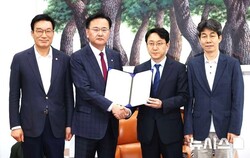
▲ 서왕진 조국혁신당 원내대표, 용혜인 기본소득당 대표를 비롯한 개혁진보4당 의원들이 18일 새벽 서울 여의도 국회 본회의장에서 '돈 정치 지구당 부활 기득권 야합 규탄한다' 라는 손피켓을 자리에 붙여놓고 있다. 2026.04.18. © 뉴시스 |
브레이크뉴스 이제항 선임기자= 대한민국국회(국회의장 우원식)는 18일 새벽에 열린 제434회국회(임시회) 제6차 본회의에서 총 4건의 법률안이 국회 문턱을 넘었다.
이번 본회의에서는 △2026년 6월 3일 실시되는 제9회 전국동시지방선거에서 적용될 총정수 및 선거구구역표를 조정하는 「공직선거법 일부개정법률안」을 비롯해 △ 「제주특별자치도 설치 및 국제자유도시 조성을 위한 특별법 일부개정법률안」, △「정당법 일부개정법률안」, △「정치자금법 일부개정법률안」이 의결됐다.
먼저, 「공직선거법 일부개정법률안」은 2026년 6월 3일 실시되는 제9회 전국동시지방선거에서 적용될 총정수 및 선거구구역표를 조정하는 내용이다.
제주특별자치도와 세종특별자치시를 제외한 지역구 시·도의회의원(광역의원) 총정수를 현행 729명에서 754명으로 25명 증원하고 이에 맞춰 선거구구역표를 조정했다.
시·도별 자치구·시·군의회의원(기초의원) 총정수를 현행 2,978명에서 3,003명으로 총 25명 증원하고, 국회의원지역선거구 기준 현행 11곳에서 16곳을 추가로 지정해 총 27개 선거구에서 중·대선거구제를 확대·실시한다.
또한 전남광주통합특별시 내 시·도의회의원(광역의원) 지역선거구 중 광주광역시 지역 4개 선거구(동구남구갑, 북구갑, 북구을, 광산구을)에서 중대선거구제를 최초 도입한다.
개정안은 비례대표 시·도의회의원 정수 비율을 현행 100분의 10에서 100분의 14로 상향 조정하는 내용도 포함됐다.
또한, 이번에 의결된 「정당법 일부개정법률안」은 시·도당 하부조직의 원활한 사무 처리를 위해 국회의원지역구마다 당원협의회(또는 지역위원회) 사무소 1개를 둘 수 있도록 하는 내용이다.
당원협의회는 2004년 법률 개정으로 폐지된 지구당의 역할을 대체해 국회의원지역구, 자치구·시·군 및 읍·면·동 등의 지역 내 정당활동을 활성화하기 위한 대안으로 도입됐다. 과거 지구당이 야기했던 정당 운영의 사당화와 고비용 문제를 방지하기 위해 당원협의회 사무소는 둘 수 없는 상황이다.
중앙당은 당원협의회 현황(사무소 현황 포함)을 매년 관할선거관리위원회에 보고하도록 했다.
*아래는 위 기사를 '구글 번역'으로 번역한 영문 기사의 [전문]입니다. '구글번역'은 이해도 높이기를 위해 노력하고 있습니다. 영문 번역에 오류가 있을 수 있음을 전제로 합니다.<*The following is [the full text] of the English article translated by 'Google Translate'. 'Google Translate' is working hard to improve understanding. It is assumed that there may be errors in the English translation>
National Assembly Plenary Session Passes 4 Bills Including the Public Official Election Act
- Expansion of medium- and large-district constituencies for local council members from 11 to 27; introduction of medium- and large-district constituencies for metropolitan council members in 4 locations for the first time
- Increase in the ratio of proportional representation for city and provincial council members from the current 10% to 14%
- Establishment of one Party Member Council (or Regional Committee) office in each National Assembly constituency
— Lee Je-hang, Senior Reporter, Break News
At the 6th plenary session of the 434th National Assembly (Extraordinary Session) held in the early hours of the 18th, a total of four bills passed the threshold of the National Assembly (Speaker Woo Won-sik). At this plenary session, the following bills were passed: the "Partial Amendment to the Public Official Election Act," which adjusts the total number of seats and electoral district boundaries to be applied in the 9th National Simultaneous Local Elections to be held on June 3, 2026; the "Partial Amendment to the Special Act on the Establishment of Jeju Special Self-Governing Province and the Creation of an International Free City"; the "Partial Amendment to the Political Parties Act"; and the "Partial Amendment to the Political Funds Act."
First, the "Partial Amendment to the Public Official Election Act" concerns the adjustment of the total number of seats and electoral district boundaries to be applied in the 9th National Simultaneous Local Elections to be held on June 3, 2026.
The total number of regional constituency city and provincial council members (metropolitan council members), excluding Jeju Special Self-Governing Province and Sejong Special Self-Governing City, was increased by 25 from the current 729 to 754, and the electoral district boundaries were adjusted accordingly.
The total number of council members (basic council members) for autonomous districts, cities, and counties by city and province will be increased by 25, from the current 2,978 to 3,003. Additionally, based on the criteria for National Assembly regional constituencies, 16 additional districts will be designated, bringing the total to 27 constituencies, thereby expanding and implementing the multi- and large-district constituency system.
Furthermore, the multi- and large-district constituency system will be introduced for the first time in four constituencies within Gwangju Metropolitan City (Dong-gu Nam-gu Gap, Buk-gu Gap, Buk-gu Eul, and Gwangsan-gu Eul) among the regional constituencies for city and provincial council members (regional council members) within the Jeonnam-Gwangju Integrated Special City.
The amendment also includes a provision to increase the proportion of proportional representation city and provincial council members from the current 10 percent to 14 percent. In addition, the recently passed "Partial Amendment to the Political Parties Act" allows for the establishment of one Party Member Council (or Regional Committee) office in each National Assembly constituency to facilitate the smooth administrative operations of subordinate organizations within city and provincial party branches.
Party Member Councils were introduced as an alternative to replace the district party chapters, which were abolished by a legal amendment in 2004, in order to revitalize party activities within local areas such as National Assembly constituencies, autonomous districts, cities, counties, and towns, townships, and neighborhoods. However, to prevent the issues of party privatization and high costs caused by the former district party chapters, the establishment of Party Member Council offices is currently prohibited.
The central party is required to report the status of Party Member Councils (including the status of offices) to the competent National Election Commission annually.