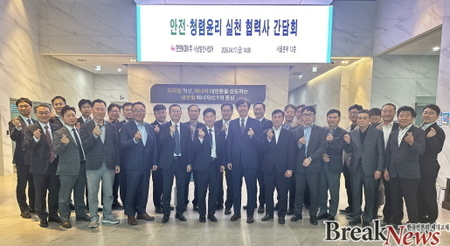
[브레이크뉴스경기남부=용인 이현준기자] 이상일 용인특례시장은 11일 오후 서울 서초구 양재동 엘타워 멜론홀에서 열린 ‘제65차 환경리더스포럼’에 참석했다.
(사)한국환경한림원(회장 허탁 전 건국대 부총장) 주최로 열린 이날 포럼은 ‘반도체 국가 전략산업 육성과 물 환경 정책’을 주제로 용인 반도체 클러스터 산업단지에 필요한 산업용수 확보 방안과 물 환경 전반에 미치는 영향에 대해 토의하고 정책 대안을 제시하기 위해 마련됐다.
포럼엔 이상일 용인특례시장, 허탁 (사)한국환경한림원 회장, 김명자 KAIST 이사장(제7대 환경부 장관), 곽결호 한국물포럼 총재(제9대 환경부 장관), 이규용 김앤장 법률사무소 상임고문(제12대 환경부 장관) 등 정부, 기업, 학계 전문가 등 100여 명이 참석했다.
이 시장은 인사말에서 “용인특례시 이동ㆍ남사읍 220만 평에 삼성전자가 360조 원을 투자하는 국가 첨단시스템반도체 국가산업단지가 조성되는 데 전력, 용수에 대한 예비타당성 조사 면제가 이뤄졌고, 국가산단을 관통하는 국도 45호선을 4차로에서 8차로로 확장하는 사업도 예비타당성 조사가 면제돼 도로 확장이 3년 이상 빨라진다”며 “국가산단 안에 150여 개의 반도체 소재·부품·장비ㆍ설계 기업이 입주할 것으로 보이고, 국가산단 인근 이동읍 69만 평에는 1만6000 가구가 입주할 수 있는 반도체 특화 신도시가 조성되는 만큼 산업용수와 생활용수, 전력의 원활한 공급이 굉장히 중요하다”고 강조했다.
이 시장은 “SK하이닉스는 삼성전자 국가산단과 머지않은 처인구 원삼면 126만 평에 122조 원을 투자하는 용인 반도체클러스터 조성을 위한 토목공사를 진행하고 있고, 내년 봄 첫 번째 생산라인(Fab) 착공에 들어간다”며 “국가산단과 용인 반도체클러스터에 통합 관로를 통해 산업용수를 공급하는 일을 원활하게 추진하기 위해 예비타당성 조사 면제를 추진하고 있다”고 밝혔다.
이 시장은 “이들 두 곳이 계획대로 모두 가동될 경우 필요한 용수는 하루 약 134만 톤으로, 삼성전자 국가산단에만 77만여 톤, SK하이닉스의 용인 반도체클러스터에 57만여 톤"이라며 "국가산단에 필요한 물 77만여 톤은 240만 인구의 대구광역시 시민들이 하루 동안 쓰는 물에 해당할 정도로 엄청난 만큼 산업용수가 원활히 확보할 수 있도록 정부와 긴밀히 협력하고 있는데, 이 자리의 전문가들께서도 물 공급과 관련해 좋은 아이디어를 주시기 바란다”고 했다.
이날 포럼에선 김성효 K-water 수도계획부장이 ‘국가 반도체 산업 정책과 용수 공급 방안’을, 황호송 삼성전자 상무가 ‘삼성 반도체 친환경 경영전략과 수자원 관리’를 주제로 발표를 했다.
이어 윤제용 서울대 화학생물공학부 교수가 좌장을 맡아 권지향 대한상하수도학회 회장, 안종호 한국환경연구원 물국토연구본부장, 이정용 환경부 물이용정책과장, 조영무 경기연구원 선임연구위원, 최동진 국토환경연구원 대표 등이 패널로 참석해 용수 공급의 안정성과 물 환경 건전성 확보를 위한 발전 방안, 용인 반도체클러스터 국가산업단지 용수 공급과 환경 보전 방안, 합리적인 물 배분을 위한 제도 개선 등에 대해 견해를 밝혔다.
아래는 위 기사를 '구글 번역'으로 번역한 영문 기사의 [전문]입니다. '구글번역'은 이해도를 높이기를 위해 노력하고 있습니다. 영문 번역에 오류가 있을 수 있음을 전제로 합니다.<*The following is [the full text] of the English article translated by 'Google Translate'. 'Google Translate' is working hard to improve understanding. It is assumed that there may be errors in the English translation.>
[Break News Gyeonggi Nambu = Reporter Lee Hyeon-jun, Yongin] Mayor Lee Sang-il of Yongin Special City attended the ‘65th Environmental Leaders Forum’ held at the Melon Hall of the El Tower in Yangjae-dong, Seocho-gu, Seoul on the afternoon of the 11th.
Hosted by the Korea Environmental Academy (Chairman Heo Tak, former Vice President of Konkuk University), the forum was organized to discuss ways to secure industrial water needed for the Yongin Semiconductor Cluster Industrial Complex and the overall impact on the water environment, and to suggest policy alternatives, with the theme of ‘Fostering the National Strategic Industry of Semiconductors and Water Environment Policy.’
Approximately 100 people including Yongin Special City Mayor Lee Sang-il, Chairman Heo Tak of the Korea Environmental Academy, KAIST Chairman Kim Myung-ja (7th Minister of Environment), Korea Water Forum President Kwak Gyeol-ho (9th Minister of Environment), and Kim & Chang Law Firm Senior Advisor Lee Gyu-yong (12th Minister of Environment) attended the forum, including experts from the government, business, and academia.
In his opening remarks, the mayor emphasized, “Samsung Electronics is investing 360 trillion won in the National Advanced System Semiconductor Industrial Complex in Idong and Namsa-eup, Yongin Special City, and the preliminary feasibility study on electricity and water has been exempted. The project to expand National Route 45, which runs through the national industrial complex, from 4 lanes to 8 lanes has also been exempted from the preliminary feasibility study, accelerating the road expansion by more than 3 years.” He added, “It appears that around 150 semiconductor material, component, equipment, and design companies will move into the national industrial complex, and a semiconductor-specialized new city will be built in Idong-eup, 690,000 pyeong near the national industrial complex, where 16,000 households can live, so the smooth supply of industrial water, domestic water, and electricity is extremely important.” The mayor said, “SK Hynix is currently carrying out civil engineering work for the Yongin Semiconductor Cluster, which will invest 122 trillion won in 1.26 million pyeong of Wonsam-myeon, Cheoin-gu, not far from the Samsung Electronics National Industrial Complex, and will begin construction of the first production line (Fab) next spring.” He added, “We are pushing for exemption from preliminary feasibility studies to smoothly supply industrial water through integrated pipelines to the National Industrial Complex and Yongin Semiconductor Cluster.”
The mayor said, “If these two sites are operated as planned, the required water will be approximately 1.34 million tons per day, with 770,000 tons for the Samsung Electronics National Industrial Complex alone and 570,000 tons for SK Hynix’s Yongin Semiconductor Cluster.” He added, “The 770,000 tons of water required for the National Industrial Complex is equivalent to the amount of water used by 2.4 million Daegu citizens in a day, so we are working closely with the government to secure industrial water smoothly. I hope the experts here will give us some good ideas regarding water supply.”
At the forum that day, Kim Sung-hyo, Director of the Waterworks Planning Division of K-water, presented on the topic of ‘National Semiconductor Industry Policy and Water Supply Plan’, and Hwang Ho-song, Executive Director of Samsung Electronics, presented on the topic of ‘Samsung Semiconductor Eco-friendly Management Strategy and Water Resource Management’.
Following this, Professor Yoon Je-yong of the Department of Chemical and Biological Engineering at Seoul National University served as the moderator, and panelists including Kwon Ji-hyang, President of the Korean Society of Waterworks and Wastewater Engineering, Ahn Jong-ho, Director of the Water and Land Research Division at the Korea Environmental Research Institute, Lee Jeong-yong, Director of the Water Use Policy Division at the Ministry of Environment, Cho Yeong-moo, Senior Researcher at the Gyeonggi Research Institute, and Choi Dong-jin, President of the National Institute of Land and Environmental Research, participated and expressed their opinions on development plans to secure the stability of water supply and the soundness of the water environment, water supply and environmental preservation plans for the Yongin Semiconductor Cluster National Industrial Complex, and institutional improvements for rational water distribution.
원본 기사 보기:브레이크뉴스 경기남부