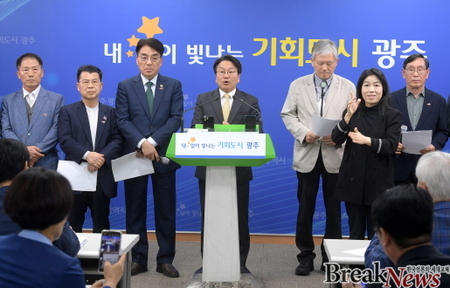
▲ 진성준 더불어민주당 정책위의장이 13일 오전 서울 여의도 국회에서 열린 추경 관련 기자간담회에서 발언하고 있다. 2025.02.13. © 뉴시스 |
브레이크뉴스 정명훈 기자= 더불어민주당은 13일 민생 회복과 경제 성장을 위해 35조원 규모의 추가경정예산(추경) 편성이 필요하다고 제안했다.
민주당 진성준 정책위의장과 이정문 정책위 수석부의장, 허영 민생경제회복단 단장은 13일 국회에서 기자회견을 통해 "12·3 비상계엄 선포 이후 계속되고 있는 정국 불안에 환율 인상, 소비 위축, 주가 하락, 수입물가 상승 등 대한민국 경제 상황이 최악으로 치닫고 있다"며 이같이 밝혔다.
민생 회복과 경제 성장 부문에 각각 24조원, 11조원 규모의 세출 증액이 필요하다는 게 민주당의 입장이다.
구체적으로 민생 회복(23조5000억원) 부문에는 ▲민생회복 소비쿠폰(13조1000억원) ▲상생소비 캐시백(2조4000억원) ▲지역화폐 할인지원(2조원) ▲8대 분야 소비바우처(5000억원)가 담긴 '소비 진작 4대 패키지'와 함께 '소상공인 손실보상 및 소상공인·중소기업 지원'(2조8000억원), '농어업 지원'(1조3000억원) 등이다.
경제 성장(11조2000억원)에서는 ▲인공지능(AI)·반도체 지원 및 R&D확대 5조원 ▲지방재정 보강(지방채 인수) 2조6000억원 ▲고교 및 5세 무상교육 1조2000억원 ▲공공주택·사회간접자본(SOC) 투자 1조1000억원 ▲기후위기 대응 1조원 ▲RE100 대응 8000억원 ▲일자리·창업 지원 5000억원 등을 투입해야 한다고 했다.
진성준 정책위의장은 다만 "추경 규모나 항목 모두는 여야 협의를 통해 결정할 사안"이라고 설명했다.
그는 "이 항목이 반드시 관철돼야 한다는 것은 아니다. 여야 협의 과정에서 탄력적으로 임하겠다"면서 "할 수 있다면 추경을 50조원 정도는 해야 장기 경제성장률을 방어할 수 있지 않겠냐는 생각이지만, 재정 여건이 그런 상황이 아니기 때문에 최대한 억제하고 발라내서 35조원로 제안한 것이다. 하지만 총 규모도 고집하지는 않겠다"고 말했다.
그러면서 "이런 민주당의 충정을 헤아려서 정부, 여당도 조속한 추경 편성에 나서주길 촉구한다"고 덧붙였다.
아울러 추경 재원 마련 방안에 대해선 "정부와 긴밀한 상의가 필요하다"면서 "나라 경제가 지금 너무 어렵기 때문에 국채를 통해서라도 일단 경기를 방어하는 게 시급해서 제안하는 것"이라고 강조했다.
허영 단장은 "정부 추경안이 국회에 제출돼서 예결위원회가 심사하는 데 최소 20~30일이 필요하다"면서 "다음주나 2월 말까지 정부가 여야 국정협의체 합의를 바탕으로 정부가 추경안을 국회에 제출하기를 진심으로 바란다"고 촉구했다.
*아래는 위 기사를 '구글 번역'으로 번역한 영문 기사의 [전문]입니다. '구글번역'은 이해도 높이기를 위해 노력하고 있습니다. 영문 번역에 오류가 있을 수 있음을 전제로 합니다.<*The following is [the full text] of the English article translated by 'Google Translate'. 'Google Translate' is working hard to improve understanding. It is assumed that there may be errors in the English translation.>
Democratic Party proposes 35 trillion won supplementary budget, "Recovering people's livelihoods and defending the economy are too urgent"
On the 13th, the Democratic Party of Korea proposed that a supplementary budget of 35 trillion won is needed to recover people's livelihoods and grow the economy.
On the 13th, Democratic Party Policy Committee Chairman Jin Seong-jun, Policy Committee Senior Vice Chairman Lee Jeong-moon, and People's Livelihood and Economic Recovery Team Director Heo Young announced this at a press conference at the National Assembly, saying, "Since the declaration of martial law on December 3, the political instability has continued, and the economic situation in South Korea is heading towards its worst, with the exchange rate hike, shrinking consumption, falling stock prices, and rising import prices."
The Democratic Party's position is that an increase in expenditures of 24 trillion won and 11 trillion won is needed for the recovery of people's livelihoods and economic growth, respectively.
Specifically, the livelihood recovery (KRW 23.5 trillion) sector includes the '4 major consumption stimulus packages' that include ▲livelihood recovery consumption coupons (KRW 13.1 trillion), ▲mutual consumption cashbacks (KRW 2.4 trillion), ▲local currency discount support (KRW 2 trillion), and ▲consumption vouchers for eight major fields (KRW 500 billion), along with 'compensation for losses to small business owners and support for small business owners and SMEs' (KRW 2.8 trillion), and 'support for agriculture and fisheries' (KRW 1.3 trillion).
For economic growth (KRW 11.2 trillion), it was said that ▲KRW 5 trillion should be invested in supporting artificial intelligence (AI) and semiconductors and expanding R&D, ▲KRW 2.6 trillion in reinforcing local finances (acquiring local bonds), ▲KRW 1.2 trillion in free education for high schools and 5-year-olds, ▲KRW 1.1 trillion in investment in public housing and social overhead capital (SOC), ▲KRW 1 trillion in responding to the climate crisis, ▲KRW 800 billion in responding to RE100, and ▲KRW 500 billion in supporting jobs and startups.
Policy Committee Chairman Jin Seong-jun explained, "However, the size of the supplementary budget and all items will be decided through consultation between the ruling and opposition parties."
He said, "This does not mean that all of these items must be implemented. He said, “I will be flexible in the process of negotiations between the ruling and opposition parties,” and added, “If possible, I think we should make a supplementary budget of around 50 trillion won to defend the long-term economic growth rate, but since the fiscal conditions are not like that, I have suggested 35 trillion won by suppressing and spreading it out as much as possible. However, I will not insist on the total amount.”
He added, “I urge the government and the ruling party to quickly prepare a supplementary budget in consideration of the Democratic Party’s sincerity.”
He also emphasized, regarding the method of securing the supplementary budget, “We need to consult closely with the government,” and “The national economy is so difficult right now, so I am proposing it because it is urgent to defend the economy even through national bonds.”
Heo Young, the head of the budget committee, said, “It will take at least 20 to 30 days for the government’s supplementary budget to be submitted to the National Assembly and reviewed by the Budget and Accounts Committee,” and urged, “I sincerely hope that the government will submit the supplementary budget to the National Assembly based on the agreement reached by the ruling and opposition party’s State Affairs Deliberation Council by next week or by the end of February.”