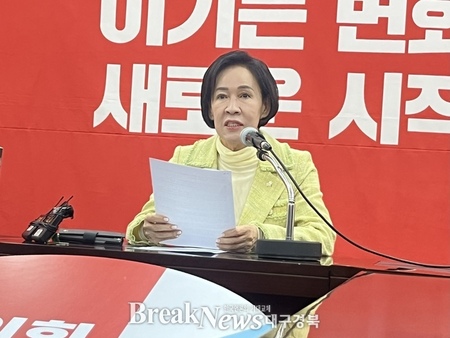
▲ 유혜미 대통령실 저출생대응 수석이 26일 용산 대통령실 청사에서 '2024 합계출산율' 관련 백브리핑을 하고 있다. © 뉴시스 |
유혜미 대통령실 저출생대응수석이 26일 용산 대통령실 청사에서 '2024 합계출산율'을 주제로 브리핑을 개최했다.
대통령실은 이날 지난해 12·3 비상계엄 선포 이후 첫 정책 브리핑을 재개한 가운데 전날 윤석열 대통령이 헌법재판소 탄핵심판 최종변론에서 직무 복귀 의지 시사 후 참모진들 역시 대외 소통에 나서는 형국이다
유 수석은 브리핑에서 "정부는 저출생 대응을 국정 우선과제로 설정하고 4대 개혁과 함께 과감히 추진해 왔다"며 그간 정부가 추진했던 부모급여 신설·출산가구에 대한 특별공급 신설 등 정책을 소개했다.
통계청에 따르면 지난해 출생아 수는 23만 8300명으로 전년 대비 8300명 증가했고 합계출산율 경우 전년 대비 0.03명 증가한 0.72명으로 집계됐다.
유 수석은 "30대 후반 여성 인구가 2.7% 감소했음에도 불구 30대 후반 여성 출생아 수가 2023년 6만 8000명에서 2024년 7만명으로 4.1% 증가하는 이례적 결과가 나타났다"며 "이는 30대 여성 인구 증감만으로 출생아수 증가를 설명하기 어렵고 정책 중심으로 한 추가적 영향 요인이 있음을 보여준다"고 했다.
또 "첫째 아이 출산까지의 시차가 줄어들고 있다"며 "결혼 후 출생 결정이 빨라진 건 출산·양육에 대한 정부 지원 확대와 아이에 대한 긍정적 인식이 커진 것"이라고 강조했다.
그러면서 "저출생정책으로 일 가정 양립·양육·주거 3대 핵심 정책 빈틈을 꼼꼼히 보완하고 다자녀·다양한 가족 형태를 지원하는 방안을 적극 발굴해 나갈 것"이라고 했다.
이어 "저출생 반전을 추세 전환으로 이끌 수 있는 핵심 요인 중 하나가 인식 변화"라며 "2025년엔 아이와 함께하는 행복을 넘어 눈치보지 않고 제도 사용하기와 부모와 함께하는 육아 등 정책을 확대하고, 고령화 관련해 세대간 공생을 중점에 두고 인식 개선에 힘 쏟을 것"이라고 했다.
더불어 "정부는 인구문제에 대한 견고한 거버넌스 구축을 위해 인구정책을 총괄 조정하는 컨트롤타워 역할을 수행할 인구부 설립 법안을 발의하고 개정을 추진중"이라며 "국회 상황이 쉽진 않지만 인구부 필요성에 여야가 모두 공감하는 만큼 논의가 진척되길 바란다"고 주문했다.
 ▲ 유혜미 대통령실 저출생대응 수석이 26일 용산 대통령실 청사에서 '2024 합계출산율' 관련 브리핑을 하고 있는 인근에 윤석열 대통령 관련 기사가 실린 신문이 놓여져 있다. © 뉴시스 |
아래는 위 기사를 '구글 번역'으로 번역한 영문 기사의 [전문]입니다. '구글번역'은 이해도 높이기를 위해 노력하고 있습니다. 영문 번역에 오류가 있을 수 있음을 전제로 합니다.<*The following is [the full text] of the English article translated by 'Google Translate'. 'Google Translate' is working hard to improve understanding. It is assumed that there may be errors in the English translation.
Office of the President: "Birth Rate Rebound Begins, Population Ministry Establishment Bill Proposed and Revision in Progress"
Yoo Hye-mi, Chief of Low Birth Rate Response, "2024 Total Fertility Rate, Number of Births Announced to Increase, First Policy Briefing after Martial Law on December 3rd, "The National Assembly is not in an easy position, but I hope that both the ruling and opposition parties will agree on the need for a Population Ministry and make progress in discussions."
-kihong Kim reporter
On the 26th, Yoo Hye-mi, the Senior Secretary to the President for Low Birth Rate Response, held a briefing on the topic of the '2024 Total Fertility Rate' at the Presidential Office in Yongsan.
On this day, the Office of the President resumed its first policy briefing since the declaration of martial law on December 3 last year, and after President Yoon Seok-yeol indicated his intention to return to work during the final argument of the impeachment trial at the Constitutional Court the day before, his staff members are also engaging in external communication.
In the briefing, Yoo said, "The government has set low birth rate response as a national priority and has been boldly pursuing it along with the four major reforms," and introduced policies that the government has been promoting, such as the introduction of parental benefits and special supplies for households with children.
According to Statistics Korea, the number of births last year was 238,300, an increase of 8,300 from the previous year, and the total fertility rate was recorded at 0.72, an increase of 0.03 from the previous year.
Chief Yoo said, "Despite a 2.7% decrease in the female population in their late 30s, the number of births by women in their late 30s increased by 4.1% from 68,000 in 2023 to 70,000 in 2024, which is an unusual result." He added, "This shows that it is difficult to explain the increase in the number of births solely by the increase or decrease in the female population in their 30s, and that there are additional influencing factors centered on policies."
He also emphasized, "The time gap until the birth of the first child is decreasing," and "The decision to have children after marriage has become faster due to the expansion of government support for childbirth and childrearing and the growing positive perception of children."
He added, "We will thoroughly supplement the gaps in the three core policies of work-family balance, childrearing, and housing as part of the low birth rate policy, and actively seek ways to support multiple children and diverse family types."
He continued, "One of the key factors that can lead the low birth rate reversal to a trend reversal is a change in awareness," and said, "In 2025, we will expand policies beyond happiness with children to using the system without worrying about what others think and childcare with parents, and focus on improving awareness with a focus on intergenerational coexistence in relation to the aging population."
He also said, "In order to establish a solid governance for the population issue, the government is proposing a bill to establish the Ministry of Population, which will serve as a control tower to comprehensively coordinate population policies, and is pushing forward with revisions," and "Although the National Assembly is not in an easy position, I hope that discussions will progress as both the ruling and opposition parties agree on the need for the Ministry of Population."