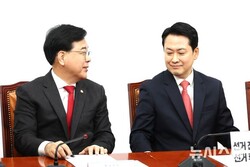
▲ 김관영(오른쪽) 전북지사가 5일 김호은(왼쪽) 전북지방환경청장과 면담을 갖고 완주군 봉동읍 폐기물 소각시설 설치와 관련, 주민 의견 등을 종합적으로 고려하는 신중한 검토를 당부하고 있다. / 사진제공 = 전북특별자치도청 (C) 김현종 기자 |
김관영 전북도지사가 완주군 구암리 폐소각장 시설을 둘러싼 지역사회 우려 해소에 나섰다.
5일 김 지사는 김호은 전북지방환경청장과 면담을 갖고 완주군 봉동읍 폐기물 소각시설 설치와 관련, 주민 의견 등을 종합적으로 고려하는 신중한 검토를 당부했다.
이번 면담은 전북지방환경청이 지정폐기물처리시설 설치에 따른 환경영향평가 및 인ㆍ허가 권한을 갖고 있어 최종 승인 여부를 판단하는 기관이라는 점에서 마련됐다.
김 지사는 이날 관련 시설이 삼봉지구와 둔산지구 등 주거 밀집 지역에 인접, 주민들의 건강과 환경오염 문제를 제기했다.
특히 입지 적절성과 설치 필요성 부족 등을 이유로 반대가 지속되는 만큼, 주민 수용성을 먼저 확보한 뒤 사업을 추진하는 것이 바람직하다는 뜻도 밝혔다.
시설 설치 검토 과정에서 철저한 검증과 투명한 절차 이행 협조도 요청했다.
아울러 ▲ 예산 확보 등 새만금 환경생태용지 조속 조성 ▲ 2026년 국가예산 확보 관련 사전 행정절차 처리 및 공동 대응 등 주요 현안에 대한 공조도 당부했다.
김 지사는 "도민의 어려움을 늘 가까이서 청취하고 이를 해결하기 위해 모든 도정 역량을 집중하고 있다"며 "도민 의견이 도정에 충실히 반영될 수 있도록 더욱 적극적으로 소통하겠다"고 강조했다.
한편, 폐소각장은 완주군 봉동읍 구암리에 1일 189.6톤 규모의 폐기물 소각시설을 건립하는 사업이다.
문제는 사업자의 연간 처리계획량이 완주군 관내 폐기물 발생량보다 많아 외부 폐기물의 대량 반입 등 주민들의 불안감이 커지고 있다.
지역 주민들은 지난해 6월 환경영향평가서 초안이 전북환경청과 완주군에 접수된 이후 반대 의사를 표명하고 있다.
주거지 및 공원묘지 등이 근거리에 위치한 입지의 부적절성과 관내 폐기물 발생량 부족으로 인한 시설 건립 필요성 부재 등을 주장하고 있다.
완주군 역시 관내 사업장 발생 일반 및 지정 폐기물량이 업체 계획량의 14%에 그치고 인근 전주ㆍ익산 소각시설에서 충분한 처리 능력을 보유하고 있다는 입장을 전했다.
☞ 아래는 위 기사를 구글 번역이 번역한 영문 기사의 '전문' 입니다.
구글 번역은 이해도를 높이기 위해 노력하고 있으며 영문 번역에 오류가 있음을 전제로 합니다.
【Below is the 'full text' of the English article translated by Google Translate.
Google Translate is working hard to improve understanding, and assumes that there are errors in the English translation.】
North Jeolla Province Governor Kim Kwan-young urges residents to embrace the new system
Interview with the Jeonbuk Environmental Office Director regarding the Guam-ri waste incineration facility in Wanju County
Reporter Park Dong-il
North Jeolla Province Governor Kim Kwan-young has taken steps to address community concerns surrounding the Guam-ri waste incinerator in Wanju County.
On the 5th, Governor Kim met with Kim Ho-eun, head of the Jeonbuk Regional Environmental Office, and urged a careful review, comprehensively considering residents' opinions, regarding the construction of the waste incinerator in Bongdong-eup, Wanju County.
This meeting was arranged because the Jeonbuk Regional Environmental Office has the authority to conduct environmental impact assessments and issue permits for designated waste treatment facilities, making it the final decision-making body on whether to approve the facility.
Governor Kim raised concerns about the health and environmental pollution of residents due to the proximity of the related facilities to densely populated areas such as Sambong and Dunsan districts.
He also expressed his intention to first secure public acceptance before proceeding with the project, given continued opposition citing issues such as site suitability and lack of necessity.
He also requested cooperation in implementing thorough verification and transparent procedures during the facility installation review process.
He also requested cooperation on key pending issues, including: ▲ the swift establishment of the Saemangeum Environmental Ecological Site, including securing a budget; and ▲ the preliminary administrative procedures and joint responses related to securing the 2026 national budget.
Governor Kim emphasized, "We are constantly listening closely to the difficulties faced by residents and focusing all our provincial government capabilities on resolving them. We will communicate more actively to ensure that residents' opinions are faithfully reflected in our provincial administration."
Meanwhile, the waste incinerator project is underway in Guam-ri, Bongdong-eup, Wanju County, with a daily capacity of 189.6 tons.
The problem is that the operator's annual planned processing volume exceeds the amount of waste generated within Wanju County, leading to increased anxiety among residents due to the large amount of waste brought in from outside the county.
Local residents have been expressing opposition since the draft environmental impact assessment was submitted to the Jeonbuk Environmental Office and Wanju County in June of last year.
They argue that the site is inappropriate due to its proximity to residential areas and a park cemetery, and that the insufficient waste generation within the county renders construction of the facility unnecessary.
Wanju County also stated that the general and designated waste generated by businesses within the county amounts to only 14% of the planned volume, and that the nearby Jeonju and Iksan incinerators have sufficient processing capacity.
원본 기사 보기:브레이크뉴스 전북판