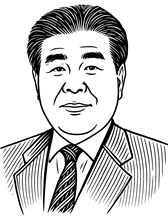
▲ 정길선 박사 ©브레이크뉴스 |
타지키스탄의 기존 헌법에는 임기 7년인 대통령이 세 번 연임을 할 수 없도록 되어 있다. 원래대로라면 라흐몬은 네 번째 임기가 끝나는 2020년에 물러났어야 한다. 그는 자신의 아들인 루스탐 에모말리에게까지 대통령 자리를 승계할 준비를 마쳤다. 개헌안에는 대선 후보의 연령 제한을 35세에서 30세로 낮추는 내용도 포함되어 있다. 라흐몬 대통령의 장남 루스탐 에모말리가 대통령에 출마할 필요가 생겼을 때에 대비해 법적 기반을 마련한 것이다. 물론 이러한 개헌 조항에는 라흐몬 대통령의 유고 시에도 루스탐 에모말리에게 바로 권력이 돌아갈 수 있도록 설정까지 해 놓았다. 절대 권력을 과시라도 하려는 듯 수도 두샨베 곳곳에는 라흐몬 대통령의 사진이 걸려 있다. 날로 커져가는 사진과 가짓수가 늘어나는 대통령 기념품들은 이제 이 나라가 독재자를 우상화하는 길로 들어섰음을 말해준다.
타지키스탄 최고 회의 의장이던 라흐몬은 1999년, 2006년, 2013년 대선에서 잇달아 승리하고 네 번째 임기를 맞았다. 의회에는 라흐몬의 집권당 밖에 없었기 때문에 개헌 통과는 당연했다. 타지키스탄은 유일 야당인 이슬람 부흥당을 해체시켜 버렸기 때문에 야당이 없는 나라다. 라흐몬의 야당 말살은 2014년 10월 야권이 연대하여 대규모 반 정부 시위를 준비하다 적발되면서 시작되었다. 당시 ‘아랍의 봄’이라는 시위 및 쿠데타가 벌어지는 중동의 상황이 타지키스탄에도 속속 전해졌다. 그 때문에 라흐몬 대통령의 친인척 비리는 국민들의 입담 및 오락거리로 전락될 지경에 이르고 있었다. 라흐몬 대통령의 측근인 자이드 사이도프(Зайд Саидов) 전 장관은 일부 기업에 편의를 봐주고 그 회사 주식의 5%를 대가로 받아 36만 달러를 갈취했다. 그가 각종 이권에 개입하여 수금한 돈이 900만 달러에 달해 타지키스탄은 이 같은 부패 스캔들로 민심이 매우 좋지 않았던 상황이었다.
이에 대해 폭로 전문 매체 ‘위키리크스’가 폭로한 미국 외교 문서에서 2010년 타지키스탄에 주재한 미국 외교관들은 “라흐몬과 그 측근이 은행을 포함한 주요 기업을 조종하며 부정한 수단도 서슴지 않는다”라고 보고했을 정도였다. 2014년 독일에서 도난 당한 고급 자동차 200여 대가 라흐몬 친인척의 소유로 둔갑해 타지키스탄에서 발견된 사건은 아직도 풀리지 않은 미스터리 중 하나로 남아있다. 라흐몬 대통령과 그 측근들의 비리가 연달아 터지자 ‘타지크 재건을 위한 청년 연합’이라는 단체와 ‘그룹 24’라는 단체 등 반 정부 세력이 대통령 탄핵을 위해 연대했다. 이들은 10월에 대규모 반 정부 시위를 열어 라흐몬 대통령을 압박하려 했다. 하지만 이와 같은 거사는 사전에 적발되었다. 이후 대대적인 반 정부 세력 색출 작전이 벌어진다. ‘그룹 24’의 지도자인 우마라리 쿠바토프(Умарари Куватов)는 국가 전복 혐의로 경찰에 수배령이 떨어졌다. 라흐몬 대통령 측근이자 당시 경찰처장 술레이몬 콰이모프(Сулейман Koаймов)는 터키 이스탄불까지 추적하여 우마라리 쿠바토프를 권총으로 사살했다.
급기야 2015년 타지키스탄 법원은 유일한 야당인 이슬람 부흥당(IRPT)을 테러 단체로 규정했다. 또 당의 모든 정치활동과 당을 소개하는 인쇄물이나 영상 등을 배포하는 행위를 금지했다. 야당에서 활동하던 인권 변호사 브주르그메르 요로프(Бзургмер Ёров)를 체포하고 야당 관계자 30여 명을 구속했다. 그에 대한 여파로 인해 2015년 3월 총선에서 이슬람 부흥당은 의회 진출에도 실패했다. 그 선거는 국제 감시단으로부터 부정선거라고 지탄받았던 선거였지만 라흐몬 정권은 이를 철저하게 무시했다. 라흐몬은 독재와 인권 탄압으로 2011년 미국 시사 주간지 〈타임〉이 선정한 10대 독재자에 오른 전력이 있다. 야당이 완전 와해된 가운데 종신 집권을 위한 개헌을 밀어붙인 것이다. 그는 〈타임〉에 의해 같은 해 10대 독재자로 뽑혔던 북한 김정일 국방위원장도 부럽지 않은 절대 권력을 구축했다.
현재 타지키스탄에서는 라흐몬에 대항할 세력이 거의 전멸했다고 볼 수 있다. 그러나 타지키스탄 정부는 이런 비민주적인 행위를 나름 정당화하는 명분을 가지고 있다. 야당인 이슬람 부흥당이 이슬람 원리주의 무장 세력과 결탁해 현 정권을 전복하려 한다는 것이다. 라흐몬은 친(親) 러시아 세력이고 원리주의 이슬람 단체의 정적이기도 하면서 미국이나 서방 국가들의 정적이기도 하다. 타지키스탄은 남쪽으로 아프가니스탄과 국경을 마주하고 있다. 아프가니스탄 전쟁 기간에 많은 타지키스탄 젊은이가 이슬람 무장세력에 가담해 이미 큰 사회 문제가 되었었던 경험이 있다. 아프가니스탄에 비해 잘 알려지지 않았지만, 내전으로 인해 고생했던 국가였다. 타지키스탄 주변 국가들인 우즈베키스탄과 키르기스스탄, 그리고 구소련권의 러시아와 친러 국가였던 카자흐스탄, 아르메니아 뿐 아니라 유엔 여러나라들의 군인들조차 파병했고, 무려 5년간의 내전과 그걸로 인한 아편 등 마약 불법 판매들이 판을 친적도 있었을 정도였기에 매우 민감했던 것이다.
우크라이나도 마찬가지다. 젤렌스키는 2019년 5월에 당선되자마자 의회 해산과 조기 총선에 관한 대통령령에 서명하며 의회 장악 행보에 본격적인 시동을 걸었다. 그는 의회 해산 명분으로 30일 이상 의회 내 연정이 없을 경우 대통령이 해산을 명할 수 있다는 헌법 조항을 들었다. 동시에 의회 해산 결정 발표 후 60일 이내에 조기 총선이 실시돼야 한다는 헌법 조항도 인용했다. 2014년 구성된 당시 라다 의회에는 젤렌스키 대통령을 지지하는 의원들이 많지 않기 때문인데 대부분 유로마이단으로 인해 포로센코파와 친러 세력인 인생을 위한 야권연단(Оппозиционная платформа — За жизнь (ОПЗЖ)) 때문이다. 이미 취임하고 나서부터 독재 권력을 장악하기 위해 이와 같은 위헌적인 행위를 감행한 것이다. 물론 이와 같은 우크라이나 헌법에 따른 삼권분립이 제대로 지켜질리가 없었고 2022년 러시아-우크라이나 전쟁은 젤렌스키의 권력 유지에 대한 당위성을 강화하게 되었다. 물론 전쟁에 1년이 지난 현재 서방과 미국이 점점 발을 빼려하는 모습을 보이면서 젤렌스키와 손절하려는 분위기가 감지되고 있긴 하다.
그러나 우크라이나는 2019년부터 야당이 없는 국회, 인민의 종 1당 만이 남은 1당 독재체제다. 이후에 친러 정당이 등장하기도 했지만 전쟁으로 인해 그마저도 해체되어 버렸다. 사실상 타지키스탄과 별다를 것이 없는 상태가 된 것이다. 타지키스탄과 달리 우크라이나에 남은 것은 대체자, 혹은 국가가 소멸될지 모르는 상태에 있다는 것이다. 타지키스탄과 우크라이나 정계의 공통점은 대상이 원리주의 이슬람과 러시아라는 이유를 들어 야당을 해체시켜버렸다는 것이고 절대권력의 토대를 마련했다는 것이다. 그러나 타지키스탄과 우크라이나 정계의 다른 점은 타지키스탄의 경제가 아무리 폭망상태라고 해도 우크라이나보다는 오래갈 것이라는 것이고 젤렌스키는 절대권력의 토대를 만들었지만 국가가 언제 패망하고 소멸될지 모른다는 것에 있다. 그리고 타지키스탄은 부자 세습이라는 확실한 플렌B가 있지만 우크라이나는 젤렌스키의 유고 시 플렌B의 불확실성이 존재한다는 것이다. 타지키스탄의 정계와 그 역사의 흔적을 보니 현 우크라이나와 많은 부분에서 닮았다는 생각이 든다.
*필자/ 정길선.
노바토포스 회원, 역사학자, 고고인류학자, 칼럼니스트, 러시아 과학아카데미 유라시아 고고인류학연구소 연구교수.
*아래는 위 기사를 '구글 번역'으로 번역한 영문 기사의 [전문]입니다. '구글번역'은 이해도 높이기를 위해 노력하고 있습니다. 영문 번역에 오류가 있을 수 있음을 전제로 합니다.<*The following is [the full text] of the English article translated by 'Google Translate'. 'Google Translate' is working hard to improve understanding. It is assumed that there may be errors in the English translation.>
Similarities Between Tajikistan and Ukraine's Politics
Columnist Jeong Gil-seon
Tajikistan's existing constitution prohibits a president from serving a three-year term. Under the current constitution, Rahmon would have stepped down in 2020, when his fourth term ended. He is now ready to hand over the presidency to his son, Rustam Emomali. The constitutional amendment also lowers the age limit for presidential candidates from 35 to 30, establishing a legal framework should Rahmon's eldest son, Rustam Emomali, run for president. Of course, the amendment also provides for the immediate transfer of power to Rustam Emomali in the event of Rahmon's death. As if to flaunt his absolute power, portraits of Rahmon hang throughout the capital, Dushanbe. The ever-growing number of portraits and the growing number of presidential memorabilia indicate that the country has descended into a cult of dictatorship.
Rahmon, who served as Chairman of the Supreme Council of Tajikistan, won consecutive presidential elections in 1999, 2006, and 2013, serving his fourth term. Since Rahmon's ruling party was the only party in parliament, passage of the constitutional amendment was a given. Tajikistan has no opposition party, having disbanded the Islamic Revival Party, its sole opposition party. Rahmon's crackdown on the opposition began in October 2014, when the opposition was caught preparing for a large-scale anti-government demonstration. At the time, the "Arab Spring" protests and coup attempts in the Middle East were rapidly spreading to Tajikistan. Consequently, the corruption of President Rahmon's relatives became a topic of public discussion and entertainment. Former Minister Zaid Saidov, a close associate of President Rahmon, allegedly extorted $360,000 by favoring certain companies in exchange for a 5% stake in those companies. His involvement in various conspiracies, which amounted to $9 million, sparked a severe public backlash in Tajikistan due to this corruption scandal.
According to US diplomatic cables leaked by the whistleblower media outlet WikiLeaks, US diplomats stationed in Tajikistan in 2010 reported that "Rahmon and his associates control major corporations, including banks, and do not hesitate to use illicit means." The 2014 discovery in Tajikistan of over 200 luxury cars stolen from Germany and disguised as belonging to Rahmon's relatives remains a mystery. Following a series of revelations of corruption involving President Rahmon and his associates, anti-government groups such as the "Youth Alliance for Tajik Reconstruction" and "Group 24" united to impeach the president. They staged large-scale anti-government protests in October, attempting to pressure President Rahmon. However, these attempts were detected beforehand. This was followed by a large-scale crackdown on anti-government forces. Umarari Kuvatov, the leader of Group 24, was wanted by the police on charges of subversion. Suleiman Koaimov, then-Police Chief and close associate of President Rahmon, tracked him to Istanbul, Turkey, where he was shot and killed.
Finally, in 2015, a Tajik court designated the Islamic Revival Party (IRPT), the sole opposition party, as a terrorist organization. It also banned all political activities and the distribution of printed materials or videos promoting the party. Bzurgmer Yarov, a human rights lawyer active in the opposition, was arrested, along with approximately 30 other opposition members. As a result, the IRPT failed to gain a seat in parliament in the March 2015 general elections. The election was condemned as fraudulent by international observers, yet the Rahmon regime completely ignored it. Rahmon was previously named one of the top 10 dictators by Time magazine in 2011 for his authoritarianism and human rights abuses. With the opposition completely disintegrated, he pushed for a constitutional amendment that would allow him to rule for life. He has established absolute power, rivaling even North Korean leader Kim Jong-il, who was also named one of the top 10 dictators by Time magazine that same year.
Currently, in Tajikistan, virtually all forces capable of opposing Rahmon have been annihilated. However, the Tajikistani government has its own justification for this undemocratic act: the opposition Islamic Revivalist Party is collaborating with Islamic fundamentalist militants to overthrow the current regime. Rahmon is a pro-Russian figure, an adversary of fundamentalist Islamic groups, and an enemy of the United States and other Western nations. Tajikistan borders Afghanistan to the south. During the Afghan War, many Tajik youth joined Islamic militants, creating a significant social problem. While less well-known than Afghanistan, Tajikistan suffered from civil war. Not only did Tajikistan's neighbors, Uzbekistan and Kyrgyzstan, but also former Soviet republics like Russia and pro-Russian Kazakhstan and Armenia, as well as several UN member states, send troops to the region. The five-year civil war, coupled with the resulting rampant illicit drug trade, made the situation highly sensitive.
Ukraine is no different. Immediately after his election in May 2019, Zelensky signed a presidential decree dissolving the parliament and calling for early elections, effectively launching a bid to control the country. He cited a constitutional provision that allows the president to order the dissolution of parliament if no coalition government is formed within 30 days. He also cited a constitutional provision requiring early elections to be held within 60 days of the decision to dissolve the parliament. This is because the Rada, formed in 2014, lacked many supporters of President Zelenskyy. This was largely due to the Poroshenko faction and the pro-Russian opposition Party for Life (OPPZZH), which emerged from the Euromaidan uprising. Even after taking office, Zelenskyy committed these unconstitutional acts to seize dictatorial power. Of course, the separation of powers stipulated in the Ukrainian Constitution was unlikely to be properly observed, and the 2022 Russia-Ukraine War strengthened Zelenskyy's justification for maintaining power. Of course, a year later, with the West and the United States increasingly withdrawing, there are signs of a severing ties with Zelenskyy.
However, since 2019, Ukraine has been a one-party dictatorship, with only the Servant of the People party remaining in the parliament and a single opposition party. While a pro-Russian party emerged later, even that was dismantled by the war. In reality, it's no different from Tajikistan. Unlike Tajikistan, what's left in Ukraine is a replacement, or a state that could collapse. The political landscapes of Tajikistan and Ukraine share a common thread: they dismantled the opposition, citing fundamentalist Islam and Russia as targets, and laid the foundation for absolute power. However, the difference between Tajikistan and Ukraine is that even if Tajikistan's economy collapses, it will outlast Ukraine's. Zelenskyy has laid the foundation for absolute power, but the country could collapse and disappear at any moment. Furthermore, while Tajikistan has a clear Plan B of hereditary succession, Ukraine faces the uncertainty of Plan B in the event of Zelenskyy's death. Looking at Tajikistan's political landscape and its history, I find many similarities with modern Ukraine.