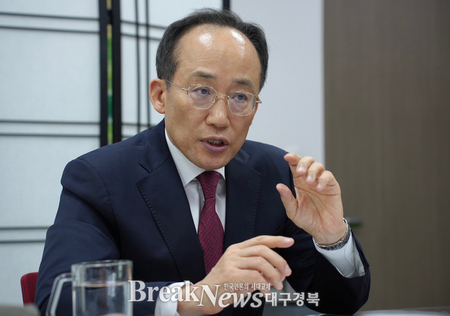
▲ 최기상 더불어민주당 의원 © 브레이크뉴스 |
브레이크뉴스 정명훈 기자= 최근 5년간 소득 상·하위 간 경제적 격차가 지속적으로 확대되며, 2025년에는 상위 20%와 하위 20% 가구의 소득 격차가 9배에 달한 것으로 나타났다.
최기상 더불어민주당 의원이 국가데이터처로부터 제출받은 ‘최근 5년간 소득 5분위별 가구당 월평균 가계 수지’ 자료에 따르면, 2020년 2분기부터 2025년 2분기까지 가구 간 소득 격차가 꾸준히 벌어졌다.
소득 상위 20%(5분위) 가구의 월평균 소득은 2020년 911만 원에서 2025년 1,074만 원으로 163만 원 늘었다. 반면 하위 20%(1분위) 가구의 소득은 같은 기간 103만 원에서 119만 원으로 16만 원 증가하는 데 그쳤다.
소득뿐 아니라 가구당 흑자액(소득에서 세금, 이자 등 비소비지출과 의식주 등 소비지출을 제외한 금액)에서도 양극화가 뚜렷했다. 상위 20% 가구는 2020년부터 2025년까지 평균 330만 원의 흑자액을 유지하며 저축·투자 여력을 확보한 반면, 하위 20% 가구는 평균 약 30만 원의 마이너스 흑자액으로 사실상 적자 구조를 벗어나지 못하고 있다.
양 그룹 간 흑자액 격차는 2020년 2분기 335만 원에서 2025년 2분기 360만 원으로 확대됐으며, 격차가 가장 컸던 시기는 2022년 1분기로 약 443만 원에 달했다. 특히 상위층의 흑자액이 5년간 5.4% 증가하는 동안 하위층의 적자는 41.6% 늘어나, 하위층의 재정적 부담이 크게 악화된 것으로 나타났다.
최기상 의원은 “소득 격차 확대는 계층 고착화를 심화시키고 사회 이동성을 떨어뜨릴 수 있다”며 “양극화 해소와 가난의 대물림을 막기 위한 정부의 적극적인 관심과 정책적 노력이 절실하다”고 강조했다.
*아래는 위 기사를 '구글 번역'으로 번역한 영문 기사의 [전문]입니다. '구글번역'은 이해도 높이기를 위해 노력하고 있습니다. 영문 번역에 오류가 있을 수 있음을 전제로 합니다.<*The following is [the full text] of the English article translated by 'Google Translate'. 'Google Translate' is working hard to improve understanding. It is assumed that there may be errors in the English translation.>
Rep. Choi Ki-sang: "Polarization among households is deepening...Urgent policies are needed to prevent the transmission of poverty."
The economic gap between the top and bottom income brackets has steadily widened over the past five years, with the income gap between the top 20% and bottom 20% expected to reach nine times by 2025.
According to data on "Average Monthly Household Expenditures by Income Quintile over the Past Five Years" submitted to Rep. Choi Ki-sang (Presidential Committee on Planning and Finance, Geumcheon District, Seoul) of the Democratic Party of Korea from the National Data Agency, the income gap between households has steadily widened from the second quarter of 2020 to the second quarter of 2025.
The average monthly income of households in the top 20% (5th quintile) increased by KRW 1.63 million, from KRW 9.11 million in 2020 to KRW 10.74 million in 2025. In contrast, the income of the bottom 20% (1st quintile) households increased by only 160,000 won, from 1.03 million won to 1.19 million won over the same period.
Polarization was evident not only in income but also in household surplus (income minus non-consumption expenditures such as taxes and interest, and consumption expenditures such as food, clothing, and shelter). While the top 20% of households maintained an average surplus of 3.3 million won from 2020 to 2025, securing savings and investment capacity, the bottom 20% of households experienced a negative surplus of approximately 300,000 won on average, effectively remaining in deficit.
The surplus gap between the two groups widened from 3.35 million won in the second quarter of 2020 to 3.6 million won in the second quarter of 2025, reaching its largest point in the first quarter of 2022, reaching approximately 4.43 million won. In particular, while the surplus of the upper class increased by 5.4% over five years, the deficit of the lower class increased by 41.6%, significantly worsening the financial burden on the lower class.
Representative Choi Ki-sang emphasized, "The widening income gap can exacerbate class entrenchment and reduce social mobility," and emphasized, "Active government attention and policy efforts are urgently needed to resolve polarization and prevent the transmission of poverty."