▲ 최영일(오른쪽) 순창군수가 지난 17일 국회를 다시 방문해 정청래 더불어민주당 대표를 만나 "과도한 지방비 매칭으로 지방자치단체 재정 악화 원인으로 지적된 '농어촌 기본소득 시범 사업' 국비와 도비 지원 비율 상향 필요성을 설명"한 뒤 공동 건의문을 전달하고 있다. / 사진제공 = 순창군청 © 김현종 기자 |
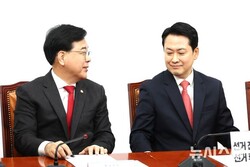
 ▲ 최영일(왼쪽) 순창군수가 지난 15일 김관영(오른쪽) 전북도지사를 면담한 자리에서 "농어촌 기본소득은 단순 현금성 지원이 아니라 사회서비스와 공동체 회복ㆍ지역경제 순환 등을 목표로 하는 구조적 정책으로 시범 사업의 실효성을 높이기 위해서는 도비 확대가 반드시 필요하다"는 설명을 하고 있다. / 사진제공 = 순창군청 © 김현종 기자 |
과도한 지방비 매칭으로 지방자치단체 재정 악화 원인으로 지적된 '농어촌 기본소득 시범 사업' 국비와 도비 지원 비율이 상향될 것으로 기대된다.
18일 전북 순창군에 따르면 국회 농해수위 전체 회의에서 기본소득 시범 사업 예산이 기존 1,703억 원에서 3,410억 원으로 무려 100% 증액되는 수정안이 의결됐다.
수정안에 따르면 부담 비율은 ▲ 국비 50%(기존 40%) ▲ 도비(전북) 30%(기존 18%)로 상향되고 ▲ 군비 부담률은 20%(기존 42%)로 줄어들게 된다.
특히 도(道)가 30% 도비를 이행하지 않을 경우, 국비 배정을 보류하도록 강력한 조건이 명시돼 정부와 도 책임이 강화됐다.
농림축산식품부는 지난달 23일 전북 순창을 비롯 경기 연천ㆍ강원 정선ㆍ충남 청양ㆍ전남 신안ㆍ경북 영양ㆍ경남 남해 등 7개 군을 농어촌 기본소득 시범 지역으로 선정했다.
지방비 부담이 전체 60%로 인구 소멸 지역 재정 부담이 지나치게 크다는 지적이 제기돼왔다.
최영일 순창군수는 지난 7일 연천ㆍ정선ㆍ신안ㆍ영양ㆍ남해 등 6개 자치단체장과 국회를 방문해 현행 국비 40%ㆍ지방비 60% 구조의 불합리함을 지적하고 중앙정부의 적극적인 지원을 요청했다.
이날 어기구 국회 농림축산식품해양수산위원장을 만나 "재정이 취약한 군 단위 지자체가 60%를 감당하기엔 한계가 있다"며 "국비 비중을 80%까지 올려야 시범 사업이 지속 가능하다"고 강조한 뒤 더불어민주당과 국민의힘 지도부를 잇달아 만나 공동 건의문도 전달했다.
15일에는 김관영 전북도지사를 면담했고 17일에는 국회를 다시 방문해 정청래 더불어민주당 대표ㆍ박수현 수석대변인ㆍ윤준병 전북도당위원장 등을 순차적으로 면담하는 시간을 갖고 국ㆍ도비 증액 필요성을 설명하며 지원을 요청했다.
농해수위 상임위 단계에서 예산 증액은 순창군이 농어촌 기본소득 시범 사업 공모 선정에 그치지 않고 실질적 재원 확보까지 주도적으로 이끌어 냈다는 점에서 의미가 각별한 의미가 담겼다.
최영일 군수는 "정부 지원 예산이 매년 감소하는 어려운 재정 여건에 현재 지방비(도ㆍ군비) 60%는 지역 발전에 제약이 될 수 있는 부담"이라며 "성공적인 농어촌 기본소득 선도모델을 구축하기 위해 국ㆍ도비 증액이 필요한 만큼, 예결위에서 원안이 통과될 수 있도록 동향을 수시로 파악하며 마지막까지 전방위적인 대응에 나설 계획"이라고 말했다.
그러면서 "농어촌 기본소득은 단순 현금성 지원이 아니라 사회서비스와 공동체 회복ㆍ지역경제 순환 등을 목표로 하는 구조적 정책으로 시범 사업의 실효성을 높이기 위해서는 국ㆍ도비 확대가 반드시 필요하다"고 덧붙였다.
한편, 국회 각 상임위 예비 심사가 마무리되고 지난 17일부터 예결위 예산소위 심사가 진행 되고 있다.
☞ 아래는 위 기사를 구글 번역이 번역한 영문 기사의 '전문' 입니다.
구글 번역은 이해도를 높이기 위해 노력하고 있으며 영문 번역에 오류가 있음을 전제로 합니다.
【Below is the 'full text' of the English article translated by Google Translate.
Google Translate is working hard to improve understanding, and assumes that there are errors in the English translation.】
Sunchang County is increasing its budget for its 'Rural Basic Income' program
Governor Choi Young-il… All-out effort to pass the Budget and Accounts Committee with 50% national and 30% provincial funding
Reporter Kim Hyun-jong
The ratio of national and provincial funding for the 'Rural Basic Income Pilot Project,' which has been pointed out as a cause of deteriorating local government finances due to excessive matching of local government funds, is expected to increase.
According to Sunchang County in North Jeolla Province on the 18th, the National Assembly's Agriculture, Forestry and Fisheries Committee approved an amendment that would increase the budget for the pilot project by a whopping 100%, from 170.3 billion won to 341 billion won.
According to the amendment, the national budget will increase to 50% (up from 40%) and the provincial budget (Jeonbuk) to 30% (up from 18%), while the county's share will decrease to 20% (up from 42%).
In particular, strong conditions were specified to withhold national funding allocation if a province fails to meet its 30% provincial budget, strengthening the responsibilities of both the government and the provinces.
On the 23rd of last month, the Ministry of Agriculture, Food and Rural Affairs selected seven counties as pilot areas for the basic income program for rural areas: Sunchang in North Jeolla Province, Yeoncheon in Gyeonggi Province, Jeongseon in Gangwon Province, Cheongyang in South Chungcheong Province, Sinan in South Jeolla Province, Yeongyang in North Gyeongsang Province, and Namhae in South Gyeongsang Province.
Critics have pointed out that the local government's share of 60% of the total budget burden is excessively high in depopulated areas.
On the 23rd of last month, the Ministry of Agriculture, Food and Rural Affairs selected seven counties—Sunchang, North Jeolla Province; Yeoncheon, Gyeonggi Province; Jeongseon, Gangwon Province; Cheongyang, South Chungcheong Province; Sinan, South Jeolla Province; Yeongyang, North Gyeongsang Province; and Namhae, South Gyeongsang Province—as pilot areas for the rural basic income program.
Critics have pointed out that the financial burden on depopulated areas is excessive, with local governments accounting for 60% of the total.
On the 7th, Sunchang County Mayor Choi Young-il visited the heads of six local governments—Yeoncheon, Jeongseon, Sinan, Yeongyang, and Namhae—and the National Assembly.
He pointed out the injustice of the current 40% national and 60% local government funding structure and requested active support from the central government.
On this day, he met with the Chairman of the National Assembly Agriculture, Food, Rural Affairs, Oceans and Fisheries Committee, Eogi-gu, and emphasized that "there is a limit to local governments with weak finances being able to cover 60%," and that "the pilot project can only be sustainable if the national budget proportion is increased to 80%."
He then met with the leadership of the Democratic Party of Korea and the People Power Party in succession and delivered a joint proposal.
On the 15th, he met with North Jeolla Province Governor Kim Kwan-young, and on the 17th, he visited the National Assembly again, meeting sequentially with Democratic Party of Korea leader Chung Cheong-rae, senior spokesperson Park Soo-hyun, and North Jeolla Province Party Chairman Yoon Jun-byeong. He explained the need for increased national and provincial funding and requested support.
The budget increase at the Agriculture, Forestry and Fisheries Committee Standing Committee level was particularly significant because it showed that Sunchang County not only secured the selection for the pilot project for basic income in rural areas but also proactively secured the necessary funding.
Governor Choi Young-il said, "In the difficult financial situation where the government support budget is decreasing every year, the current 60% of local government expenses (provincial and county expenses) is a burden that could limit regional development." He added, "In order to build a successful model for leading rural basic income, an increase in national and provincial expenses is necessary. We plan to constantly monitor trends and respond comprehensively until the end so that the original plan can pass the Budget and Accounts Committee."
He added, "The basic income for rural areas is not simply a cash subsidy, but a structural policy aimed at social services, community recovery, and regional economic circulation. To enhance the effectiveness of the pilot project, an expansion of national and provincial funding is essential."
Meanwhile, preliminary reviews by each National Assembly standing committee have been completed, and the Budget Subcommittee of the Budget and Accounts Committee has been reviewing the program since the 17th.
원본 기사 보기:브레이크뉴스 전북판