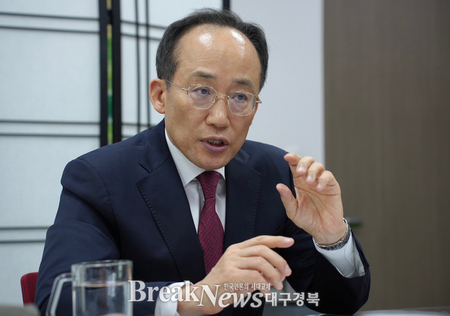
▲ 주호영 국회의원 © 주호영 의원실 |
【브레이크뉴스 대구】진예솔 기자=대구시장 선거가 본격화되면서, 이번 선거는 자연스럽게 ‘정치력 대결’ 구도로 흘러가고 있다. 다선 국회의원들이 잇따라 출사표를 던지며, 누가 중앙정부와 국회를 상대로 더 많은 예산과 권한을 끌어올 수 있느냐가 핵심 경쟁 요소로 떠올랐다.
이 가운데 주호영 후보는 대구가 처한 현실을 행정 숙련도의 문제가 아닌 구조적 한계로 진단하며, 관리형 행정가가 아닌 돌파형 정치가가 필요한 시점이라고 강조했다.
본지는 대구시장 출마를 선언한 주 후보를 만나, 그를 둘러싼 핵심 쟁점인 정치력과 행정력 논란부터 행정통합, 신공항, 취수원 이전, 그리고 지역 경제 해법까지 차례로 물었다. 정책 나열이 아니라, ‘왜 지금 주호영인가’를 검증하는 데 초점을 맞췄다.
“행정 경험 부족? 지금 대구 문제의 본질은 그게 아니다”
주 후보가 가장 먼저 마주한 질문은 ‘정치력은 충분하지만 행정 경험이 부족한 것 아니냐’는 지적이었다. 6선 정치인으로서의 중량감은 인정받지만, 복잡한 대구시 행정을 직접 운영해본 경험이 없다는 우려다.
이에 대해 주 후보는 문제의 초점을 다르게 잡았다. 그는 “지금 대구의 문제가 행정 절차를 몰라서 해결되지 않는 것은 아니다”라며 “규제에 막히고, 예산이 부족하고, 법적인 뒷받침이 없어서 못 하는 것이 문제의 본질이다”라고 말했다.
행정과 시장의 역할에 대해서도 선을 분명히 그었다. 주 후보는 “행정의 디테일은 대구시 공직자들이 저보다 훨씬 더 잘 알고 있다”며 “대구시장은 결재 도장만 찍는 관리자가 아니라, 중앙정부와 국회를 상대로 대구의 몫을 관철하는 자리이다”라고 강조했다.
그가 제시한 해법은 ‘위임과 돌파’다. 주 후보는 “실무는 전문가와 관료들에게 과감하게 위임하되, 시장은 규제와 예산, 법의 벽을 뚫는 역할을 해야 한다”고 밝혔다. 이어 “특임장관과 예결위원, 정책위의장을 거치며 600조 원 국가 예산의 흐름과 기재부를 설득하는 구조를 누구보다 잘 알고 있다”고 덧붙였다.
그는 “공무원들이 신명 나게 일할 수 있도록 외부의 방해물을 치워주는 쇄빙선 역할, 그것이 내가 생각하는 정치력 있는 행정가의 모델이다”라고 말했다.
TK 행정통합과 20조 원 공약 “말이 아니라, 법으로 못 박겠다”
주 후보의 대표 공약인 TK 행정통합과 4년간 20조 원 국비 지원을 두고는 실현 가능성 논란이 뒤따른다. 국가 재정 여건을 고려하면 장밋빛 약속에 그칠 수 있다는 지적이다.
이에 대해 주 후보는 “정권의 선의에 기대는 예산은 언제든 사라질 수 있다”며 “그래서 말이 아니라 법으로 못 박겠다는 것이다”라고 말했다.
그가 제시한 해법은 ‘대구경북통합특별법’이다. 주 후보는 “통합에 따른 재정 지원을 대통령의 시혜가 아니라 법과 제도로 보장되는 시스템 지원으로 만들어야 한다”고 밝혔다. 김민석 국무총리가 대정부 질문에서 통합 비용과 별도의 지원을 언급한 점도 근거로 들었다.
주 후보는 “지금은 충청권과 호남권까지 통합 논의가 확산되면서 정부가 균형발전을 외면할 수 없는 타이밍이다”라며 “무작정 떼쓰는 방식이 아니라, 지방 소멸과 수도권 과밀을 해결한다는 명분과 구체적인 법안을 제시해 기재부가 거절할 수 없는 구조를 만들겠다”고 말했다.
“기부대양여는 끝났다”… TK신공항, 판을 바꾸다
TK신공항 건설 방식을 둘러싼 논란에 대해 주 후보는 기존 기부대양여 방식이 사실상 한계에 도달했다고 단언했다.
그는 “고금리 시대와 부동산 경기 침체 상황에서 지자체가 빚을 내 공항을 짓는 구조는 이자만 15조 원이 나가는 파국적 설계이다”라며 “기부대양여 방식은 이미 현실에서 사망 선고를 받았다”고 말했다.
주 후보는 TK신공항을 “단순한 지역 SOC가 아니라 군 공항(K-2) 이전이 결합된 국가 안보 시설이다”라고 규정했다. 이어 “전 세계 어디에도 지자체가 빚내서 군 공항을 이전하는 나라는 없다”고 강조했다.
그의 구상은 군 공항 시설과 활주로는 국비로 국가가 책임지고, 배후 도시와 물류 단지는 통합 지방정부가 맡는 역할 분담 모델이다. 그는 “대구가 덤터기 쓸 뻔한 빚 구조를 국가 책임으로 돌려놓는 것이 게임의 룰을 바꾸는 일이다”라고 말했다.
취수원 이전 “희망 고문은 끝내야 한다”
수십 년째 표류 중인 취수원 이전 문제에 대해서도 주 후보는 강한 어조를 보였다.
그는 “물 문제를 두고 더 이상 희망 고문을 해서는 안 된다”고 말했다. 해법으로는 “과학적 검증과 확실한 보상, 이 두 가지가 동시에 가야 한다”고 밝혔다.
주 후보는 “강변여과수든 상류 댐이든 환경부 용역을 통해 수질과 수량을 과학적으로 검증하고, 그 결과를 바탕으로 임기 초에 결론을 내리겠다”고 했다. 이어 “물을 내어주는 지역에는 대구시 예산이 아니라 중앙정부 예산과 제도 개선을 결합한 패키지 딜을 제시하겠다”고 덧붙였다.
그는 “정치 생명을 걸고 임기 내에 시민들의 수도꼭지에서 맑은 물이 나오게 하겠다”고 말했다.
“균형발전은 선언이 아니라, 법으로 보장해야 한다”
행정통합 이후 경북 북부권과 대구 외곽이 소외될 수 있다는 우려에 대해 주 후보는 “균형발전은 구호가 아니라 법으로 보장돼야 한다”고 말했다.
그는 “통합 특별법에 균형발전 의무 조항을 담고, 낙후 지역에는 교부세와 국비 지원 시 가중치를 두겠다”고 밝혔다. 예산 배분 역시 “단순한 n분의 1이 아니라 기능 중심 모델로 재편하겠다”고 했다.
대구 도심은 금융·R&D, 북부권은 바이오·백신·문화관광, 동해안권은 철강·에너지·물류 거점으로 특화해 각자의 역할을 분명히 하겠다는 구상이다. 주 후보는 “중앙정부로부터 받아오는 20조 원의 지원이 특정 지역에 쏠리지 않도록 제도적으로 설계하겠다”고 말했다.
“보조금이 아니라, 세제 구조를 바꿔야 기업이 온다”
주 후보의 지역 경제 해법에서 가장 눈에 띄는 대목은 기업 이전 전략의 전환이다.
그는 “보조금 몇 푼으로는 기업을 움직일 수 없다”며 “기업은 애국심이 아니라 계산으로 움직이는 존재이다”라고 말했다. 이어 “지방으로 오라고 외치는 방식은 이미 한계에 부딪혔다”고 진단했다.
주 후보가 제시한 해법은 세제와 제도의 구조 개편이다. 그는 “법인세와 지방세 감면, 규제 완화, 투자 회수 기간 단축까지 포함한 세제·제도 패키지를 통해 수도권 기업의 지방 이전을 유도해야 한다”고 밝혔다. 또 “대구·경북으로 오면 세금 구조 자체가 달라지고 장기적으로 더 유리하다는 확신을 줘야 한다”고 강조했다.
이 전략의 목표는 단순한 기업 이전이 아니다. 주 후보는 “기업이 이전하면 일자리가 생기고, 일자리가 생기면 인구가 유입된다”며 “인구 증가는 소비와 주거, 세수 확대로 이어지고, 그 재원이 다시 복지와 인프라 투자로 돌아가는 선순환 구조를 만들어야 한다”고 말했다.
특히 그는 “세제 혜택은 무차별적 특혜가 아니라 고용 유지와 지역 투자를 조건으로 한 인센티브여야 한다”며 “이전만 하고 빠져나가는 기업이 아니라 지역에 뿌리내리는 기업을 만들어야 한다”고 강조했다.
주 후보는 “지방정부 조례만으로는 한계가 있는 만큼, 중앙정부 세제와 연동되는 법과 제도 개선까지 염두에 둔 전략이다”라고 밝혔다.
“불도저가 아니라, 사회적 대타협의 시장”
주 후보는 행정 철학에 대해서도 분명한 입장을 내놨다. 그는 “갈등은 피할 수 없지만, 푸는 방식이 리더의 능력이다”라고 말했다.
공무원연금 개혁과 세월호 수습 경험을 언급하며, 그는 “반대 세력을 적으로 돌리지 않고 끝까지 대화 테이블에 앉히는 것이 정치력이다”라고 강조했다. 또 “감정이 아니라 데이터와 보상, 미래 비전으로 설득하는 시장이 되겠다”고 밝혔다.
주호영 후보의 메시지는 분명하다. 대구의 문제를 행정 기술의 부족이 아니라 구조와 권한, 그리고 중앙과의 힘의 관계에서 찾고 있다는 점이다. 정치력에 기반한 제도 설계와 세제 개편을 통해 기업과 인구를 다시 끌어들이겠다는 그의 구상은, 그 자체로 이번 선거의 프레임을 ‘관리 능력 경쟁’에서 ‘돌파력 경쟁’으로 이동시키고 있다.
관건은 이러한 인식과 해법이 유권자들에게 얼마나 설득력을 얻을 수 있느냐다. 주 후보가 던진 ‘돌파하는 정치가’라는 문제 제기가 이번 선거에서 어떤 구도를 만들어낼지, 그리고 그 선택이 대구의 다음 10년을 여는 해법으로 이어질 수 있을지는 또 하나의 과제로 남았다. 이번 대구시장 선거는 단순한 인물 선택을 넘어, 대구가 스스로를 어떻게 진단하고 어떤 방식으로 돌파할 것인지를 묻는 시험대가 되고 있다.
<구글 번역으로 번역한 영문 기사의 전문 입니다. 번역에 오류가 있을 수 있음을 밝힙니다.>
As the Daegu mayoral election draws near, the race is naturally evolving into a contest of political prowess. With multiple-term National Assembly members announcing their candidacies one after another, the key competitive factor is who can wield more budget and authority against the central government and the National Assembly.
Among these candidates, candidate Joo Ho-young has diagnosed Daegu's current situation not as a matter of administrative prowess but rather structural limitations, emphasizing the need for a breakthrough-oriented politician, not a managerial administrator.
This magazine met with Joo, who has declared his candidacy for Daegu mayor, and questioned him on key issues surrounding him, ranging from the controversy over his political and administrative power to administrative integration, the new airport, water source relocation, and solutions for the local economy. Rather than listing his policies, we focused on examining the question, "Why Joo Ho-young now?"
"Lack of administrative experience? That's not the root of Daegu's current problems."
The first question Joo faced was the criticism that he possessed sufficient political prowess but lacked administrative experience. While his weight as a six-term politician is acknowledged, there are concerns that he lacks direct experience in managing the complex Daegu city administration.
Candidate Joo addressed this issue differently. He stated, "Daegu's current problems are not unsolvable due to a lack of understanding of administrative procedures. The root of the problem lies in regulations, insufficient budgets, and a lack of legal support."
He also drew a clear line between the roles of the administration and the mayor. Candidate Joo emphasized, "Daegu city officials are far more knowledgeable about the details of administration than I am," and "The mayor of Daegu is not an administrator who simply stamps approvals, but rather a position to enforce Daegu's obligations to the central government and the National Assembly."
His proposed solution is "delegation and breakthrough." Candidate Joo stated, "While practical tasks should be boldly delegated to experts and bureaucrats, the mayor should play a role in overcoming barriers of regulation, budget, and law." He added, "Having served as a special minister, member of the Budget and Accounts Committee, and chairman of the policy committee, I understand better than anyone the flow of the 600 trillion won national budget and the structure of persuading the Ministry of Strategy and Finance."
He stated, "The role of an icebreaker, removing external obstacles so that civil servants can work with enthusiasm, is the model of a politically competent administrator in my opinion."
TK Administrative Integration and 20 Trillion Won Pledge: "I Will Secure It with Law, Not Words"
Candidate Joo's signature pledges, the TK administrative integration and the 20 trillion won in national funding over four years, are being met with controversy over their feasibility. Some argue that considering the national fiscal situation, these promises could remain mere rosy promises.
Candidate Joo responded, "A budget that relies on the goodwill of the administration can disappear at any time. That's why I will secure it with law, not words."
The solution he proposed is the "Daegu-Gyeongbuk Integration Special Act." Candidate Joo stated, "Financial support for the integration should not be a presidential favor, but a system guaranteed by law and regulations." He also cited Prime Minister Kim Min-seok's mention of separate support for the integration costs during his interpellation of the government as evidence.
Candidate Joo stated, "Now, with discussions on integration expanding to the Chungcheong and Honam regions, the government cannot ignore balanced development. Rather than blindly pushing the envelope, I will present a justification and specific bill to address the disappearance of local governments and overcrowding in the metropolitan area, creating a structure the Ministry of Strategy and Finance cannot refuse."
"Donation-based loans are over"... TK New Airport changes the game
Regarding the controversy surrounding the construction method of TK New Airport, candidate Joo asserted that the existing donation-based loans have effectively reached their limits.
He stated, "In an era of high interest rates and a sluggish real estate market, the structure of local governments borrowing money to build airports is a catastrophic design that will cost 15 trillion won in interest alone. The donation-based loans system has already been declared dead in the water."
Candidate Joo defined TK New Airport as "not simply a regional SOC, but a national security facility combined with the relocation of the military airport (K-2)." He went on to emphasize, "No country in the world relocates a military airport by incurring debt."
His plan envisions a shared role model, where the national government would be responsible for military airport facilities and runways, while integrated local governments would take responsibility for the surrounding cities and logistics complexes. He said, "Changing the national responsibility for the debt structure that Daegu almost incurred is a game-changer."
Water Source Relocation: "The Torture of Hope Must End"
Candidate Joo also took a strong stance on the issue of water source relocation, which has been adrift for decades.
He stated, "We can no longer torment hope with water issues." He stated, "The solution must be a simultaneous approach of scientific verification and clear compensation."
Candidate Joo stated, "Whether it's riverbank filtration or upstream dams, I will scientifically verify water quality and quantity through a Ministry of Environment contract, and based on the results, I will reach a conclusion early in my term." He added, "For regions that provide water, I will propose a package deal that combines central government funding and institutional improvements, rather than relying on Daegu City's budget."
He stated, "I will stake my political career on ensuring that citizens have clean water flowing from their taps within my term."
"Balanced development should be guaranteed by law, not a declaration."
Responding to concerns that the northern part of North Gyeongsang Province and the outskirts of Daegu could be marginalized after administrative integration, Candidate Joo stated, "Balanced development should be guaranteed by law, not a slogan."
He stated, "I will include a balanced development obligation in the special integration law and give weight to underdeveloped regions in grants and national funding." He also pledged, "We will reorganize budget allocation to a function-based model, rather than a simple one-nth allocation."
The plan is to specialize Daegu's downtown area as a hub for finance and R&D, the northern region as a biotech, vaccine, and culture/tourism hub, and the east coast as a steel, energy, and logistics hub, each with a distinct role. Candidate Joo stated, "I will design the system so that the 20 trillion won in support from the central government is not concentrated in a specific region."
"Companies will come only when the tax structure is changed, not subsidies."
The most notable aspect of Candidate Joo's regional economic solution is a shift in corporate relocation strategies.
He stated, "Companies cannot be swayed by a few cents in subsidies. Companies are driven by calculation, not patriotism." He added, "The approach of urging people to relocate to the provinces has already reached its limits."
Candidate Joo's proposed solution involves restructuring the tax system and institutions. He stated, "We must encourage companies from the metropolitan area to relocate to the provinces through a tax and institutional package that includes corporate and local tax cuts, deregulation, and shorter investment payback periods." He also emphasized, "We must convince them that relocating to Daegu and Gyeongbuk will change the tax structure itself and be more advantageous in the long term."
The goal of this strategy goes beyond simply relocating businesses. Candidate Joo stated, "When businesses relocate, jobs are created, and when jobs are created, population inflows occur. We must create a virtuous cycle where population growth leads to increased consumption, housing, and tax revenue, and these resources are then channeled back into welfare and infrastructure investment."
He specifically emphasized, "Tax benefits should not be indiscriminate preferential treatment, but rather incentives conditioned on job retention and local investment." He added, "We must foster businesses that take root in the region, not simply relocate and then leave."
Candidate Joo stated, "Since local government ordinances alone have limitations, this strategy also considers improving laws and systems that link with the central government's tax system."
"Not a bulldozer, but a mayor of social compromise."
Candidate Joo also expressed a clear stance on his administrative philosophy. He stated, "Conflict is inevitable, but the way a leader resolves it is his ability to do so."
Citing his experience with civil servant pension reform and the Sewol ferry disaster recovery, he emphasized, "Political power lies in not turning opponents into enemies but in bringing them to the negotiating table." He also declared, "I will become a mayor who persuades with data, compensation, and a vision for the future, not with emotion."
Candidate Joo Ho-young's message is clear: he sees Daegu's problems not as a lack of administrative skills, but rather in its structure, authority, and power relations with the central government. His plan to attract businesses and the population back through institutional design and tax reform, based on political power, is in itself shifting the frame of this election from a "competition for management ability" to a "competition for breakthrough."
The key question is how persuasive this perception and solution will be to voters. What kind of structure will Joo's call for a "breakthrough politician" shape this election, and whether his choice will lead to a solution that will usher in the next decade for Daegu, remains a question. This Daegu mayoral election is more than just a simple choice of candidates; it's a test of how Daegu will assess itself and how it will overcome obstacles.
원본 기사 보기:브레이크뉴스 대구경북