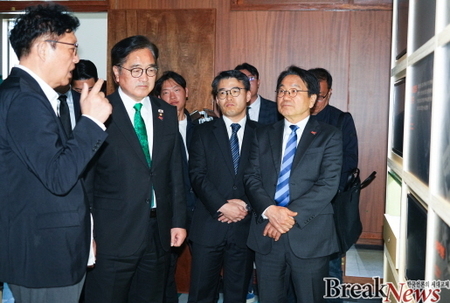
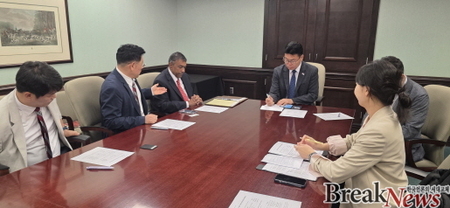
▲ KIOST 서해연구소 설립과 관련해 지난 23일 김기웅 서천군수와 강동진 한국해양과학기술원 부원장이 면담을 진행했다.=서천군 제공 © 정지완 기자 |
충남 서천군이 서해 해양환경 연구를 이끌 국책 연구기관 유치에 속도를 내고 있다. 군은 충청남도, 한국해양과학기술원(KIOST)과 시범사업 업무협약을 맺은 데 이어, 지난 23일 김기웅 군수와 강동진 KIOST 부원장이 만나 서해연구소 설립을 위한 구체적인 실행 방안을 논의했다고 밝혔다.
이번 논의의 초점은 시범사업의 안정적인 추진과 연구소 정착 기반 마련에 맞춰졌다. 군은 금강 하구 해수 유통 문제와 김 양식장 황백화 현상처럼 지역이 안고 있는 해양환경 현안을 해결하려면 KIOST의 과학적 분석과 연구 지원이 필요하다고 보고 있다. 해양 생태 변화와 지역 산업 문제가 맞물린 서천의 현실을 감안하면, 연구소 유치는 단순한 기관 이전을 넘어 현안 해결의 실질적 수단으로 받아들여진다.
시범사업은 30개월 동안 연안 환경 변화 분석과 기수 환경 복원 가능성 검증을 중심으로 진행될 예정이다. 이를 통해 서해권 해양환경의 특성을 체계적으로 축적하고, 연구소 설립의 타당성과 운영 방향을 구체화하는 절차가 함께 이뤄질 전망이다.
사업이 예정대로 추진되면 ‘KIOST 서해연구소’는 장항국가산업단지 내 약 3500㎡ 규모로 조성되고, 총사업비 498억 원이 투입된다. 연구소에는 약 100명의 전문 연구 인력이 상주하며, 강화군에서 해남군까지 서해안 전역을 아우르는 국책 해양 연구기관으로 운영될 계획이다.
군은 연구소 설립이 현실화될 경우 장항국가산단을 중심으로 친환경 융복합 산업 집적이 한층 탄력을 받을 것으로 기대하고 있다. 연구 성과가 지역 산업으로 이어지는 구조가 자리 잡으면, 일자리 창출과 청년 연구인력 유입 등 지역경제 전반에도 적지 않은 변화가 뒤따를 가능성이 있다.
이번 유치 추진은 연구기관 하나를 더 들이는 차원의 문제가 아니다. 서천이 해양바이오와 생태복원, 산업 전환을 함께 묶는 서해안 연구 거점으로 자리 잡을 수 있을지 가늠하는 과정에 가깝다. 시범사업의 성과와 이후 타당성 평가가 어떻게 이어지느냐에 따라 서천의 미래 산업 지형도 달라질 수 있다.
*아래는 위 기사를 '구글 번역'으로 번역한 영문 기사의 [전문]입니다. '구글번역'은 이해도를 높이기를 위해 노력하고 있습니다. 영문 번역에 오류가 있을 수 있음을 전제로 합니다.<*The following is [the full text] of the English article translated by 'Google Translate'. 'Google Translate' is working hard to improve understanding. It is assumed that there may be errors in the English translation.>
Seocheon County Accelerates Efforts to Attract KIOST West Sea Research Center
Pilot Project to be Established Based in Janghang National Industrial Complex... Laying the Foundation for Linking Ecological Restoration and Marine Industry
Seocheon County in South Chungcheong Province is accelerating its efforts to attract a national research institute that will lead research on the marine environment of the West Sea. Following the signing of a memorandum of understanding (MOU) for a pilot project with South Chungcheong Province and the Korea Institute of Ocean Science and Technology (KIOST), the county announced that County Governor Kim Ki-woong and KIOST Vice President Kang Dong-jin met on the 23rd to discuss concrete implementation plans for the establishment of the West Sea Research Center.
The focus of these discussions was on the stable implementation of the pilot project and the establishment of a foundation for the institute's settlement. The county believes that KIOST's scientific analysis and research support are necessary to resolve pending marine environmental issues facing the region, such as problems with seawater circulation in the Geum River estuary and the yellowing of seaweed farms. Given the reality in Seocheon, where changes in the marine ecosystem and local industrial issues are intertwined, attracting the institute is viewed not merely as a relocation of an institution, but as a practical means of resolving these pressing issues.
**Seocheon County Accelerates Efforts to Attract KIOST West Sea Research Center** The pilot project is scheduled to run for 30 months, focusing on analyzing changes in the coastal environment and verifying the feasibility of restoring the brackish water environment. Through this, it is expected that the characteristics of the marine environment in the West Sea region will be systematically accumulated, and the process of concretizing the feasibility of establishing the research institute and its operational direction will be carried out simultaneously.
If the project proceeds as planned, the ‘KIOST West Sea Research Institute’ will be constructed within the Janghang National Industrial Complex on a scale of approximately 3,500 square meters, with a total project cost of 49.8 billion won. About 100 professional researchers will be stationed at the institute, and it is planned to operate as a national marine research institution covering the entire West Coast from Ganghwa-gun to Haenam-gun.
The county expects that if the establishment of the institute becomes a reality, the concentration of eco-friendly convergence industries centered around the Janghang National Industrial Complex will gain further momentum. Once a structure is established where research results lead to local industries, there is a possibility that significant changes will follow in the overall regional economy, including job creation and the influx of young research personnel.
This push to attract the institute is not merely a matter of bringing in another research institution. This is essentially a process of gauging whether Seocheon can establish itself as a research hub on the West Coast that integrates marine biotechnology, ecological restoration, and industrial transformation. Depending on the outcomes of the pilot project and how the subsequent feasibility assessment unfolds, Seocheon's future industrial landscape could change.
원본 기사 보기:브레이크뉴스대전세종충청