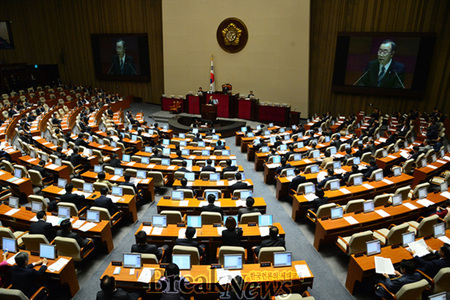
정몽준 의원 강연<번역문>
안녕하십니까? 서울에 오신 것을 환영합니다.
예전에 한국은 “조용한 아침의 나라”로 불렸습니다. 지금 한국은 “할 수 있다”는 자신감과 에너지가 넘쳐나는 활기찬 나라입니다.
|

아버님은 서울에서는 건설 현장의 일용직 노동자로, 인천에서는 부두 일꾼으로 일했습니다. 그 후 장사를 시작하셨고 결국은 현대 그룹을 만드셨습니다. 현대 자동차와 세계 최대의 조선회사인 현대중공업이 현대 그룹에 있었지요.
아버님께는 현재 한국에서 가장 큰 자선단체인 아산 재단도 설립하셨습니다. 아산재단은 세계에서 가장 크고 좋은 병원을 운영하고 있습니다. 저는 6년 전에 그 병원에서 심장판막수술을 받았는데요. 여러분께서 보시다시피, 아주 건강하게 잘 살고 있습니다.
제 아버님의 이야기는 현대 한국의 이야기입니다. 아버님께서 회사 이름을 “현대”라고 지으셨는데 우연의 일치만은 아닌 것 같습니다.
저에 대해 말씀 드리겠습니다. 저는 서울에서 대학을 다니며 경제학을 전공했습니다. 그리고 ROTC 장교로 복무했습니다. 그 후에 MIT Sloan 경영대학원에서 공부했습니다.
그런데 여러분 MIT가 뭐의 줄임말인지 아시나요? “메이드 인 타이완” (Made In Taiwan) 입니다.
|

제 아버님은 스스로를 “부유한 노동자”라고 불렀습니다. 저는 지금 대한민국 국회의 6선 의원입니다. 저는 스스로를 “정치 노무자”라고 부릅니다.
오늘, 국제정치를 공부하는 여러분들과 우리가 직면하고 있는 글로벌 현안과 도전에 대한 견해를 나누고 싶습니다.
그리고 저를 MJ라 불러 주시면 좋겠습니다. 작년에 저는 정의론 강의로 유명한 하버드 대학의 마이클 조세프 샌델 교수님을 한국에 초청했었습니다. 반갑게도 샌델 교수님도 MJ 시더군요. 샌델 교수님 외에도 정말 많은 MJ가 있습니다. 믹 재거 (Mick Jagger), 마이클 조던 (Michael Jordan), 그리고 매직 존슨 (Magic Johnson) 까지. 모두 다 제 먼 친척뻘이라 할 수 있죠. 그럼 지금부터 저를 MJ라 불러주시기 바랍니다.
프란시스 후쿠야마 교수는 1990년대 초반, 그의 유명한 저서 ‘역사의 종언 (The end of history)' 을 통해 소련이 무너지고 공산주의가 붕괴된 것은 자유시장경제와 자유민주주의가 승리하였음을 뜻하는 것이라 말했습니다. 인류는 이제 자유시장경제와 자유민주주의보다 더 나은 정치· 경제 체제를 생각해 낼 수 없기 때문에 “역사의 변증법”은 끝났다고 선언했습니다. 그 이후로 많은 사람들이 이 가설을 받아들였습니다.
그러나 지금은 오히려 시장경제 체제를 채택하고 있는 미국, EU, 일본 등 자유민주주의 국가들이 위기를 겪고 있습니다.
반면, 공산주의 국가인 중국은 그 누구보다도 위기를 잘 헤쳐나가고 있습니다. 중국은 위기를 통하여 더 강해지고 더 자신감을 갖게 되었습니다. 중국은 G2의 위치를 완전히 굳히고 있지요. 결과적으로 자유민주주의와 자유시장경제가 승리했다고 한 후쿠야마 교수의 선언은 성급한 것이 되어 버렸습니다.
오늘의 현실은 자본주의가 내부모순에 의해 망할 것이라고 한 칼 맑스의 말을 새삼 떠올리게 합니다. 맑스가 결국 옳았던 것일까요? 저는 여전히 아니길 바랍니다. 맑스가 간과한 것이 두 가지가 있습니다. 첫 번째는 과학과 기술의 지속적인 발전입니다. 두 번째는 인간의 창의성과 자기정화능력 (self-correction) 입니다. 특히 자유민주주의에서 잘 발현되는 능력이지요.
제가 1980년대 미국 MIT대학에서 공부할 때 저의 스승이었던 레스터 써로우 교수는 오래 전부터, 재정적자와 무역적자라는 쌍둥이 적자 때문에 “미국 경제는 세계 경제의 시한폭탄 (time bomb) ”이라고 말했습니다. 우리나라는 물론이고 중국, 일본 등 전 세계의 많은 국가들이 미국에 대한 수출에 의존하며 경제를 운영해 왔습니다. 이것이 세계 경제의 큰 모순입니다. 미국 경제가 중환자인데, 세계 경제가 지금껏 이 중환자에 기대어 지탱해 온 셈입니다. 미국 경제는 더 이상 지속 가능하지 않습니다. 써로우 교수가 세계경제의 시한폭탄인 셈이란 것은 바로 이것을 두고 한 말입니다.
이제 미국 경제는 더 이상 다른 나라의 수출을 흡수할 수 없는 지경에 이르렀습니다. 세계 경제는 침체기로 빠져들고 있습니다. 전문가들은 성장률이 떨어지고 물가와 실업률은 오르는 최악의 상태인 스태그플레이션 (stagflation) 이 올 것을 우려합니다.
아시아에서는 일본이 GDP 의 210% 가 넘는 부채를 안고 있습니다. 어떤 전문가들은 일본 국채의 대부분을 외국인들이 아닌 일본인들이 가지고 있기 때문에 일본의 상황이 그리 심각한 것은 아니라고 진단합니다. 이것이 사실인지 그리고 그 함의가 무엇인지는 더 생각해 보아야 합니다. 분명한 것은 모두가 수입을 초과한 과분한 소비 생활을 지속하고 있다는 것입니다. 재정의 건전성이 얼마나 중요한지를 인식해야 할 때 입니다.
그렇다면 자유 민주주의 국가들은 왜 세계 경제위기를 막는데 실패했을까요?
거의 200년 전, 1830년에 젊은 프랑스 판사였던 알렉시 드 토크빌은 『미국의 민주주의』(Democracy in America) 라는 유명한 책을 썼습니다. 이 책에서 그는 “평등이 인간의 독립성에 미치는 유해성”에 대해서 경고했습니다 (P. 672.) 모든 국가는 민주화가 진행될수록 점점 평등주의로 흐르게 됩니다. 사람들은 차츰 독립심을 잃고 국가에 의존하게 됩니다. 국가야 말로 “노예상태의 새 얼굴입니다.”. (p. 410) 이것이 바로 민주주의가 실패하는 이유입니다.
3년 전 세계 경제위기가 시작되었을 때, 자유시장경제의 상징이었던 씨티뱅크와 AIG는 파산 직전까지 내몰렸고 정부 지원금을 받고 겨우 회생할 수 있었습니다. 민간 부문 (private sector) 은 모두 사라지고 정부만이 남았지요. 토크빌이 거의 200년 전 내 놓은 분석은 오늘의 상황에도 그대로 적용됩니다. 젊은 프랑스 판사가 “민주주의”라는 정치제도의 약점을 이렇게 내다 볼 수 있었다는 게 정말 놀랍습니다.
정치인들은 자신들이 국민들에게 무언가를 베풀 수 있다는 것을 과장합니다. 따라서 민주주의에서는 항상 포퓰리즘과 대중 선동의 위험이 도사리고 있습니다. 일단 포퓰리즘의 덫에 걸리면 빠져 나오기가 쉽지 않습니다. “정직한 사람은 속일 수 없다”라는 말이 있습니다. 결국 정치인들과 국민 모두가 책임의식을 가져야 할 것입니다.
왜 정치인들은 “포퓰리즘”과 “대중 선동”에 의지하게 될까요? 국가 미래에 대한 비전을 제시 할 수 없기 때문입니다. 비전을 제시할 수 없는 정치인들은 국민들에게 “포퓰리즘”과 “복지주의”라는 독이 든 사과를 내밀게 됩니다. 이미 있는 파이를 쪼개서 나누어 먹는 것이 바로 모두가 잘 살 수 있는 가장 쉽고 빠른 길이라고 국민들을 호도하면서 말입니다.
미국이 전 세계 유일의 초강대국이 된 것은 단순히 군사력이 강해서가 아니라, 개인의 자유, 인간의 권리, 자유민주주의라는 인류의 보편적 이상을 지키는 나라로서의 도덕적 권위가 뒷받침되었기 때문입니다. 존 에프 캐네디 대통령이 취임 연설에서 얘기했듯이, 미국은 “우리는 자유를 지키고 성공시키기 위해서라면 그 어떤 대가라도 치르고, 어떤 짐도 지고, 어떠한 어려움도 극복하고, 어떤 우방도 지지하고, 어떤 적과도 맞설 것”을 공언해 왔습니다.
미국은 제 1, 2차 세계대전에서는 유럽의 제국주의, 나치즘, 파시즘, 그리고 일본의 군국주의와 싸웠고, 냉전 중에는 공산주의에 대항하는 자유민주주의와 자유시장경제의 보루였습니다. 미국이 이토록 강력한 적들과 싸워서 이길 수 있었던 것은 자유에 대한 확고한 신념과 지키려는 의지가 있었기 때문입니다. 미국의 독립운동가 패트릭 헨리가 남긴 “자유가 아니면 죽음을 달라”는 말은 미국의 이상을 간결하게 표현하고 있습니다.
오늘날 미국의 위기는 몹시 걱정스러운 상황입니다. 미국은 이번 디폴트 위기를 겪으면서 경제적 파탄상태만 노출시킨 것이 아니고, 미국이 상징해 온 도덕적 공동체와 가치를 관리할 수 있는 능력마저 상실했음을 보여주었기 때문입니다. 양극화와 정치 시스템 마비는 체제 자체가 추락하고 실패하고 있다는 단적인 증거입니다.
미국이 수많은 동맹국이나 우방들과 맺은 안보 공약 (commitment) 과 이를 지킬 수 있는 힘 (strength) 사이에 괴리가 있다는 것은 이미 30~40년 전부터 지적되어왔습니다. 그런데 이번 위기를 통해서 미국은 경제만 타격을 받은 것이 아니라 도덕적 힘과 군사적 신뢰에 있어서도 동시에 큰 상처를 입게 되었습니다. 미국은 전 세계 민주주의의 상징이었습니다. 민주주의를 하면 평화롭게, 인권을 누리며, 풍요롭게 살 것이라는 것을 보여주었습니다. 오늘날 미국의 경제 위기는 곧 자유민주주의의 위기입니다.
이것은 전세계, 특히 한국의 안보에 심각한 영향을 미칠 수 있습니다.
광활한 유라시아 대륙의 엄청난 지정학적 무게를 고려할 때 그 동쪽 끝에 위치한 한국이라는 작은 나라가 자유시장경제와 자유민주주의를 꽃피우며 주권 국가로 살아남아있다는 것은 기적이며 이 기적은 현재에도 진행 중입니다.
이런 기적은 우리의 피나는 노력과 함께 미국이 우리의 안보를 뒷받침 해 주었기에 가능했습니다. 그러나 자유 진영의 수호자로서의 미국의 도덕적 권위 (soft power) 가 추락하면서 우리는 외교 안보상에 큰 위기에 직면하고 있습니다.
OECD 전 사무총장이 저에게 멕시코 대통령이 한 것이라며 전해준 농담입니다. “멕시코는 신으로부터는 너무 멀리 떨어져 있고 미국과는 너무 가깝게 있다. 이것이 바로 문제다.” 그런데 그 후에 이스라엘 총리가 그 얘기를 듣더니 ”이스라엘은 신과 너무 가깝고 미국과는 너무 멀리 떨어져 있다. 이것이 바로 문제다”라고 답하더랍니다. 한국은 매우 종교적인 국가입니다. 국민의 50%가 기독교인이고 50%가 불교도라고 할 수 있지요. 그래서 저는 이렇게 말할 수 있습니다. “한국은 신과 너무 가깝고 미국과는 너무 멀리 떨어져 있다. 이것이 바로 문제다.”
농담처럼 들리겠지만 실제로 정말 심각한 문제입니다. 한국의 역사를 살펴보면 미국이 한국을 방치할 때에는 어김없이 한국의 안보와 국가 존망에 큰 위기가 찾아왔습니다. 1905년, 미국의 국방 장관 하워드 태프트와 일본의 가쓰라 총리가 체결한 테프트-가쓰라 밀약이 대표적인 사례인데요. 이 밀약에 의해 한국의 운명이 갈리게 됩니다. 러-일 전쟁에서 승리한 일본은 이 밀약을 체결하면서 일본의 한국 강점에 미국이 반대하지 않을 것이라는 확신을 갖게 되었습니다.
1945년, 미국은 일본을 패망시켰고 한국을 해방시켰습니다. 1949년에 중국 공산당은 국민당을 물리치고 광활한 중국 대륙을 공산화시켰습니다. 공산주의가 전 세계를 휩쓸어 버릴 것 같은 기세였지요. 많은 남한의 지식인들이 자진 월북을 하고 있던 때였습니다.
같은 해에 미군은 남한에서 철수하였습니다. 1950년 1월 딘 애치슨(Dean Acheson) 미 국무장관은 한국을 미국의 ‘방위선(defense perimeter)’에서 제외하는 선언을 합니다.
공산주의세력은 이 선언을 남한을 침공해도 좋다는 신호로 해석했습니다. 5개월 뒤 북한은 소련과 중국의 지원을 등에 업고 남한에 대한 전면전을 개시하였습니다.
한국전쟁은 1950년부터 1953년까지 지속되었습니다. 한국은 완전히 파괴되었지요. 모택동의 외아들도 한국 전쟁에서 죽었습니다. 저는 한국전쟁이 한창이던 1951년에 한국 남쪽 끝의 항구 도시 부산에서 태어났습니다. 한국전쟁 직후 한국은 1인당 국민 소득인 65불에 불과한 세계 최빈국이었습니다.
휴전과 함께 체결한 한미방위동맹조약은 미국을 한반도에 묶어 놓는 역할을 하도록 고안되었습니다. 그 이후로 한반도와 동북아지역은 전례 없는 평화와 번영을 누려왔습니다.
중국에 대해 말씀 드리기 전에 농담을 하나 해도 될까요?
1949년도에 중국이 공산화 되면서 사람들은 “오직 사회주의만이 중국을 구할 수 있다”라고 말했습니다.
30년 후인 1979년에 덩샤오핑이 개방과 개혁을 시작했을 때, 사람들은 “오직 자본주의 만이 중국을 구할 수 있다”라고 말했습니다.
10년 후인 1989년에 구 소련이 붕괴하고 동구권이 붕괴했을 때 사람들은 “오직 중국만이 사회주의를 구할 수 있다”라고 말했습니다.
오늘날 모든 사람이 말합니다. “오직 중국만이 자본주의를 구할 수 있다”라고요.
미국이 경제적으로, 군사적으로 약화되는 틈을 타서 급격하게 부상한 것이 중국입니다. 국제통화기금 (IMF) 에 따르면 2016년이면 중국은 구매력 평가 기준으로 세계 최대 경제가 된다고 합니다. 영국의 시사주간지 이코노미스트는 그 시점을 2020년으로 보고 있습니다. 중국은 군비를 급속히 증강하고 있고 첫 항공모함도 진수시켰습니다.
최근 동북아에서 보이고 있는 중국의 움직임은 매우 걱정 됩니다. 중국은 “동북공정 ”을 통해 동북아시아의 역사를 다시 쓰려 하고 있습니다. 중국은 현재의 북한과 만주 지역을 다스렸던 한국의 고대왕조인 고구려가 중국계 왕조라는 주장을 하고 있습니다. 이것은 우리나라를 역사적으로도, 현실적으로도 왜소화시키려는 시도로 밖에 보이지 않습니다.
다음으로 일본에 대해 잠시 말씀 드리겠습니다.
일본은 동북아시아에서 우리와 유일하게 같은 자유시장경제 체제와 자유민주주의 체제를 유지하고 있는 국가입니다. 그런데 힘이 되어주기는커녕 아직도 과거사 문제와 영토문제로 우리를 힘들게 하고 있습니다. 일본의 정치인들은 국내에 산적해 있는 골치 아픈 문제들에 대한 불만을 무마하고 국민들의 시선을 외부로 유도하는 차원에서 독도에 대한 도발을 계속해서 감행하고 있습니다. 이러한 상태가 지속될 경우 무력충돌까지는 안 가더라도 독도 주변에 무력 대치상황은 얼마든지 가능해 보입니다.
북한에 대해 말씀 드리면, 북한은 핵무기를 만들면서 남북간 군사력의 균형을 완전히 바꾸어 놓았습니다. 지금까지는 북한이 아무리 큰 재래식 군대를 가졌어도 시간이 가면 결국 전쟁을 하지 않고도 자유민주주의 체제로 통일될 가능성이 있었습니다. 그러나 북한이 핵무기를 개발하면서 상황은 변했습니다. 북한은 핵무기를 우리에 대한 협박 수단으로 삼아 천안함 폭침, 연평도 포격과 같은 도발을 해오고 있습니다. 쟈스민 혁명과 그 이후 중동에서 얼어지고 있는 사태는 북한의 핵 보유 의지를 더욱 굳건하게 만들고 있습니다.
내년 2012년은 북한이 말하는 강성대국 완성의 해 입니다. 북한은 지금 정치력과 군사력, 정신력에서는 자신들이 남한보다 우위에 있으며 다만 경제력에서만 뒤처질 뿐이라고 생각하고 있습니다. 김정일은 아마도 자기 부하들에게 시간은 자신들의 편이라고 말 하고 있을 것입니다. 결국 남한이 북한에게 손 들게 될 것이라고 생각하는 것입니다.
문제는 북한이 핵 프로그램을 포기하도록 설득할 방법이 별로 남아 있지 않다는 것입니다. 어느 국제정치 전문가가 저에게 오늘날 세계에서 가장 큰 뉴스 중 하나는 이란의 핵무기 개발이라고 얘기해주었습니다. 그런데 이란의 핵 프로그램은 북한에 비하면 최소한 2~3년은 뒤져 있다고 합니다. 많은 사람들이 한반도 상황이 얼마나 심각한 것인지 깨닫지 못하고 있습니다. 우리가 지금 있는 서울 시내와 군사분계선은 불과 40km 정도 밖에 떨어져 있지 않습니다. 대략 뉴욕 맨해탄과 JFK 공항 사이의 거리지요.
중국은 북한이 핵 프로그램을 포기하도록 북한에 압력을 가할 의향이 없는 것으로 보입니다. 중국은 또한 북한의 붕괴를 원하지도 않습니다. 러시아, 인도, 파키스탄이 보유한 수천 개의 핵무기에 둘러싸여 있기 때문인지, 중국은 북한의 원시적인 핵무기를 몇 개 갖고 있다는 사실을 심각한 위협으로 보지 않는 것 같습니다.
게다가 미국은 북한과의 아무런 성과 없이 계속되는 협상에 지칠 대로 지친 것 같습니다. 과거에 미국은 북한에 “CVID”, 즉 완전하고 검증 가능하며 되돌릴 수 없는 핵 폐기 (Complete, Verifiable, Irreversible Dismantlement) 를 요구했습니다. 그러나 북한의 첫 번째 핵실험 이후로 미국은 CVID라는 용어를 사용하지 않고 있습니다. 지금 상태로라면 미국은 북한의 핵무기 제거는 포기한 채 북 핵무기 비확산에 만족하려는 것이 아닌가 하는 의구심도 듭니다.
몇몇 한국인은 한국도 자체 핵무기를 개발해야 한다고 주장합니다. 저는 북핵에 대한 협상 카드로 전술핵 재도입을 주장합니다. 오늘 우리가 생각해보아야 할 문제는 핵으로 무장한 북한과 평화롭게 공존할 수 있느냐 없느냐인데요. 저의 대답은 ‘없다’입니다. “현상유지”는 옵션이 될 수 없습니다. 우리는 지금 당장 어떤 조치든 취해야 합니다.
다른 한편, 우리 정부는 북한에게 현재의 고립상태를 벗어날 수 있는 문이 여전히 열려 있다는 것을 분명히 하고 있습니다. 북한이 핵 프로그램을 포기하기만 한다면, 한국은 북한이 스스로 자립할 수 있도록 원조와 투자를 제공할 것입니다.
제가 서두에 말씀 드렸다시피, 저의 부모님은 모두 북한 출신이십니다. 1998년에 아버님은 1001마리 소를 끌고 휴전선을 넘으셨습니다. 그리고 아버님께서는 금강산 관광 프로젝트와 개성공단을 시작하셨습니다.
아시다시피, 북한은 경제적으로 완전히 파탄 난 상태입니다. 1990년대에는 3백만 명에 이르는 북한 주민이 굶어 죽었습니다. 김일성은 1994년에 죽었습니다. 김일성이 그의 아들 김정일에게 유언을 남기면서 모든 것에 대해 책임을 지되 경제에 대해서만은 책임을 지지 말라고 말했다는 우스개 소리가 있습니다. 아마 지금쯤 김정일은 새삼 아버지의 말이 옳았구나 느끼고 있을 것입니다.
북한이 주민들을 먹여 살리기 위해 필요로 하는 것은 오늘날 삼성이나 현대와 같은 한국의 대기업들이 세계 최고의 경쟁력을 갖고 있는 사회간접자본과 첨단 산업에의 투자입니다. 자본과 산업의 발전수준, 기술과 지리적 위치 등을 고려할 때, 북한을 도울 수 있는 가장 좋은 위치에 있는 것은 한국입니다.
만약 북한이 핵 프로그램을 포기하고 개혁 개방 정책을 채택하겠다는 전략적인 결정을 내린다면, 저 개인적으로 한국의 우수한 대기업들이 북한에 투자하여 북한의 경제를 획기적으로 발전시킬 것이라는 것을 보장할 수 있습니다. 이것만이 한국과 북한이 대립을 넘어 평화 공존으로 나아갈 수 있는 길입니다. 저는 북한의 지도자들이 “현명한 선택을 할 것”을 촉구합니다.
전 세계의 주요 선진국에 불어 닥치고 있는 경제위기는 사실상 시스템의 한계를 보여주는 것으로써 우리에게 근본적인 사고의 전환을 요구하고 있습니다. 이러한 위기 속에서 우리는 글로벌 경제의 지속 성장을 위한 새로운 성장동력을 찾아야 합니다. 안보 차원에서는 우리 국민과 정치인들이 동북아시아의 변화된 안보환경을 똑바로 인식해야 합니다. 우리는 지금 역사의 갈림길에 서 있습니다. 오늘 우리가 내리는 결정이 우리 나라의 운명을, 이 지역의 미래를 결정하게 될 것입니다.
마지막으로, 여러분보다 조금 더 오래 산 사람으로서 시의 한 구절을 인용하면서 오늘의 강연을 마치도록 하겠습니다
“겨울이 오면, 봄이 멀지 않았다.”
경청해 주셔서 감사합니다.
[원문]
Good afternoon.
Welcome to Seoul, Korea
Korea used to be called the “Land of the Morning Calm.” Now Korea is a bustling country, full of energy and “can do” spirit.
Let me start by telling you about myself and my family. My father was born and raised in a small, rural village in North Korea. He was fated to till the land. He studied only three years in elementary school. That was all the formal education he received. At the age of 17, he ran away from home to Seoul with the money that my grandfather had made selling the family’s only cow.
In Seoul, my father worked as a day laborer at construction sites and as a stevedore in Incheon harbor. He then started his own business. He eventually built the Hyundai Group, which includes Hyundai Motors, and Hyundai Heavy Industries, the largest shipbuilder in the world.
He also established the largest philanthropic organization in Korea which operates one of the largest and best hospitals in the world. I had my heart-valve operation at the hospital 6 years ago and as you can see, now I am still alive and healthy.
My father’s story is the story of modern Korea. It’s more than just coincidence that he named his company Hyundai, which means “modernity” in Korean.
Let me know tell you about myself. I studied economics in Korea. Then, I served in the army as an officer. Afterwards I studied at MIT’s Sloan School of Management.
By the way, do you know what MIT stands for? “Made in Taiwan.”
For the next several years I worked at Hyundai Heavy Industries. However, I felt that my true calling was in public service. So, I decided to study international relations and went to the School of Advanced International Studies (SAIS) at the Johns Hopkins University in Washington.
My father called himself a “wealthy laborer.” I am now a six-term member of the Korean parliament. I call myself a “political laborer.”
Today, as fellow students of international affairs, I hope that you and I can share our views on current global affairs and the challenges that we face.
By the way, please call me MJ. Last year, I invited Professor Michael Joseph Sandel of Harvard University, famous for his lectures on justice, to Korea for a lecture. I was very glad to discovered that his initials were also “MJ,” just like mine. Besides him, there are many other MJs in the world: Mick Jagger, Michael Jordan, and Magic Johnson. They are all my cousins. So, from now on, please call me MJ.
1) Crisis of the Free Market Economy and Liberal Democracy
Professor Fukuyama, declared in the early 1990s in his famous book, The End of History and the Last Man that the collapse of the Soviet Union and the demise of Communism signaled the ultimate victory of the free market economy and liberal democracy over all other forms of economic and political systems. The “dialectic of history” has come to an end because the human race cannot imagine economic and political systems superior to the free market economy and liberal democracy. This argument has been widely accepted since.
However, the current global economic crisis has devastated the market economies of liberal democracies such as the U.S., EU and Japan.
On the other hand, communist country China, has weathered the crisis better than anyone else. China has emerged from the crisis even stronger and more confident. It has fully consolidated its status as a member of the “G2”. Now, it seems Professor Fukuyama was somewhat hasty in declaring the “End of History.”
Today’s economic crisis reminds me of Karl Marx’s assertion that Capitalism is bound to collapse because of its own internal contradictions. Was Karl Marx right, after all? I still hope not. There were two things that Marx was not able to predict: first, the continuous advances in science and technology and second, human creativity and ability for self-correction, especially in a liberal democracy.
Professor Lester Thurow of MIT, my mentor when I was at the Sloan School in the 1980s, mentioned that the “U.S. economy was a Time Bomb of the world economy” because of its so-called “Twin Deficits,” budget and trade deficits. Here, the contradiction of the global economy was the fact that China, Japan, Korea and many other countries around the world were relying on exports to the U.S. to feed their economies over the past decades. The entire world has been surviving by feeding on the U.S. economy, who was almost a patient in an intensive care unit. The American economy is no longer sustainable. This is what Prof. Thurow meant by the term a “Time Bomb of the world economy.”
Now that the U.S. economy can no longer absorb the exports from the outside world, the world economy is in for a period of recession. Experts predict that the global economy will enter a “slumpflation” with high inflation, high unemployment and negative growth.
In Asia, Japan’s national debt exceeds 210% of its GDP. Some experts say that Japan’s situation is not as serious because most of Japan’s national debt is owned by the Japanese and not foreigners. Whether this is true and what implications it has, we need to think further. In any case, everyone has continued consumption beyond means. The importance of a sound fiscal policy cannot be over-emphasized.
Why and how did liberal democracies fail to prevent a global economic crisis?
Almost 200 years ago, in 1830, Alexis de Tocqueville, a young French judge, wrote his famous book, Democracy in America. In the book, he warned about “the perils that equality brings to human independence” (p.672). The more a country becomes democratic, the more it becomes egalitarian. Then, people lose their sense of independence and increasingly rely on the government which becomes the “new face of servitude” (p.410.) This is how democracies fall.
When the global economic crisis started three years ago, we saw symbols of free market economy such as Citibank and AIG collapse and then survive only through government handouts. The private sector has all but disappeared after which government was the only remaining institution. Tocqueville’s words ring true today as it did almost two centuries ago. It is really amazing that a young French judge was so smart to foresee the weakness of the political system called “democracy.”
Politicians always exaggerate their ability to provide things for the people. That is why they are in constant danger of falling victim to populism and demagoguery. Once a country falls into the populist trap, it is very difficult to escape. It is said that “an honest man cannot be cheated.” Both the politicians and the people are responsible.
Why do politicians turn to “populism” and become “demagogues”? They do so when they are unable to present a vision for the country’s future. They present the people with a poisoned apple, called “populism” and “welfarism.” They mislead the people by saying that the quickest and easiest way for everyone to be better off is to divide-up the already existing pie.
2) The Security Crisis
The power of the U.S. / as the world’s only superpower / derived not only from its economic and military might, but also from its moral leadership as the defender of universal values of individual freedom, human rights, and liberal democracy. As President John F. Kennedy said in his inaugural address, the U.S. has pledged to “pay any price, bear any burden, meet any hardship, support any friend, oppose any foe, in order to assure the survival and the success of liberty.”
The U.S. fought against European imperialism, Nazism, Fascism, and Japanese Militarism during the First and Second World Wars, and was the bastion of free market economy and Liberal Democracy against Communism during the Cold War. The U.S. was able to defeat such powerful enemies because of its / unwavering commitment / to freedom as captured by the famous words of Patrick Henry, “Give me liberty, or give me death.”
Today’s crisis in the U.S. is worrisome because it not only represents economic failure, but also the nation’s inability to manage and sustain the moral community and values it represents. Polarization and paralysis of the political system are symptoms of a systemic decline and failure.
Over the past 30 to 40 years, the gap between U.S. security commitments to its allies and friends and its capacity to keep them has often been noted. The current crisis undermines U.S. moral standing and military credibility throughout the world. The U.S. has been the symbol of democracy in the world. It showed that if you have democracy, you will enjoy peace, human rights, and economic prosperity. Crisis of the U.S. economy is the crisis of Liberal Democracy.
This has serious implications for the entire free world and especially for South Korea’s security.
If we look at the sheer magnitude of the geopolitics of the vast Eurasian continent, the fact that a small country like South Korea—located at the tip of the continent—remains a sovereign nation with a market economy and full democracy is a miracle, a miracle in progress.
This miracle was made possible by continued U.S. support of South Korea’s national security. However our national security faces a great challenge as the United States’ moral authority as the ultimate defender of the free world declines.
Now, I will tell you a very funny joke that I heard from the former Secretary General of the OECD. He said that the Mexican president once said, “Mexico is too far from god and too close to the U.S. and that is a problem.” Later, he told this joke to the visiting Israeli Prime Minister who said, “Israel is too close to god and too far from the U.S. and that is a problem.” Korea is a deeply religious country. 50% of the people are Christians and the other 50% are Buddhists. So, I can safely say that, “Korea is too close to god and too far from the U.S. and that is a problem.”
In the real world, this is not a joke. History shows that when the U.S. abandoned Korea, the latter’s security and existence was threatened. The “Taft-Katsura Memorandum” of 1905, a secret conversation between U.S. Secretary of War Taft and Japanese Prime Minister Katsura sealed Korea’s fate. Fresh from victory in the Russo-Japanese War, Japan took this as a clear sign that the U.S. would not object to the Japanese colonization of Korea.
In 1945, by defeating Japan the U.S. literally liberated Korea. In 1949, the Chinese Communists defeated the Nationalists and communized the vast land mass called China. Communism seemed to be sweeping the whole world. In South Korea, intellectuals who were under the spell of communist ideology voluntarily crossed the 38th parallel to North Korea.
That same year, the U.S. forces withdrew from South Korea. In January 1950, U.S. Secretary of State, Dean Acheson, announced that Korea was outside the US “defense perimeter in the Pacific.”
It was interpreted by the Communist bloc as an open invitation to take over South Korea. Five months later, the North launched a full scale invasion against the South with the aid of the Soviet Union and China.
The Korean War lasted from June 1950 to July 1953. Korea was completely devastated. Mao’s only son was killed. I was born in 1951 at the height of the Korean War in Busan, a port city in the south of the Korean Peninsula. By the end of the war, Korea was the poorest country in the world with a per capita income of 65 dollars.
The “Korea-U.S. Mutual Defense Treaty” signed after the armistice in 1953, was designed to keep the U.S. engaged in peninsular affairs. The Korean peninsula as well as the region has enjoyed a period of unparalleled peace and prosperity since.
China
Let us now turn to China and let me start with a joke:
In 1949, when Communists took over China people said, “Only socialism could save China.”
30 years later, in 1979, when Deng Xiaoping started his reforms they said, “Only capitalism could save China”
10 years later, in 1989, when the Soviet Union and the Communist bloc fell they said, “Only China could save socialism."
Today, everyone says, “Only China could save capitalism.”
China is rapidly rising as the United States continues to struggle. According to the IMF, in terms of purchasing parity, China will be the world’s largest economy in 2016. The Economist magazine predicts the year will be 2020. China is increasing its defense budget and has launched an aircraft carrier.
China’s actions in Northeast Asia are very worrisome. China launched the so-called “Northeast Project” which we understand, is an attempt to rewrite the history of Northeast Asia. It claimed that Goguryeo, an ancient Korean kingdom which ruled over much of present-day northern Korea and Manchuria, was an ethnically Chinese kingdom. We regard this as an attempt to reduce the scope and size of Korean history as well as present reality.
Japan
Next, let me briefly speak about Japan.
Japan, the only other nation that is a democracy with a free-market economy in Northeast Asia, is not helping matters, either. Instead, it is making things even more difficult by making unfounded territorial claims and by distorting history. Japanese politicians continue to make provocative claims about Dokdo Island, perhaps as a way to divert the Japanese public’s attention away from intractable domestic issues. This may not necessarily lead to an open war, but it may lead to a tense military standoff over Dokdo island.
North Korea
Regarding North Korea, / its nuclear weapons have dramatically shifted the military balance between the two Koreas. Before North Korea acquired nuclear weapons, there was a possibility that even if North Korea had a large conventional army, we would be able to build a unified, democratic Korea without having to resort to war. However, the situation has now fundamentally changed. North Korea is now using its nuclear weapons as a means of intimidation and continues provocations such as the sinking of the South Korean navy vessel Cheonan and the shelling of Yeonpyeong Island. The Jasmine revolution and the subsequent events in the Middle East only served to strengthen North Korea’s resolve to keep its nuclear program.
North Korea has vowed that next year, 2012 will be the opening year of a “Strong and Prosperous Nation (Gang Seong Dae Guk).” They seem to believe that it is superior to the South in terms of its political system, military capabilities, and national discipline, if not in terms of the economy. Kim Jong-il may be telling his subordinates that time is on their side and that the South will eventually bow to North Korea.
The problem is that we are rapidly running out of options for persuading North Korea to give up its nuclear programs. An expert on international affairs recently told me that one of the biggest news in the world today is Iran’s development of nuclear weapons. However, the Iranian nuclear program is said to be 2 to 3 years behind North Korea’s. Many people do not realize how serious the situation is on the Korean Peninsula. The distance between downtown Korea where we are now to the military border is only about 40 kilometers. That is roughly the distance between Manhattan and the JFK Airport.
China seems unwilling to pressure North Korea to give up its nuclear program. It does not want North Korea to collapse, either. Surrounded by thousands of nuclear weapons owned by Russia, India and Pakistan, China perhaps does not regard a few primitive North Korean nuclear devices as a serious threat.
To make things worse, the U.S. seems to be exhausted from the endless and fruitless negotiations with North Korea. In the past, the U.S. demanded “CVID,” complete, verifiable, irreversible dismantlement of North Korea’s nuclear program. Since the North’s first nuclear test, the U.S. has stopped using the term. It is now perhaps willing to settle for non-proliferation rather than complete elimination of North Korean nuclear weapons.
Some in South Korea are calling for our own nuclear arsenal. I have called for the re-introduction of tactical nuclear weapons as a bargaining chip against North Korea’s nuclear program. Today, the question is whether peaceful co-existence with a nuclear North Korea is possible. My answer is, no. Maintaining the status quo is not an option. Now is the time to act.
On the other hand, our government has made it clear that the door is open for North Korea to come out of its current isolation. Once it abandons its nuclear programs, South Korea will provide aid and investment that will help North Korea get back on its feet.
As I told you at the beginning of this talk, both my parents are from North Korea. My father took 1001 cows across the border to North Korea in 1998. He also started the Mount Gemugang tourism project as well as the Gaeseong Industrial Complex.
As you all know, North Korean economy has collapsed completely. In the 1990s, up to 3 million North Koreans died of starvation. Kim Il Sung died in 1994. The joke is that in his will, Kim Il Sung told his son, Kim Jong Il, to remain responsible for everything except the economy. Kim Jong Il must be thinking how wise his father’s advice was.
What North Korea needs in order to provide food and other basic necessities to its people are investments in infrastructure and modern industries that South Korean companies like Samsung and Hyundai leads the world in. In terms of capital, industrial capacity, technology, and geography, South Korea is in the best position to help North Korea.
If North Korea makes the strategic decision to abandon its nuclear programs and adopts a policy of opening and reform, I can personally guarantee that South Korea’s best industrial companies will make major investments in North Korea that will transform its economy. This is the only way for the two Koreas to go beyond confrontation to peaceful co-existence. I urge the North Korean leaders to “do the right thing.”
3) Conclusion
The crisis that has befallen the leading economies of the world is systemic in nature and requires fundamental rethinking. In the face of this crisis, it is crucial for us to search for a new engine for continued growth for the global economy. In terms of our national security, people and politicians need to wake up to the changing security environment of Northeast Asia. We are at a cross-road in our nation’s history. What we decide will determine our nation’s destiny and the future of this region.
In conclusion, as someone who is somewhat older than you I wanted to tell you that “If winter comes, spring is not far.”
Thank you very much for your attention.