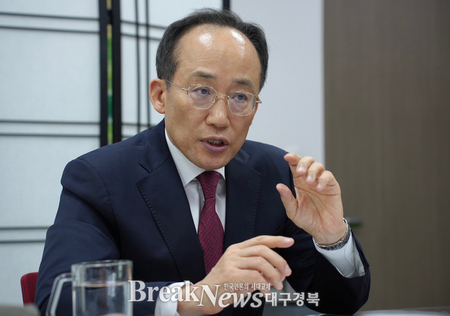
▲ 최상목 부총리 겸 기획재정부 장관이 4월 3일 오전 서울 중구 은행연합회에서 열린 ‘거시경제·금융현안 간담회’에 참석, 모두발언을 하고 있다. © 기획재정부 |
브레이크뉴스 문홍철 기자= 최상목 부총리 겸 기획재정부 장관이 미국의 상호관세 부과로 대외 불확실성이 확대됨에 따라 준비된 시장안정조치를 적기 시행하고, 통상환경 변화 대응 강화에 나서겠다고 밝혔다.
최 부총리는 3일 8시 전국은행연합회관에서 한국은행 총재, 금융위원장, 금융감독원장과 ‘거시경제·금융현안간담회’를 개최, 미국의 상호관세 부과(4월 2일, 현지시간)에 따른 국내외 금융·외환시장 동향을 점검하고 향후 대응방안을 논의했다.
최 부총리는 “오늘 새벽 미국 정부는 관세율 10%를 기본으로, 한국 25%, 일본 24%, EU 20%, 중국 34%, 대만 32% 등 국가별 상호관세 부과 조치를 발표했다”며 “글로벌 금융시장은 발표 직후 달러 가치가 상승하고, 미국 국채금리 및 증시 선물지수가 하락하는 등 전반적으로 위험회피 심리가 높아진 모습을 보였다”고 말했다.
이어 “미국 정부의 상호관세 조치로 당분간 글로벌 금융시장의 높은 변동성이 지속될 것으로 보인다”며 “국내 금융·외환시장도 민감하게 반응할 것으로 예상된다”고 덧붙였다.
이에 최 부총리는 “시장 변동성이 과도하게 확대될 경우에는 상황별 대응계획에 따라 가용한 모든 시장안정조치를 즉각 시행하겠다”며 “시장 상황이 충분히 안정될 때까지 관계기관 합동 24시간 점검체계를 지속 가동하고, 외환/국채/자금시장 등 각 분야별 점검체계도 운영하겠다”고 강조했다.
또한, “높은 상호관세 부과가 현실로 다가온 이상, 미국 관세정책에 대한 면밀한 분석을 바탕으로 우리 경제에 미치는 피해가 최소화되도록 대미협상에 범정부적 노력을 집중하고, 경제안보전략 TF 등을 통해
민관이 함께 최선의 대응전략을 마련하겠다”고 말했다.
계속해서 “산업경쟁력강화 관계장관회의를 통해 자동차 등 피해 예상 업종별 지원, 조선 RG 공급 확대 등 상호관세 대응을 위한 세부 지원방안을 순차적으로 발표하겠다”고 덧붙였다.
마지막으로 최 부총리는 “나아가 글로벌 통상환경 변화를 계기로
우리 경제·산업의 체질 개선 노력도 병행하겠다”며 “신시장 개척을 통해 수출시장을 다변화하고, 가격이 아닌 기술을 기반으로 한 근본적 산업경쟁력을 제고하며, 국내 일자리를 지키는 정책적 노력도 더욱 강화하겠다”고 전했다.
break9874@naver.com
*아래는 위 기사를 '구글 번역'으로 번역한 영문 기사의 [전문]입니다. '구글번역'은 이해도 높이기를 위해 노력하고 있습니다. 영문 번역에 오류가 있을 수 있음을 전제로 합니다.<*The following is [the full text] of the English article translated by 'Google Translate'. 'Google Translate' is working hard to improve understanding. It is assumed that there may be errors in the English translation.>
Choi Sang-mok, “If the US tariff of 25% changes excessively, all market stabilization measures will be implemented immediately”
Deputy Prime Minister and Minister of Strategy and Finance Choi Sang-mok announced that he would promptly implement prepared market stabilization measures and strengthen responses to changes in the trade environment as external uncertainty increases due to the US’s reciprocal tariff imposition.
On the 3rd at 8:00 AM, Deputy Prime Minister Choi held a ‘Macroeconomic and Financial Issues Discussion’ with the Governor of the Bank of Korea, the Chairman of the Financial Services Commission, and the Governor of the Financial Supervisory Service at the Korea Federation of Banks building to review domestic and international financial and foreign exchange market trends and discuss future response measures following the US’s reciprocal tariff imposition (April 2, local time).
Deputy Prime Minister Choi said, “This morning, the US government announced reciprocal tariff imposition measures by country, including a 10% basic tariff rate, 25% for Korea, 24% for Japan, 20% for the EU, 34% for China, and 32% for Taiwan.” He added, “The global financial market showed an overall increase in risk aversion, with the value of the dollar rising immediately after the announcement, and US Treasury yields and stock market futures indices falling.”
He added, “The US government’s reciprocal tariff measures are expected to continue to result in high volatility in the global financial market for the time being,” and “The domestic financial and foreign exchange markets are also expected to react sensitively.”
In response, Deputy Prime Minister Choi emphasized, “If market volatility increases excessively, we will immediately implement all available market stabilization measures according to the situation-specific response plan,” and “Until the market situation is sufficiently stabilized, we will continue to operate a joint 24-hour inspection system with relevant organizations, and we will also operate inspection systems for each sector, such as foreign exchange/government bonds/funding markets.”
He also said, “Now that the imposition of high reciprocal tariffs has become a reality, we will focus pan-governmental efforts on negotiations with the US to minimize the damage to our economy based on a thorough analysis of the US tariff policy, and through the Economic Security Strategy TF, etc., the public and private sectors will work together to devise the best response strategy.”
He continued, “We will sequentially announce detailed support measures for responding to reciprocal tariffs, such as support for industries expected to be affected, such as automobiles, and expansion of shipbuilding RG supply, through the Ministerial Meeting on Strengthening Industrial Competitiveness.”
Finally, Vice Prime Minister Choi said, “In addition, we will make efforts to improve the constitution of our economy and industry in light of the changes in the global trade environment,” adding, “We will diversify export markets by developing new markets, enhance fundamental industrial competitiveness based on technology rather than price, and further strengthen policy efforts to protect domestic jobs.”