▲ 21일 김관영 전북지사와 우범기 전주시장ㆍ정성주 김제시장ㆍ유희태 완주군수가 전북특별자치도청 4층 회의실에서 '김제 용지 특별관리지역 현업 축사 매입 사업 지방비 재원 분담'을 골자로 업무협약 체결한 뒤 환하게 웃으며 손에 손을 맞잡은 상태로 기념촬영을 하고 있다. 【사진 왼쪽부터 유희태 완주군수ㆍ정성주 김제시장ㆍ김관영 전북특별자치도지사ㆍ우범기 전주시장】 / 사진제공 = 전북특별자치도청 © 박동일 기자 |
 ▲ 김관영(왼쪽에서 두 번째) 전북지사가 업무협약에 앞서 환담을 나누는 시간을 갖고 "행정구역을 넘어 도민 삶의 질 향상이라는 공동 목표로 뜻을 모은 이번 협약이 환경정책과 지역 상생발전의 새로운 이정표가 될 것"이라며 "오랜 기간 불편을 감내해 온 혁신도시 주민들에게 희망을 드리는 등 도민이 체감할 수 있는 변화로 보답하겠다"는 약속을 하고 있다. / 사진제공 = 전북특별자치도청 © 박동일 기자 |
전북 혁신도시 악취 해결을 위해 4개 단체장이 협력을 약속했다.
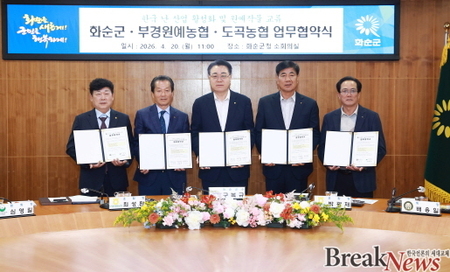
21일 김관영 전북지사와 우범기 전주시장ㆍ정성주 김제시장ㆍ유희태 완주군수가 전북특별자치도청 4층 회의실에서 김제 용지 특별관리지역 현업 축사 매입 사업 지방비 재원 분담을 골자로 업무협약 체결하고 손에 손을 맞잡았다.
이번 협약은 사업 대상 지역인 김제시와 혁신도시가 위치한 전주시ㆍ완주군이 공동으로 재원을 부담하는 방식이 담겨, 지역 환경 현안에 공동 대응한다는 점에서 각별한 의미가 담겼다.
김제시 용지면 특별관리지역에 남아있는 현업 축사 27개 농가를 매입ㆍ철거하는 사업의 지방비 분담은 총사업비 340억(토지매입비 244억ㆍ축사 철거비 96억) 원이다.
국비 238억 원(70%)을 제외한 지방비 102억을 ▲ 전북자치도 30% ▲ 김제시 50% ▲ 전주시와 완주군이 각각 10%씩 부담한다.
사업 기간은 2026년부터 2029년까지 4년이다.
전북자치도는 협약에 따라, 기관 간 협의 및 조정과 국비 확보를 위한 중앙부처 건의ㆍ사업 추진성과 점검ㆍ평가를 맡는다.
김제시는 사업 시행ㆍ추진 상황 보고ㆍ악취배출시설 관리 강화ㆍ악취 저감 대책 추진을 담당한다.
전주시와 완주군은 지방비 분담과 악취 저감 관련 연계사업에 협력한다.
축사 매입과 함께 종합적인 악취 관리 대책도 추진된다.
올해 용지면 일원을 악취 관리지역으로 지정, 매입 대상에서 제외된 축사와 가축분뇨 처리시설에 대한 관리를 강화한다.
김관영 전북지사는 "행정구역을 넘어 도민 삶의 질 향상이라는 공동 목표로 뜻을 모은 이번 협약이 환경정책과 지역 상생발전의 새로운 이정표가 될 것"이라며 "오랜 기간 불편을 감내해 온 혁신도시 주민들에게 희망을 드리는 등 도민이 체감할 수 있는 변화로 보답하겠다"고 밝혔다.
한편, 이번 업무협약은 지난 2022년 시작된 1단계 매입 사업의 연장선에 있다.
당시 환경부는 국비 481억 원을 투입, 용지면 특별관리지역 내 53개 농가 중 26개 농가를 매입 완료했으며 보건환경연구원 조사에 따르면 용지면 일원 복합악취 농도는 2021년 15.8배에서 2025년 8.0배로 약 50% 감소했다.
나머지 27개 농가는 새만금사업법 개정으로 매입 기한이 4년 연장되면서 2단계 사업인 신암ㆍ신흥ㆍ비룡마을 일원으로 축사 부지 8만 9,238㎡와 건물 3만 8,679㎡가 철거 대상이다.
이에 따라, 연평균 20건 이상의 민원이 여전히 발생하는 등 혁신도시 주민들의 불편은 완전히 해소되지 않은 상황이다.
☞ 아래는 위 기사를 구글 번역이 번역한 영문 기사의 '전문' 입니다.
구글 번역은 이해도를 높이기 위해 노력하고 있으며 영문 번역에 오류가 있음을 전제로 합니다.
【Below is the 'full text' of the English article translated by Google Translate.
Google Translate is working hard to improve understanding, and assumes that there are errors in the English translation.】
Four heads of organizations in Innovation City sign agreement to address odor issues
Target completion date: 2029… Local government funding for livestock farm purchase project
Reporter Park Dong-il
Four heads of local governments have pledged cooperation to address the odor problem in Jeonbuk Innovation City.
On the 21st, Jeonbuk Governor Kim Kwan-young, Jeonju Mayor Woo Beom-ki, Gimje Mayor Jeong Seong-ju, and Wanju County Mayor Yoo Hee-tae signed a business agreement in a conference room on the 4th floor of the Jeonbuk Special Self-Governing Provincial Office, focusing on sharing local government funding for the purchase of livestock farms in the Gimje Special Management Area.
This agreement holds special significance as it involves Gimje City, the project target area, and Jeonju City and Wanju County, where the innovation city is located, jointly sharing the financial burden, thereby fostering a joint response to local environmental issues.
The local government's share of the project, which involves purchasing and demolishing 27 livestock farms remaining in the Yongji-myeon Special Management Area in Gimje City, is KRW 34 billion (KRW 24.4 billion for land acquisition and KRW 9.6 billion for livestock farm demolition).
Excluding KRW 23.8 billion (70%) in national funding, the local government will shoulder KRW 10.2 billion, divided into: Jeonbuk Province (30%), Gimje City (50%), and Jeonju City and Wanju County (10%) each.
The project period is four years, from 2026 to 2029.
According to the agreement, the Jeollabuk-do Autonomous Province will be responsible for inter-agency consultation and coordination, making recommendations to the central government for securing national funding, and monitoring and evaluating project progress.
Gimje City will be responsible for project implementation, reporting progress, strengthening management of odor-emitting facilities, and implementing odor reduction measures.
Jeonju City and Wanju County will cooperate on local funding sharing and related odor reduction projects.
Along with the purchase of livestock farms, comprehensive odor management measures will also be implemented.
This year, the entire Yongji-myeon area will be designated as an odor control area, strengthening management of livestock sheds and livestock waste treatment facilities excluded from purchase.
Jeollabuk-do Governor Kim Kwan-young stated, "This agreement, which transcends administrative boundaries and fosters a shared goal of improving the quality of life for residents, will mark a new milestone in environmental policy and regional development. We will repay residents of the Innovation City, who have endured long-standing inconveniences, with tangible changes, offering hope."
Meanwhile, this business agreement is an extension of the Phase 1 acquisition project that began in 2022.
At the time, the Ministry of Environment invested KRW 48.1 billion in national funds to purchase 26 of the 53 farms within the Yongji-myeon Special Management Area. According to a survey by the National Institute of Environmental Research, the combined odor concentration in Yongji-myeon decreased by approximately 50%, from 15.8 times in 2021 to 8.0 times in 2025.
The remaining 27 farms are subject to demolition, with 89,238 square meters of livestock farm land and 38,679 square meters of buildings in the Sinam, Sinheung, and Biryong villages, Phase 2 of the project, due to a four-year extension of the purchase deadline due to revisions to the Saemangeum Development Act.
Consequently, the inconveniences faced by residents of the innovation city remain unresolved, with an average of over 20 civil complaints still being filed annually.
원본 기사 보기:브레이크뉴스 전북판