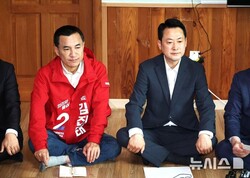
▲ '대전조차장 철도지화화 통합개발' 업무협약식 진행 모습 © 대전시 제공 |
대전 도심 핵심 철도시설인 대전조차장을 지하화하고 상부 공간을 입체적으로 재편하는 대규모 통합개발 사업이 공식 절차에 들어갔다.
대전시는 29일 오전 대전조차장 철도고객센터에서 국토교통부를 비롯해 국가철도공단, 한국철도공사, 한국토지주택공사, 국토연구원, 한국교통연구원과 함께 ‘대전조차장 철도지하화(입체화) 통합개발 사업’ 추진을 위한 업무협약을 체결하고, 곧바로 관련 용역 착수보고회를 열었다.
이번 협약은 도심 한복판에 자리한 조차장 부지를 철도 지하화를 통해 재구성하고, 확보되는 상부 공간을 미래 산업과 창업 중심지로 전환하기 위한 정책·기술·연구 협력 기반을 마련하는 데 목적이 있다. 참여 기관들은 정례 협의체를 구성해 철도시설 지하화 기술, 도시개발 전략, 교통·공간 구조 개선 방안 등을 공유하며 사업 추진의 완성도를 높일 계획이다.
협약 체결 이후 진행된 착수보고회에서는 타당성조사와 기본계획 수립 용역의 추진 방향이 제시됐다. 국토교통부와 대전시는 각각 철도시설 지하화와 상부 공간 개발을 핵심 축으로 삼아 역할을 분담하고, 단계별 추진 일정과 과제를 공유했다. 철도 운영 안정성과 도시 기능 회복을 동시에 고려한 입체화 전략도 같이 논의됐다.
대전시는 조차장 기능 이전과 철도시설 지하화를 통해 도심 공간의 물리적 단절을 해소하고, 상부 부지를 대덕연구개발특구와 대전산업단지, 한남대학교 캠퍼스혁신파크 등과 연계한 빅테크·딥테크 기업 성장 공간으로 조성한다는 구상이다. 청년 창업과 신기술 실증, 기업 성장 지원이 가능한 복합 플랫폼을 구축해 대전을 대표하는 미래 산업 거점으로 육성하겠다는 방향이다.
이번 사업은 단순한 철도시설 개선을 넘어 도시 구조 전반을 재편하는 전략적 개발로 평가된다. 철도 지하화로 확보되는 연속적인 도시 공간은 산업·주거·연구 기능의 융합을 가능하게 하고, 장기적으로는 대전 도심 경쟁력과 혁신 역량을 끌어올리는 기반이 될 것으로 보인다. 관계기관 간 협업을 전제로 한 이번 통합개발이 계획 단계에서 실행 단계로 안정적으로 이어질 수 있을지 주목된다.
*아래는 위 기사를 '구글 번역'으로 번역한 영문 기사의 [전문]입니다. '구글번역'은 이해도를 높이기를 위해 노력하고 있습니다. 영문 번역에 오류가 있을 수 있음을 전제로 합니다.<*The following is [the full text] of the English article translated by 'Google Translate'. 'Google Translate' is working hard to improve understanding. It is assumed that there may be errors in the English translation.>
A large-scale integrated development project to bury the Daejeon Rail Yard, a key downtown railway facility, and reorganize the overhead space has officially begun.
On the morning of the 29th, Daejeon City signed a business agreement with the Ministry of Land, Infrastructure and Transport, the Korea Railroad Corporation, the Korea Railroad Corporation, the Korea Land and Housing Corporation, the Korea Research Institute for Human Settlements, and the Korea Transport Institute at the Daejeon Rail Yard Rail Customer Center to promote the "Daejeon Rail Yard Underground (Overground) Integrated Development Project." A related service launch briefing session will be held immediately following the signing.
The agreement aims to reconstruct the yard site, located in the heart of the city, by burying the railway underground and establish a foundation for policy, technology, and research cooperation to transform the resulting overhead space into a hub for future industries and startups. The participating organizations plan to form a regular consultative body to share technologies for undergrounding railway facilities, urban development strategies, and plans for improving transportation and spatial structures, thereby enhancing the project's overall effectiveness.
The launch briefing session, held following the signing of the agreement, will present the direction for the feasibility study and basic plan development services. The Ministry of Land, Infrastructure and Transport and the Daejeon Metropolitan Government will each share responsibilities, focusing on undergrounding railway facilities and developing overhead space, and share phased implementation schedules and tasks. A multi-faceted strategy that simultaneously considers railway operational stability and urban restoration will also be discussed.
Daejeon plans to address the physical disconnection of urban space through the relocation of the rail yard and undergrounding of the railway facilities. The city plans to develop the overhead space into a growth space for big and deep tech companies, linking it with the Daedeok Research and Development Special Zone, the Daejeon Industrial Complex, and the Hannam University Campus Innovation Park. The goal is to establish a multi-faceted platform capable of supporting youth entrepreneurship, new technology testing, and corporate growth, fostering Daejeon as a leading future industrial hub.
This project is considered a strategic development that goes beyond simple railway facility improvements and reorganizes the entire urban structure. The continuous urban space secured by undergrounding the railway will enable the convergence of industrial, residential, and research functions, and in the long term, will serve as a foundation for enhancing downtown Daejeon's competitiveness and innovation capacity. It remains to be seen whether this integrated development, predicated on inter-agency collaboration, can be successfully implemented from the planning stage.
원본 기사 보기:브레이크뉴스대전세종충청