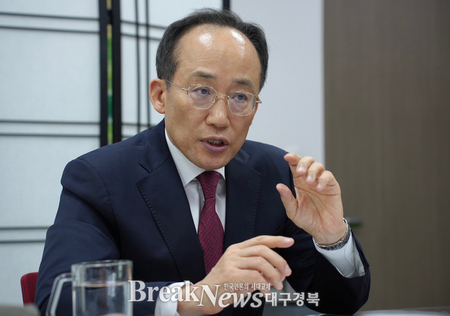
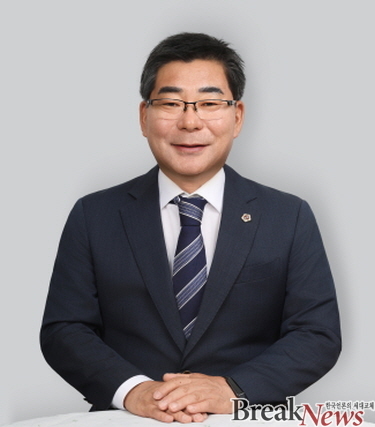
▲ 최은석 의원, 803마스터플랜 발표 © 진예솔 기자 |
【브레이크뉴스 】진예솔 기자= 최은석 대구시장 출마예정자가 기업 중심의 산업 구조 전환을 내건 ‘803 대구 마스터 플랜’을 공개하며 대구 경제 회생 구상을 밝혔다.
장기간 침체된 제조업과 건설 경기, 청년 유출을 구조적 위기로 진단하고, 기업 성장과 산업 고도화를 해법으로 제시한 것이 골자다.
최 예정자는 2일 오전 대구시당 회의실에서 열린 정책 발표회에서 “대구의 문제는 결국 경제이며, 회사로 치면 부도 직전 상황”이라며 “경제의 핵심은 기업인데 대구에는 성장과 도전에 나설 경쟁력 있는 기업이 너무 적다”고 말했다. 전국 최하위 수준의 지역내총생산(GRDP), 소비 위축, 부동산·건설 경기 침체가 맞물리며 악순환에 빠졌다는 진단이다.
그는 2024년 대구의 GRDP 성장률이 -0.79%로 광역시 가운데 유일한 마이너스 성장을 기록한 점을 언급하며 제조업과 건설업 동반 부진을 주요 원인으로 꼽았다. “GRDP를 1% 끌어올리려면 연간 6,663억 원의 추가 소득 창출이 필요하다”며 “산업 구조 고도화와 기업의 성장성·수익성 제고, 건설 경기 정상화가 회복의 출발점”이라고 강조했다.
‘803 대구 마스터 플랜’은 8대 전략 산업, 정주 환경 걱정 제로, 3대 성장 목표를 축으로 한다. 추진 체계는 기업·대학·대구시가 역할을 분담하는 ‘삼중 나선 구조’다. 기업은 혁신과 도전의 주체로, 대학과 연구기관은 인재와 기술 공급원으로, 대구시는 정책과 예산, 전담기관을 연계하는 컨트롤타워 역할을 맡는다는 구상이다. 이를 위해 시정 조직도 ‘경제 최우선 체계’로 개편하겠다고 밝혔다.
8대 전략 산업으로는 섬유, 안광학, 기계, 바이오 헬스케어, 물산업, 지능형 로봇, 미래 모빌리티, 콘텐츠 IP 산업을 제시했다. 섬유 산업은 첨단·고기능 텍스타일 중심으로 고도화하고, 안광학 산업은 기술·디자인·브랜드를 결합한 K-아이웨어 산업으로 전환한다는 계획이다. 기계 산업은 지능형 메카트로닉스와 로봇 산업으로 확장하고, 바이오 헬스케어는 연구 중심 구조에서 산업화 중심의 ‘레드바이오 허브’로 육성하겠다고 밝혔다.
특히 안광학 산업과 관련해 그는 “지금 방식대로 가면 안경 산업의 미래는 없다”며 “단순 제조·하청 구조에서 벗어나 기술과 디자인, 브랜드를 결합한 비즈니스 모델로 전환해야 글로벌 시장에서 경쟁력이 생긴다”고 말했다. 개별 기업에 소액 지원을 나눠주는 방식이 아니라 선택과 집중을 통한 산업 구조 개편이 필요하다는 설명이다.
정주 환경 개선을 위한 ‘제로 전략’도 병행한다. 청년 창업 특구 조성, 10분 응급 의료 체계 구축, 교육 플랫폼 연계를 통한 교육 격차 해소, 수요 기반 부동산 정책, 문화·관광 인프라 확충 등을 통해 청년·의료·교육·부동산·문화 분야의 시민 부담을 줄이겠다는 구상이다.
정량 목표로는 혁신 기업 300개 육성, 투자·유치 기업 30개 확보, 매년 스타 기업 30곳 이상 발굴, ‘1조 클럽’ 기업 3개 조기 창출, GRDP 3% 성장 조기 달성을 제시했다. 최 예정자는 “정치적 자부심이 아닌 경제적 자신감을 가진 도시로 대구를 바꾸겠다”며 “대한민국 3대 핵심 도시로 도약하는 기반을 만들겠다”고 말했다.
재원 마련 방안에 대해서는 국비 확보와 민간 투자 유치를 병행하겠다는 입장을 밝혔다. 그는 “국가 예산 구조와 확보 전략은 잘 알고 있다”며 “국비만으로는 한계가 있는 만큼 민간 자본을 적극적으로 유치해 기업 성장과 투자 수익이 함께 돌아가는 구조를 만들겠다”고 말했다. 아울러 “불요불급하거나 정치적 구호로 추진된 SOC 사업은 원점에서 재검토하고, 절감된 예산을 산업 구조 혁신과 기업 지원, 문화·관광 인프라에 우선 투입하겠다”고 덧붙였다.
<구글 번역으로 번역한 영문 기사의 전문 입니다. 번역에 오류가 있을 수 있음을 밝힙니다.>
Choi Eun-seok, a candidate for Daegu mayor, unveiled his "803 Daegu Master Plan," which advocates a corporate-centered industrial restructuring, revealing his vision for Daegu's economic revitalization.
The plan identifies the prolonged stagnation of the manufacturing and construction sectors and the exodus of young people as structural crises, and proposes corporate growth and industrial advancement as solutions.
At a policy presentation held in the Daegu City Party conference room on the morning of the 2nd, Choi stated, "Daegu's problem is ultimately the economy. If we were to compare it to a company, it would be on the verge of bankruptcy." He added, "Companies are the core of the economy, but Daegu has too few competitive companies willing to pursue growth and challenges." He concluded that Daegu's lowest Gross Regional Domestic Product (GRDP) in the nation, shrinking consumption, and sluggish real estate and construction sectors have all combined to create a vicious cycle.
He cited Daegu's 2024 GRDP growth rate of -0.79%, the only metropolitan city to experience negative growth, and attributed the simultaneous slump in manufacturing and construction to the simultaneous decline in the economy. He emphasized, "Increasing GRDP by 1% requires generating an additional 666.3 billion won in annual income," and added, "Recovery begins with the advancement of the industrial structure, enhanced corporate growth and profitability, and normalizing the construction market."
The "803 Daegu Master Plan" centers on eight strategic industries, zero concerns about the residential environment, and three growth goals. The implementation system is a "triple helix" structure, with shared roles among businesses, universities, and the Daegu Metropolitan City. Businesses are the driving force behind innovation and challenge, universities and research institutes are the source of talent and technology, and the Daegu Metropolitan City serves as the control tower, linking policies, budgets, and dedicated agencies. To achieve this, the city government also announced plans to reorganize its administrative structure into an "economy-first system."
The eight strategic industries include textiles, optical optics, machinery, bio-healthcare, water, intelligent robots, future mobility, and content IP. The textile industry will be advanced, focusing on cutting-edge, high-performance textiles, while the ophthalmic industry will transform into a K-eyewear industry that combines technology, design, and branding. The machinery industry will expand into intelligent mechatronics and robotics, and the bio healthcare sector will be fostered from a research-centric structure to an industrialization-focused "Red Bio Hub."
Regarding the ophthalmic industry in particular, he stated, "If we continue on our current path, the eyewear industry has no future." He added, "We must move beyond a simple manufacturing and subcontracting structure and transition to a business model that combines technology, design, and branding to become competitive in the global market." He emphasized the need for a restructuring of the industry through selection and focus, rather than distributing small amounts of support to individual companies.
A "Zero Strategy" to improve the residential environment is also being implemented. This plan aims to reduce the burden on citizens in the youth, healthcare, education, real estate, and cultural sectors by establishing special youth entrepreneurship zones, establishing a 10-minute emergency medical system, bridging the education gap through educational platform integration, implementing demand-based real estate policies, and expanding cultural and tourism infrastructure.
The quantitative goals set forth include fostering 300 innovative companies, securing 30 investment-attracting companies, discovering at least 30 star companies annually, creating three "1 trillion club" companies early, and achieving a 3% GRDP growth rate early. Choi stated, "I will transform Daegu into a city driven by economic confidence, not political pride," and "I will lay the foundation for Daegu to become one of Korea's top three core cities."
Regarding funding, he stated his intention to secure both national funding and private investment. He stated, "I am fully aware of the national budget structure and funding strategy. Since national funding alone has its limitations, I will actively attract private capital to create a structure where corporate growth and investment returns coexist." He added, "We will reexamine unnecessary or politically motivated SOC projects from scratch, and prioritize the budget savings in industrial restructuring, corporate support, and cultural and tourism infrastructure."
원본 기사 보기:브레이크뉴스 대구경북