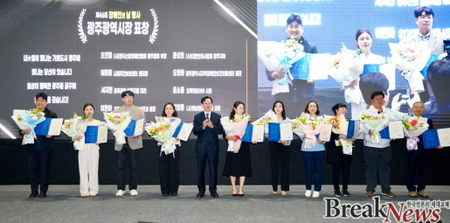
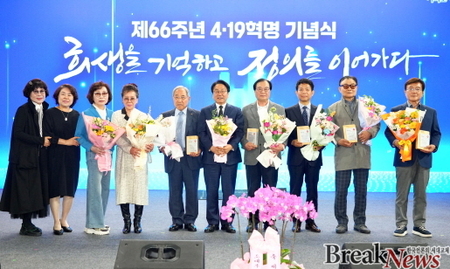
▲ 글로벌 헬스케어 의공학 연구소(K-BIGHEART, 국가연구소 NRL 2.0) 개소식 ©포항시 |
【브레이크뉴스 포항】박영재 기자=포항시와 포스텍이 차세대 의료기술로 주목받는 바이오반도체 분야 육성에 본격 착수했다.
포항시와 포스텍은 18일 체인지업그라운드에서 ‘글로벌 헬스케어 의공학 연구소(K-BIGHEART)’ 개소식을 열고 본격적인 운영에 들어간다고 밝혔다.
이날 행사에는 구혁채 과학기술정보통신부 제1차관, 이해숙 교육부 고등평생정책실장, 양금희 경상북도 경제부지사, 홍원화 한국연구재단 이사장, 김성근 포스텍 총장 등 정부와 지자체, 학계 관계자 100여 명이 참석했다.
이번 연구소 설립은 과학기술정보통신부와 교육부가 공동 추진하는 ‘국가연구소(NRL 2.0)’ 사업에 최종 선정된 데 따른 것으로, 2034년까지 총 1,130억 원(국비 950억 원, 지방비 100억 원, 민자 80억 원)이 투입된다. 연구소는 미래 바이오반도체 기술을 선도할 전략 거점 역할을 맡게 된다.
연구소는 바이오와 반도체를 융합한 ‘바이오반도체’ 기술 확보를 목표로 ▲글로벌 헬스(휴대용 진단기기) ▲오가노이드(줄기세포 배양) ▲세포치료 ▲분자의학 ▲양자기술 등 5대 핵심 분야를 중심으로 전주기 연구개발을 추진할 계획이다.
또한 연구 성과를 기반으로 포항의 신성장 동력인 바이오반도체 파운드리를 단계적으로 구축해, 시제품과 검증 기술, 데이터 등을 지역 기업의 제품화와 기술 고도화에 연계하는 산업 생태계 조성에도 나선다.
바이오반도체는 생체 신호 검출과 전자 신호 처리를 결합한 기술로, 초정밀 질병 진단과 맞춤형 치료를 가능하게 하는 차세대 핵심 기술로 평가된다.
특히 연구소는 2024년 지정된 포항 국가첨단전략산업 바이오특화단지 내에 위치해 기업 유치와 창업, 산학연 협력을 촉진하는 거점 역할을 수행할 것으로 기대된다. 이를 통해 고부가가치 바이오 산업 집적과 함께 양질의 일자리 창출 등 지역경제 활성화 효과도 전망된다.
연구소장에는 포스텍의 루크 P. 리(Luke P. Lee) 교수가 임명됐다. 하버드대학교 의과대학 교수 등을 역임한 그는 나노기술과 생명과학, 광학이 결합된 ‘나노바이오포토닉스’ 분야의 세계적 연구자로, 포항의 방사광가속기와 세포막단백질연구소, 생명공학연구센터 등 기존 연구 인프라와의 연계를 통해 시너지 창출이 기대된다.
이상엽 포항시 일자리경제국장은 “이번 연구소 개소는 포항이 글로벌 바이오 기술 경쟁력을 확보하는 전환점이 될 것”이라며 “국가 바이오 산업을 선도하는 연구 중심지로 성장할 수 있도록 적극 지원하겠다”고 말했다.
<구글 번역으로 번역한 영문 기사의 전문 입니다. 번역에 오류가 있을 수 있음을 밝힙니다.>
Pohang City and POSTECH Launch ‘Bio-Semiconductor’ Forward Base… K-BIGHEART Research Institute Opens
Pohang City and POSTECH have officially embarked on fostering the bio-semiconductor sector, which is garnering attention as a next-generation medical technology.
Pohang City and POSTECH announced on the 18th that they held an opening ceremony for the ‘Global Healthcare Biomedical Engineering Research Institute (K-BIGHEART)’ at Change-Up Ground and have begun full-scale operations.
Approximately 100 officials from the government, local governments, and academia attended the event, including Koo Hyuk-chae, First Vice Minister of Science and ICT; Lee Hae-sook, Head of the Higher Education and Lifelong Learning Policy Office at the Ministry of Education; Yang Geum-hee, Vice Governor for Economic Affairs of Gyeongsangbuk-do; Hong Won-hwa, President of the National Research Foundation of Korea; and Kim Sung-keun, President of POSTECH. The establishment of this research institute follows its final selection for the ‘National Research Laboratory (NRL 2.0)’ project, jointly promoted by the Ministry of Science and ICT and the Ministry of Education. A total of 113 billion won (95 billion won in state funding, 10 billion won in local funding, and 8 billion won in private investment) will be invested by 2034. The institute will serve as a strategic hub to lead future biosemiconductor technology.
With the goal of securing ‘biosemiconductor’ technology—a fusion of bio and semiconductors—the institute plans to pursue full-cycle R&D centered on five core fields: Global Health (portable diagnostic devices), Organoids (stem cell culture), Cell Therapy, Molecular Medicine, and Quantum Technology.
Furthermore, based on research achievements, the institute will establish a biosemiconductor foundry in stages to serve as a new growth engine for Pohang. It will also work to foster an industrial ecosystem that links prototypes, verification technologies, and data to the commercialization and technological advancement of local companies. Biosemiconductors are a technology that combines biological signal detection with electronic signal processing, and are considered a core next-generation technology that enables ultra-precise disease diagnosis and personalized treatment.
In particular, the research institute is located within the Pohang National Advanced Strategic Industry Bio-Specialized Complex, designated in 2024, and is expected to serve as a hub for attracting companies, facilitating startups, and promoting industry-academia-research collaboration. Through this, it is anticipated to revitalize the local economy by creating high-quality jobs alongside the concentration of high-value-added bio-industries.
Professor Luke P. Lee of POSTECH has been appointed as the Director of the Research Institute. Having served as a professor at Harvard Medical School, he is a world-renowned researcher in the field of "nanobiophotonics," which combines nanotechnology, life sciences, and optics. Synergy is expected to be generated through linkages with existing research infrastructure in Pohang, such as the Synchrotron Radiation Accelerator, the Cell Membrane Protein Research Institute, and the Biotechnology Research Center.
Lee Sang-yeop, Director of the Jobs and Economy Bureau of Pohang City, stated, “The opening of this research institute will be a turning point for Pohang to secure global competitiveness in biotechnology,” adding, “We will provide active support to help it grow into a research hub leading the national bio industry.”
원본 기사 보기:브레이크뉴스 대구경북