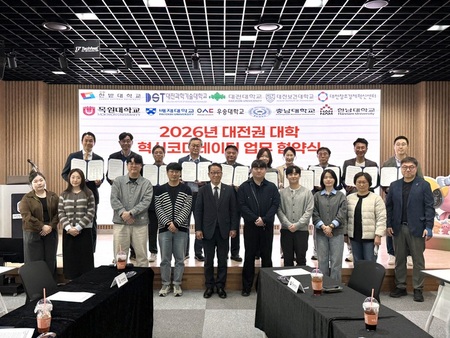
▲ 대전광역시 'AI 리터러시 교육 안전윤리 가이드 라인 제정을 위한 정책토론회' 참여자 단체 기념촬영 모습=대전시의회 제공 © 정지완 기자 |
대전광역시의회가 인공지능 활용 확산에 대응한 공공 기준 마련 논의에 나섰다. 시의회는 18일 소통실에서 김진오 의원(국민의힘·서구1)을 좌장으로 ‘AI 리터러시 교육 가이드라인 제정 정책토론회’를 열고, 시민과 교육 현장에서 요구되는 책임 있는 AI 활용 원칙을 점검했다.
이번 토론회는 AI 기술이 일상과 학습 환경 전반으로 빠르게 스며드는 상황에서, 활용 역량 못지않게 윤리와 책임 의식을 함께 키워야 한다는 문제의식에서 마련됐다. 기술 수용 속도에 비해 안전한 사용 기준과 교육 원칙은 충분히 정리되지 않았고, 그 공백이 현장 혼선으로 이어지고 있다는 판단이 배경에 깔렸다.
김진오 의원은 이날 토론회에서 AI가 이미 시민 생활 깊숙이 들어와 있지만, 이를 안전하게 다루는 방법과 기준에 대한 사회적 논의는 아직 부족하다고 짚었다. AI를 단순한 편의 기술이 아니라 개인의 권리와 사회적 책임이 맞물리는 영역으로 보고, 공공이 먼저 최소한의 기준을 제시해야 한다는 점을 강조했다.
발제에 나선 박현서 KAIST 정보전자연구소 박사는 개인정보 유출, 알고리즘 편향, 딥페이크 범죄, AI 의존성 심화 등을 주요 위험 요인으로 제시했다. 그는 사전에 기준을 세우지 않으면 충분히 줄일 수 있는 문제까지 반복될 수 있다며, 대전시 차원의 AI 활용 윤리 가이드라인 제정이 필요하다고 제안했다.
토론에서는 교육 현장의 실제 사례도 공유됐다. 학생이 생성형 AI에 개인정보를 무분별하게 입력하거나, AI를 활용한 과제에 대한 평가 기준이 마련되지 않아 학교별·교사별 대응이 달라지는 문제, 딥페이크와 저작권 침해에 대한 인식 부족 등이 대표적인 사례로 거론됐다. 참석자들은 이런 혼선이 개별 현장의 판단만으로는 해소되기 어렵고, 일정한 공통 기준이 있어야 같은 문제가 되풀이되지 않는다는 데 의견을 모았다.
이번 논의는 AI 교육을 단순한 디지털 기능 습득의 문제로 볼 수 없다는 점도 다시 확인시켰다. AI 리터러시는 기술을 쓰는 능력에 그치지 않고, 정보 판단력과 윤리의식, 책임 있는 시민성까지 함께 요구하는 영역이기 때문이다. 그런 점에서 가이드라인 제정은 규제 강화라기보다 기술 활용의 공적 기준을 세우는 작업에 가깝다.
김 의원은 AI가 업무와 학습의 효율을 높이는 강력한 도구인 만큼, 그에 상응하는 책임 있는 활용 기준도 함께 마련돼야 한다는 점을 재차 강조했다. 대전시가 선도적으로 윤리 가이드라인을 정비해 시민 보호 정책의 출발점을 마련해야 한다는 주장도 같은 맥락에서 나왔다.
이제 남은 일은 문제를 확인하는 데서 그치지 않고, 이를 실제 교육 현장과 시민 교육에 적용 가능한 기준으로 구체화하는 것이다. 기술의 확산 속도를 제도가 뒤따르지 못한다면 혼선은 반복될 수밖에 없다. 이번 토론회는 대전이 AI 활용의 편의뿐 아니라 책임의 기준까지 함께 설계할 수 있을지를 가늠하는 첫 논의의 장으로 보인다.
*아래는 위 기사를 '구글 번역'으로 번역한 영문 기사의 [전문]입니다. '구글번역'은 이해도를 높이기를 위해 노력하고 있습니다. 영문 번역에 오류가 있을 수 있음을 전제로 합니다.<*The following is [the full text] of the English article translated by 'Google Translate'. 'Google Translate' is working hard to improve understanding. It is assumed that there may be errors in the English translation.>
Daejeon City Council Begins Full-Scale Discussions on AI Literacy Education Standards… “Ethical Guidelines Needed”
Policy Debate Held with Council Member Kim Jin-o as Chair… Focusing on On-Site Issues Including Personal Information, Deepfakes, and Confusion in Evaluation Standards
The Daejeon Metropolitan City Council has begun discussions to establish public standards in response to the widespread use of artificial intelligence (AI). On the 18th, the City Council held a "Policy Debate on the Establishment of AI Literacy Education Guidelines" in the Communication Room, chaired by Council Member Kim Jin-o (People Power Party, Seo-gu 1), to review principles for responsible AI utilization required of citizens and the educational field.
This debate was organized based on the awareness that, as AI technology rapidly permeates daily life and learning environments, ethics and a sense of responsibility must be cultivated alongside utilization capabilities. The underlying judgment is that safe usage standards and educational principles have not been sufficiently established compared to the speed of technology adoption, and that this gap is leading to confusion in the field. At the forum held on this day, Assemblyman Kim Jin-oh pointed out that while AI has already deeply permeated citizens' daily lives, social discussion regarding methods and standards for handling it safely remains insufficient. He emphasized that AI should be viewed not merely as a convenience technology, but as an area where individual rights and social responsibilities intersect, and that the public sector must take the lead in establishing minimum standards.
Dr. Park Hyun-seo of the KAIST Institute of Information and Electronics, who gave a presentation, identified personal information leakage, algorithmic bias, deepfake crimes, and deepening dependence on AI as major risk factors. He suggested that without establishing standards in advance, problems that could have been sufficiently mitigated could recur, proposing the need for the enactment of ethical guidelines for AI utilization at the Daejeon City level.
Real-world examples from the educational field were also shared during the discussion. Representative cases cited included students indiscriminately inputting personal information into generative AI, inconsistent responses by school and teacher due to the lack of established evaluation criteria for AI-based assignments, and a lack of awareness regarding deepfakes and copyright infringement. Participants agreed that such confusion cannot be resolved solely through the judgment of individual sites, and that consistent common standards are necessary to prevent the recurrence of the same problems. This discussion reaffirmed that AI education cannot be viewed merely as a matter of acquiring digital skills. This is because AI literacy is a domain that requires not only the ability to use technology but also information judgment, ethical awareness, and responsible citizenship. In this regard, the enactment of guidelines is closer to establishing public standards for technology utilization than to strengthening regulations.
Assemblyman Kim reiterated that since AI is a powerful tool for enhancing work and learning efficiency, corresponding standards for responsible utilization must also be established. The argument that Daejeon City should take the lead in overhauling ethical guidelines to lay the groundwork for citizen protection policies stemmed from the same context.
The remaining task is not to stop at merely identifying the issues, but to concretize them into standards applicable to actual educational settings and civic education. If the system fails to keep pace with the speed of technology diffusion, confusion is bound to recur. This forum appears to be the first venue for assessing whether Daejeon can design standards for responsibility alongside the convenience of AI utilization.
원본 기사 보기:브레이크뉴스대전세종충청