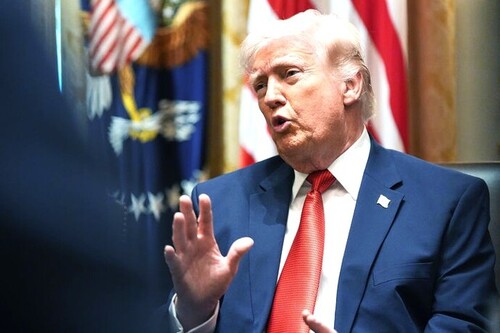
▲ 도널드 트럼프 미국 대통령이 25일(현지시간) 워싱톤 DC 백악관 집무실에서 열린 중국 동영상 플랫폼 틱톡 합의 관련 행정명령 서명식에서 미소짓고 있다. © AP/뉴시스 |
도널드 트럼프 미국 대통령이 25일(현지시간) “우리는 일본에서 5천 500억불(약 775조) 한국에서 3천 500억불(약 493조)을 (투자)받고 있고, 그것들은 선불"이라고 밝혔다.
미 'WSJ(월스트리트저널)' 등에 따르면 트럼프 대통령은 이날 워싱톤 DC 백악관 집무실에서 열린 중국 동영상 플랫폼 틱톡 합의 관련 행정명령 서명식에서 상호 관세 무역 합의에 따른 한·일 대미투자 약속을 언급하면서 이같이 말했다.
그러면서 "우리는 다른 나라들로부터 결코 제대로 대우받지 못했으나 이젠 잘하고 있다"며 "우리가 이토록 잘한 적은 없었다"고 했다.
또 "우리는 무역협상에서 아주 잘하고 있다"며 "중국 등 많은 국가들과 잘하고 있다”고 전했다.
이날 트럼프 대통령의 '한국 3500억불 선불' 발언은 현재 대미 투자를 둘러싼 한·미 양국 입장이 평행선을 그리고 있는 상황에서 한국에 대한 관세 인하 전제조건임을 거듭 공식화한 형국이다.
앞서 지난 16일(현지시간) 일찌감치 무역 합의를 이룬 일본과 달리 한국은 아직 무역 합의 세부 협상이 완료되지 않는 등 지지부진한 상태다.
이 때문에 일본은 자동차 대미 수출 관세 경우 기존 27.5%에서 15%로 인하 확정되면서 미국 시장내 가격 경쟁력 확보 계기를 마련했으나 한국은 여전히 25% 고율 관세가 적용되고 있어 현대차그룹 등 한국 자동차 업계는 불리한 위치에 놓인 상태다.
일본의 관세 부담이 줄면서 미국 내 점유율 확대 가능성이 높아진 반면 한국 자동차 기업은 상대적으로 가격 경쟁력이 약화되면서 대미 수출에 타격이 불가피해졌다.
앞서 지난 7월 30일 한·미는 무역 협상에서 미국이 한국에 부과하는 상호·자동차 관세를 25%에서 15%로 낮추는 대신 한국은 3천 500억불 규모 대미 투자 등을 시행키로 합의했으나 대미 투자 패키지 구성·이행 방식을 놓고 이견을 좁히지 못하고 있다.
한국은 지분 투자를 최소화하고 대부분 보증으로 하려는 반면 미국 경우 달러 현금을 한국에서 받아 투자처를 미국이 결정하고 투자 이익 역시 미국이 90%를 가져가는 등 합의를 요구 중이나 한국은 한·미 간 통화스와프 체결을 요구 중이다.
만약 한국이 미국의 선불 방식 요구를 거부할 시 관세 인하 혜택이 축소·철회될 가능성이 있는 한편 수용할 경우 외환시장·경제 전반에 위험 부담이 커지는 가운데 진퇴양난에 빠진 형국이다. 단기간 대규모 달러 유출은 원화 약세 심화와 함께 금융 시장을 흔들 수 있기 때문이다.
영문 기사의 [전문]입니다. '구글번역'은 이해도 높이기를 위해 노력하고 있습니다. 영문 번역에 오류가 있을 수 있음을 전제로 합니다.<*The following is [the full text] of the English article translated by 'Google Translate'. 'Google Translate' is working hard to improve understanding. It is assumed that there may be errors in the English translation.
US President Trump: "South Korea's $350 billion investment in the US will be paid upfront."
The current parallel positions of South Korea and the U.S. regarding investment in the U.S. are reflected in the repeated formalization of prerequisites for tariff reductions in South Korea. Unlike Japan, South Korea still applies a high 25% tariff on automobiles, which inevitably impacts the Korean auto industry's exports to the U.S.
-kihong Kim reporter
US President Donald Trump announced on the 25th (local time), "We're receiving $550 billion (approximately 775 trillion won) in investment from Japan and $350 billion (approximately 493 trillion won) from South Korea, and those are prepayments."
According to the Wall Street Journal and other sources, President Trump made this remark at an executive order signing ceremony held in the Oval Office of the White House in Washington, D.C., regarding the agreement with the Chinese video platform TikTok. He mentioned South Korea and Japan's commitment to investment in the US under the bilateral tariff and trade agreement.
He added, "We've never been treated well by other countries, but we're doing well now. We've never done better."
He also said, "We're doing very well in trade negotiations. We're doing very well with many countries, including China."
President Trump's remarks on the "$350 billion prepayment from South Korea" reaffirm the precondition for tariff reductions against South Korea, amidst the ongoing conflicting positions between South Korea and the US regarding investment in the US.
Unlike Japan, which reached a trade agreement early on the 16th (local time), South Korea's trade deal remains stalled, with detailed negotiations yet to be finalized.
While Japan's final reduction of its US auto tariffs from 27.5% to 15% has secured price competitiveness in the US market, South Korea remains subject to a high 25% tariff, putting Korean automakers, including Hyundai Motor Group, at a disadvantage.
With Japan's reduced tariff burden, the potential for increased market share in the US has increased, while Korean automakers' price competitiveness has weakened, inevitably impacting their US exports.
On July 30th, South Korea and the US agreed to lower the US reciprocal tariff on South Korea's autos from 25% to 15% in exchange for South Korea's commitment to investing $350 billion in the US. However, differences remain unresolved over the composition and implementation of this investment package.
While Korea seeks to minimize equity investments and rely primarily on guarantees, the US is demanding an agreement whereby Korea receives dollar cash, the US determines investment destinations, and the US retains 90% of the investment profits. However, Korea is demanding a currency swap agreement between the two countries.
If Korea rejects the US's demand for an upfront payment, tariff reduction benefits could be reduced or even withdrawn. Accepting the US's demand would increase risks in the foreign exchange market and the overall economy, creating a dilemma. A large-scale dollar outflow in the short term could weaken the Korean won and destabilize financial markets.