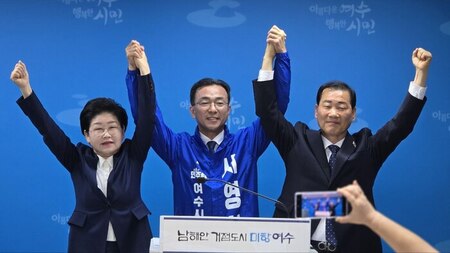
▲ 정의당 대전시당과 충남도당이 5일 대전시청 북문 앞에서 대전충남통합 반대 기사회견을 개최 했다=정의당 제공 © 김정환 기자 |
정의당 대전시당·충남도당이 대전·충남 통합특별법 제정을 강하게 반대하며 5일 대전시청 북문 앞에서 기자회견을 열었다. 이재명 대통령 주도의 "속도전"을 정략적 공세로 규정하고 법안 전면 폐기를 촉구했다.
정의당은 특별법이 "묻지마 통합"의 반민주적 절차를 밟고 있다고 비판했다.
주민투표 의무화가 빠진 제50조와 기존 의회를 형식적으로 끼워넣은 꼼수를 지적하며, "아이 학교·버스·치안 변화조차 모르는 깜깜이 상황"이라고 꼬집었다. 행정·자원 쏠림으로 농촌·소도시 소외 우려도 제기했다.
특별법의 기업 특혜 조항도 집중 비판했다. 법인세·소득세 감면(제86조), 외국인투자 고용평등 배제(제165조), 규제자유화 우선정비(제21조)를 들어 "노동자 권리와 안전 규제를 내준 반노동·친재벌 법안"이라 규정했다. 중대재해처벌법 등 필수 규제까지 흔들릴 위험을 경고했다.
환경 파괴 우려도 강하게 나왔다. 개발 인허가 의제(제79조, 44개 법률 적용 생략), 예비타당성 면제(제22조)를 "토건 자본에 환경 파괴 면허증"이라며 난개발 허용 악법으로 비판했다. 기후위기 가속화와 지역 재난 초래를 우려했다.
교육 불평등 심화 지적도 이어졌다. 영재학교 특혜 설립(제121조), 교육장 개방형 직위화(제38조), 국무총리 성과협약(제6조)을 "특권학교 양산과 공교육 파괴"로 규정했다. 비전문가의 교육 개입 가능성도 문제 삼았다.
특히 국방산업 클러스터 조성(제167조)을 "충청을 죽음의 무기 장사로 전락시킨다"고 반발했다. 과거 반대하던 민주당의 태도 변화를 비꼬며 "첨단·평화 도시를 무기 공장 소굴로 만들 수 없다"고 강조했다.
정의당은 "20조 원 미끼로 숙의 없는 졸속 통합은 수도권 규제만 지역에 풀어주는 자본 놀이터"라며 지역재투자·공공은행 등 대안을 제시했다. "주민자치·지방분권·지역 연대"를 해법으로 내세우며 공론화와 법안 폐기를 재차 촉구했다.
이번 기자회견은 통합특별법 국회 논의 속에서 반대 목소리를 본격화한 자리로, 지역 여론 분열을 가속화할 전망이다.
*아래는 위 기사를 '구글 번역'으로 번역한 영문 기사의 [전문]입니다. '구글번역'은 이해도를 높이기를 위해 노력하고 있습니다. 영문 번역에 오류가 있을 수 있음을 전제로 합니다.<*The following is [the full text] of the English article translated by 'Google Translate'. 'Google Translate' is working hard to improve understanding. It is assumed that there may be errors in the English translation.>
The Justice Party held a press conference to criticize the president's speed battle, demanding a "scrappy" resolution.
"Anti-democratic, evil law without a mandatory referendum... anti-labor, anti-climate, anti-education."
The Justice Party's Daejeon City and South Chungcheong Province chapters held a press conference in front of the north gate of Daejeon City Hall on the 5th, strongly opposing the enactment of the Daejeon-South Chungcheong Special Act. They characterized President Lee Jae-myung's "speed battle" as a political offensive and called for the bill's complete scrapping.
The Justice Party criticized the special law for following the anti-democratic process of "blind integration."
Criticizing Article 50, which omits a mandatory referendum, and the gimmick of formally incorporating the existing National Assembly, they criticized the law, saying, "We're in the dark about changes to our children's schools, buses, and public safety." They also raised concerns about the concentration of administrative and resource resources, which will marginalize rural areas and small cities.
They also focused their criticism on the special law's provisions favoring businesses. They cited Article 86 for corporate and income tax reductions, Article 165 for the exclusion of foreign investment from equal employment opportunities, and Article 21 for prioritizing regulatory liberalization, calling it "an anti-labor, pro-chaebol bill that compromises workers' rights and safety regulations." They also warned of the risk of undermining essential regulations, including the Serious Accident Punishment Act.
Concerns about environmental destruction were also raised. They criticized the development permit agenda (Article 79, omitting the application of 44 laws) and the preliminary feasibility study exemption (Article 22) as "a license for construction capital to destroy the environment" and as a vicious law that allows for reckless development. They expressed concerns about the acceleration of the climate crisis and the potential for regional disasters.
Criticisms of deepening educational inequality also continued. They characterized the establishment of preferential schools for the gifted (Article 121), the creation of open positions for superintendents of education (Article 38), and the Prime Minister's Performance Agreement (Article 6) as "producing privileged schools and destroying public education." They also raised concerns about the potential for non-expert intervention in education.
In particular, they opposed the establishment of a defense industry cluster (Article 167), claiming it "reduces Chungcheong to a deadly weapons trade." They mocked the Democratic Party's shift in stance, which had previously opposed the merger, emphasizing, "We cannot turn a high-tech, peaceful city into a den of weapons factories."
The Justice Party argued, "The hasty integration, using 20 trillion won as bait, is a capital playground that only relaxes regulations in the metropolitan area," and proposed alternatives such as regional reinvestment and public banks. They again called for public discussion and the bill's repeal, citing "local autonomy, local decentralization, and regional solidarity" as solutions.
This press conference, which marked the beginning of a full-blown opposition to the special merger law amid National Assembly deliberations, is expected to further divide regional public opinion.
원본 기사 보기:브레이크뉴스대전세종충청