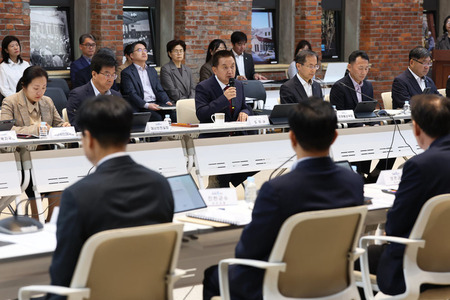
역사・문화・통일분야 전문가 토론모임인 최용기 교수 주도의 고전문화통일포럼이 지난 5월 21일 관악문화원 내의 1층 강의실에서 개최됐다. 이 중에서 홍익경영전략원 대표인 필자는 "홍익인간의 성통공완의 수행비결해"라는 제목으로 발표했다. 이 발표의 취지는 홍익인간 사상에 대해서 우리나라 국내외의 다양한 현안문제 등에 관한 도덕적 책임감으로 해결방향 모색이 가능할 것이라는 점이다.
그러므로 일반시민의 바른 생활은 물론 과거 통치자와 같은 대통령을 비롯한 법령・제도의 결정권자는 인간을 모두 이롭게 하기 위해, 홍익인간의 실천수단인 법령・정책 시행 등의 올바른 논의와 공정한 결정을 위한 재세이화 실천의 충족 전제로써, 성통・공완을 충족해야 한다라는 선결적 요건의 중요성이 매우 크다고 강조한다. 이와 관련한 동영상 설명은 [성통공완 이해 3 - 홍익인간의 성통공완 명상 수행원문], [성통공완 이해 2] 삼일신고의 성통공완 수행이론]에서 참조가 가능하다.
 © 임기추 박사/칼럼니스트, 홍익사상학자 |
우리의 홍익인간 사상에 관해서 성통・공완의 충족을 위한 명상 수행이론에 의거 수련비결 재현의 여망이 있다. 예로부터 명상 수행자들은 모든 것을 비우는 수련에 매진하기 때문에, 어떤 흔적이나 기록 전수가 거의 없기 마련이다. 그리고 삼일신고 「진리훈」(단군정신선양회, 1984)에서는 구체적 명상 수련방법이 나타나 있지 않다. 조한석(2019)은 “성통(性通)은 ‘재세이화・홍익인간’의 실현이라는 공완(功完)을 이루기 위한 전제조건인 동시에 인간의 자기실현을 위한 필수조건”이라고 주장하였다. 조옥구(2012)는 “성통・공완과 재세이화는 ‘홍익인간’하는 2가지 방법론에 해당하고 이 2가지 방법론을 통하면 ‘홍익인간’에 이를 수 있다”고 설명하였다. 그러므로 삼일신고 「진리훈」에서는 구체적 명상 수련방법이 나타나 있지 않기 때문에(박진규, 2012), 성통・공완의 완성을 위한 명상 수행이론에 의거한 수련비결 재현의 여망이 커져 왔다.
본 발표에서는 필자가 2003년 말부터 시작한 수련 경험인 지생쌍수법을 바탕으로, 현대인의 생활을 반영하여 지생쌍수법(智生雙修法)(한시원, 2004)에 의거한 명상 수행방법의 비결을 제시하고자 한다. 이는 삼일신고 「진리훈」(원문은 167자로 김은수(1985) 참조)의 지감(止感)・조식(調息)・금촉(禁觸) 수행이론에 입각한 홍익명상 수행법을 안내하는 데에 주안점을 두고 있다. 삼일신고는 환웅 천왕의 신시개천시대에 교화 경전이었다(김은수, 1985).
삼일신고의 성통ㆍ공완의 완성을 위한 수행이론은 간담히 요약하면 다음과 같다. 삼일신고 「진리훈」에서 명시한 지감(止感)・조식(調息)・금촉(禁觸) 수행은 우리 민족 고유의 수행법으로 전승되어 왔다(박진규, 2012; 이근철, 2010). 인간과 모든 만물은 다 같이 삼진(三眞)을 받았으니, 성(性)・명 (命)・정(精)이다. 뭇사람은 미혹한 경지에서 삼망(三妄)이 뿌리 내리니, 심(心)・기(氣)・신(身)이라 한다. 심(心)은 성(性)을 원형으로 선악(善惡)이 있으니 선하면 복이 되고 악하면 화를 입는다. 기(氣)는 명(命)을 원형으로 청탁(淸濁)이 있으니 맑으면 장수하고 탁하면 일찍 죽는다.
신(身)은 정(精)을 원형으로 후박(厚薄)이 있으니 후하면 귀하고 박하면 천하다. 진(眞)과 망(妄)이 서로 마주해 3갈래로 나뉘어져 감(感, 희구애노탐염), 식(息, 분란한열진습), 촉(觸, 성색취미음저)이라고 한다. 다 버려야 18경지를 완성한다고 한다(박진규, 2012). 감(感)(喜懼哀怒貪厭)・식(息)(芬㱫寒熱震濕)・촉(觸)(聲色 臭味 淫抵)의 망령됨을 수행으로 되돌려 참됨을 찾아서 신기(神機)를 크게 발현하니, 성통・공완(性通功完)이다(박진규, 2012; 이근철, 2010). 그런데 앞서 언급대로 구체적 수행방법이 나타나 있지 않아서, 후대의 종교나 수행단체에서는 어떠한 방식으로 수행법을 전수하고 있는지 탐구대상이 되어 왔다(박진규, 2012).
한족은 ‘수신제가 치국평천하’를 중시하지만, 한민족은 ‘성통・공완과 홍익인간・재세이화’의 인간・건국・세계・우주 이념을 추구하였다(이경호, 2010). 본 내용에서는 지생쌍수법의 명상 수련경험을 활용한 삼일신고의 지감・조식・금촉에 관한 3법수행 방법의 개요를 제시한다(임기추, 2016; 2017; 2018). 삼일신고 지감・조식・금촉의 3법수행 이론에 의거 , 1) 기쁨・두려움・슬픔・성냄・탐욕・싫어함의 6가지 감정과, 2) 향기・썩은내・차가움・더위・메마름・습기의 6가지 숨결과, 3) 소리・색깔・냄새・맛・성욕・부딪침의 6가지 감각 등에 대한 홍익명상의 수행비결을 간단히 정리한다.
삼일신고는 366자의 한자로 쓰여졌으며, 천훈(天訓)을 비롯한 신훈(神訓), 천궁훈(天宮訓), 세계훈(世界訓), 진리훈(眞理訓)의 5훈(五訓)으로 구성되어 있다(한국민족문화대백과, 삼일신고). 「신훈」에서는 ‘신(神)’이 대덕(大德)・대혜(大慧)・대력(大力)이라는 3대 권능(三大權能)을 명시하고 있다. 앞서 설명대로 「진리훈」에서 지감(止感)・조식(調息)・금촉(禁觸) 수행의 수행이론을 전수해 왔다. 「진리훈」에서 가르치는 지감(止感)・조식(調息)・금촉(禁觸)의 수행을 통해서, 3진(三眞)인 무선악과 무청탁 및 무후박을 완성하고 나서 기필코 신인합일(神人合一)의 완성(박진규, 2012)으로 나아갈 수 있을 것이다. 삼일신고를 통해서 마침내 성통・공완의 사명을 완수함으로써, 마침내 21세기의 새로운 정신문화를 확립하고, 우리나라를 비롯하여 지구와 모든 인류를 밝게 빛낼 수 있게 될 날이 가까워질 것이다.
홍익인간 사상의 구현을 위한 ‘홍익인간’ 이념은 환국으로부터 배달, 조선, 고구려, 발해 등으로 전승되었다. 곧, 성통・공완(성통・광명, 일신강충)이후 재세이화하고 홍익인간을 추구하여 왔다(장영주, 2013). 홍익인간 이념은 환국에서 기원전 3898년에 신시 배달국을 개천한 1대 거발한 환웅으로부터 비롯되었다. 다시 말하자면, 홍익인간 역사가 적어도 5,920여년에 다다른다(서기전 3897년 → 서기전 1891년 → 서기 610년 → 1949년 → 2023(4356)년 홍익인간 정신이 전수)다. 특히 염표문은 배달국을 개천한 거발한 환웅 천왕이 환국의 마지막 7대 지위리 환인으로 부터 천부인을 전수받고, 신시 개천 시에 홍익인간 정신을 통치이념으로 전수받은 것이다(고동영, 1986; 박명성, 2018). 인류의 시원국가 환국으로부터 내려오는 홍익인간 문화의 진리를 깨달아, 마음을 아로 세기고 생활화하여 환국의 진정한 백성이 되는 글이다. 바로 홍익인간 사상의 구현을 위한 홍익인간의 실현관련 이론이 함축되어 있다고 할 수 있다.
이러한 홍익명상의 성통・공완 방법은 주문을 읽는 주문수행법이 아니라 지식과 경험, 지혜와 물질생활, 생명력을 닦아가는 지생쌍수법의 유형이다(한시원, 2004). 대략적인 수행방법은 1) 상상으로 몸이 죽어 없어지고, 2) 영혼이 된 뒤, 3) 허공 우주에 가서, 4) 마음(감정)과 기(숨결) 및 몸(감각)을 버리고, 5) 영혼마저 블랙홀(태양의 수백만배 – 수십억 배 질량)에 버림 등의 순서로 수행한다(임기추, 2016). 수행기법은 시간・장소에 구애받지 않고 언제 어디서나 수련자세를 취한다. 대체로 남녀노소와 빈부귀천, 종교・민족・지역 등에 관계없이 누구든지 어디서나 혼자든 단체든 제약이 없다.
본 발표에서는 통치자(정치자, 법령・제도 결정권자)가 [성통・공완의 명상 충족 전제와 현대 헌법・법령・정책의 시행 등 재세이화 실천의 충족 전제(김철수, 2015; 조한석, 2019; 조옥구, 2012)]를 통해 “인간(국민, 인류, 자연)을 모두 이롭게 한다, 또는 인간을 모두 이익이 되게 한다,”로 해석하고 있다. 앞서 성통・공완 수행법은 “삼일신고”에 대한 연구사례(이근철, 2010; 박진규, 2012)에 의거하여 마음(감정) 기억, 기(숨결) 기억, 몸(감각) 기억을 떠올려서 모두 버리고 본성・본명・본정을 회복하는 것이다.
이와 같이 성통・공완의 명상 충족 전제와 재세이화 실천의 선결적 전제에 의거, 홍익인간의 개념을 바로 세울 수 있다면, 우리나라 국내외의 다양한 현안문제 등에 관한 도덕적 책임감으로 현대 법령・정책 시행 등 재세이화의 실천적 전제에 의해서 해결방향 모색, 현대적 적용 가능성 모색이 가능할 것임을 시사한다. 그러므로 일반시민의 바른 생활은 물론, 과거 통치자와 같은 대통령을 비롯한 법령・제도의 결정권자는 인간을 모두 이롭게 하기 위해, 홍익인간의 실천수단(김철수, 2015)인 법령・정책 시행 등의 올바른 논의와 공정한 결정을 위한 재세이화 실천의 충족 전제로써, 성통・공완을 충족해야 한다라는 선결적 요건의 중요성이 매우 크다고 강조한다.
*필자/임기추 박사.
*아래는 위 기사를 '구글 번역'으로 번역한 영문 기사의 [전문]입니다. '구글번역'은 이해도 높이기를 위해 노력하고 있습니다. 영문 번역에 오류가 있을 수 있음을 전제로 합니다.<*The following is [the full text] of the English article translated by 'Google Translate'. 'Google Translate' is working hard to improve understanding. It is assumed that there may be errors in the English translation.>
Hongik Ingan’s secret to practicing Seongtong Gongwan
-Dr. Lim Gi-chu
The Classical Culture Unification Forum led by Professor Choi Yong-gi, a discussion group of experts in the fields of history, culture, and unification, was held in a classroom on the first floor of the Gwanak Cultural Center on May 21. Among these, the author, the CEO of Hongik Management Strategy Institute, presented a presentation titled “Hongik Ingan’s Secret of Successful Completion and Completion.” The purpose of this presentation is that it will be possible to find a solution to the Hongik Ingan ideology with a sense of moral responsibility regarding various pending issues at home and abroad in our country.
Therefore, in order to not only lead a good life for ordinary citizens but also to benefit all people, the decision-makers of laws and systems, including presidents like past rulers, are practicing Jaeseihwa for correct discussions and fair decisions, such as the implementation of laws and policies, which are Hongik Ingan's means of practice. It is emphasized that the importance of the prerequisites of satisfying success and perfection is very important. Video explanations related to this can be referenced in [Understanding Seongtong Gongwan 3 - Hongik Ingan's original text of Seongtong Gongwan meditation practice] and [Understanding Seongtong Gongwan 2] Samil Shingo's Seongtong Gongwan practice theory].
© Dr. Im Ki-chu/Columnist, Hongik Thought Scholar
Regarding our Hongik Ingan ideology, there is a hope of reproducing the secrets of training based on the theory of meditation practice for the satisfaction of perfection and perfection. Since ancient times, meditation practitioners have devoted themselves to the practice of emptying everything, so there are almost no traces or records left. And in Samil Shingo 「Jinrihun」 (Dangun Spiritual Seonyanghoe, 1984), no specific meditation training method is provided. Jo Han-seok (2019) argued, “Seongtong (性通) is a prerequisite for achieving the perfection of ‘rebirth and Hongik Ingan’ and at the same time a necessary condition for human self-realization.” Cho Ok-gu (2012) explained, “Seongtong·Gongwan and Jaeseihwa correspond to the two methodologies of ‘Hongik Ingan,’ and through these two methodologies, one can reach ‘Hongik Ingan.’” Therefore, since the Samil Shingo 「Jinrihun」 does not indicate a specific meditation training method (Jin-gyu Park, 2012), there has been a growing desire to reproduce the secrets of training based on the theory of meditation practice for the completion of seongtong and emptiness.
In this presentation, based on the author's experience of training since the end of 2003, the Jiseongssangsubeop, the secret of meditation practice based on the Jiseongssangsoobeop (Han Si-won, 2004) is presented, reflecting the lives of modern people. I want to do it. The main focus of this is to guide the Hongik meditation practice method based on the practice theory of Jigam (止感), Consciousness (調息), and Geumchok (禁觸) of Samil Shingo “Jinrihun” (original text is 167 characters, see Eunsu Kim (1985)). is leaving. Samilshingo was an educational scripture during the era of the new world under King Hwanung (Kim Eun-soo, 1985).
The practice theory for the completion of Samil Shingo's Seongtong and Gongwan can be briefly summarized as follows. The practice of awareness, consciousness, and geumchok, as specified in the Samil Shingo Jinrihun, has been handed down as a unique practice method of our people (Jin-gyu Park, 2012; Geun-cheol Lee, 2010). Human beings and all living things share the three truths, which are nature, life, and essence. In the state of delusion, all people take root in the three delusions, which are called heart, energy, and body. The heart is the prototype of nature and has good and evil. If it is good, it will bring good fortune, and if it is evil, it will bring misfortune. Qi (氣) is the prototype of life (淸濁), so if it is clear, you will live long, and if it is cloudy, you will die early.
The body is modeled after the essence and has a thick body. If it is generous, it is noble, and if it is thin, it is lowly. Jin (眞) and Mang (妄) face each other and are divided into three branches, which are called Gam (感, pleasure, annoyance), Consciousness (息, turbulent heat and passion), and Chok (觸, sexual taste, taste and pleasure). It is said that you must throw away everything to complete the 18 realms (Park Jin-gyu, 2012). By returning to practice the vainness of sensation, consciousness, cold, heat, and moisture, through practice, we find the truth and discover the divine power. It manifests greatly, and it is the perfection of sexual pain and perfection (Park Jin-gyu, 2012; Lee Geun-cheol, 2010). However, as mentioned earlier, there is no specific method of practice, so it has been a subject of investigation into how later religions and practice groups transmit the method (Jin-gyu Park, 2012).
While the Han Chinese place great importance on ‘the system of governing the nation and the world under the supreme government,’ the Korean people pursued the human, nation-building, world, and universe ideology of ‘Seongtong, Gongwan, Hongik Ingan, and Re-Eihwa’ (Lee Gyeong-ho, 2010). In this content, we present an outline of the three methods of practicing Samil Shingo's Jigam, Josik, and Geumchok using the meditation training experience of Jisaeng Ssangsu Method (Im Gi-chu, 2016; 2017; 2018). Samil Shingo Based on the theory of practicing the three laws of Jigam, Joshik, and Geumchok, 1) six emotions: joy, fear, sadness, anger, greed, and dislike, and 2) six emotions: scent, putrid smell, cold, heat, dryness, and moisture. Briefly summarize the secrets of practicing Hongik Meditation regarding the six senses of breath, 3) sound, color, smell, taste, sexual desire, and impact.
Samilsinggo is written with 366 Chinese characters, and is divided into five disciplines, including CheonHun (天訓), Shin Hun (神訓), Cheongung Hun (天宮訓), World Hun (World Hun), and Jinri Hun (眞理訓). It is composed (Encyclopedia of Korean Culture, Samil Shingo). In 「Shinhun」, ‘God’ specifies the three great powers of great virtue, great wisdom, and great power. As previously explained, the practice theory of Jijam (止感), Consciousness (調息), and Geumchok (禁觸) practice has been passed down in 「Jinrihun」. Through the practice of Jijam (止感), Consciousness (調息), and Geumchok (禁觸) as taught in the Jinrihun, after completing the three truths of non-music, non-soliciting, and non-hubak, one is sure to achieve the unity of God and God. We will be able to move towards the completion of God-Man Unity (Jin-gyu Park, 2012). By finally completing the mission of Seongtong and Gongwan through the Samil Shingo, the day will come closer when we will finally be able to establish a new spiritual culture of the 21st century and brighten our country, the Earth, and all mankind.
The ‘Hongik Ingan’ ideology, aimed at realizing Hongik Ingan’s ideology, was passed down from Hwanguk to Baedal, Joseon, Goguryeo, Balhae, etc. In other words, after Seongtong·Gongwan (Seongtong·Gwangmyeong, Ilsin Gangchung), he was reborn and pursued Hongik Ingan (Jang Young-ju, 2013). The Hongik Ingan ideology originated from Hwanwoong, the first ruler of Hwanguk, who founded the new city of Baedalguk in 3898 BC. In other words, the history of Hongik Ingan spans at least 5,920 years (3897 BC → 1891 BC → 610 AD → 1949 → 2023 (4356), the spirit of Hongik Ingan was passed down). In particular, Yeompyomun is written by King Hwanwoong, who founded Baedalguk, and received Cheonbuin from Hwanin, the last 7th generation of Jijiri of Hwanguk, and the spirit of Hongik Ingan was passed down as the ruling ideology when he founded the new city (Go Dong-young, 1986; Park Myeong-seong, 2018). ). This is an article about realizing the truth of the Hongik Ingan culture that has been passed down from Hwan, the origin nation of mankind, and becoming a true citizen of Hwanguk by counting it in your heart and incorporating it into your daily life. It can be said that Hongik Ingan's theory of realization for the realization of Hongik Ingan's ideas is implied.
This Hongik meditation method of seongtong and gongwan is not a spell practice method of reading spells, but a type of Jiseng Dusangsu method that cultivates knowledge, experience, wisdom, material life, and vitality (Han Si-won, 2004). The approximate method of practice is 1) imagine the body dying and disappearing, 2) become a soul, 3) go to the empty universe, 4) abandon the mind (emotions), energy (breath), and body (feelings), 5) Even the soul is thrown into a black hole (millions to billions of times the mass of the sun) (Im Gi-chu, 2016). The practice technique is to adopt a training posture anytime, anywhere, regardless of time or place. In general, there are no restrictions for anyone, anywhere, alone or in a group, regardless of age, gender, rich or poor, religion, ethnicity, region, etc.
In this presentation, the ruler (politician, law and system decision-maker) must fulfill the premise of satisfying the meditation of integrity and righteousness and the implementation of modern constitution, laws and policies (Cheol-soo Kim, 2015; Han-seok Cho, 2019; Ok-gu Cho, 2012)], it is interpreted as “benefiting all humans (citizens, humanity, nature), or benefiting all humans.” Previously, the method of practicing Seongtong and Gongwan was based on research cases on “Samil Shingo” (Lee Geun-cheol, 2010; Park Jin-gyu, 2012), recalling mind (emotion) memories, energy (breath) memories, and body (sensing) memories, discarding them all, and returning to nature. It is to restore one's real name and original identity.
In this way, if the concept of Hongik Ingan can be established correctly based on the premise of satisfying the meditation of Seongtong and Gongwan and the prerequisites of practicing revitalization, it is possible to establish revitalization, such as the implementation of modern laws and policies, with a sense of moral responsibility regarding various pending issues at home and abroad in our country. It suggests that it will be possible to find a solution and the possibility of modern application based on practical premises. Therefore, in order to ensure a good life for ordinary citizens, as well as for the benefit of all people, the decision-makers of laws and systems, including presidents like past rulers, should conduct proper discussions and fair implementation of laws and policies, which are Hongik Ingan's means of practice (Kim Cheol-soo, 2015). It is emphasized that the importance of the prerequisites of meeting Seongtong and Gongwan as a prerequisite for the practice of re-seihwa for decision-making is very important.
*Writer/Dr. Lim Gi-chu