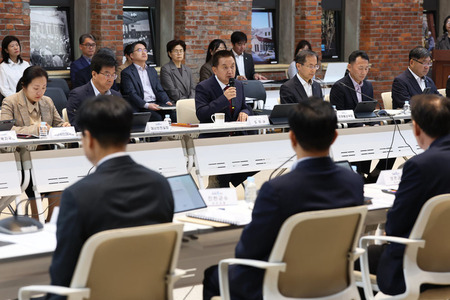
▲ 2026년도 제1회 추가경정예산안이 10일 오후 서울 여의도 국회에서 열린 제434회국회(임시회) 제3차 본회의에서 가결되고 있다. 2026.04.10. © 뉴시스 |
브레이크뉴스 이제항 선임기자 = 국회가 중동 전쟁 장기화에 따른 경제적 파고를 넘기 위한 26조 원 규모의 추가경정예산(이하 추경)안이 여야 합의로 국회 문턱을 넘었다.
대한민국국회(국회의장 우원식)는 10일 오후 10시 10분 본회의를 개최하고, 고물가·고유가로 고통받는 서민층 지원과 에너지 수급 안정을 골자로 한 ‘중동 전쟁 대응 추경안’을 의결했다.
이번 추경의 핵심은 ‘고유가 피해지원금’이다. 여야는 막판까지 접전을 벌였으나, 최종적으로 정부안을 유지해 소득 하위 70%에 해당하는 국민 3,256만 명에게 소득 수준에 따라 인당 10만 원에서 최대 60만 원을 지급하기로 했다.
또한, 민생 실무 예산은 오히려 강화됐다. 대중교통 이용객의 부담을 덜기 위해 ‘K-패스’ 한시적 50% 할인 예산 1000억 원이 신설됐으며, 산업계의 원료 수급을 돕기 위한 나프타(납사) 지원 예산도 2000억 원 증액됐다. 특히 면세경유 유가 연동 보조금 상향과 무기질 비료 지원 등 농어민들의 생산비 부담을 줄이기 위한 예산 2000억 원이 추가 반영됐다.
반면, 국민의힘이 ‘전쟁 추경 취지에 부합하지 않는다’고 비판했던 단기 일자리 사업과 중화권 관광객 유치 관련 사업(지방 전세기 연계 상품 등)은 사업 내용을 조정하거나 규모를 축소하는 방식으로 합의를 끌어냈다.
이번 추경안 처리는 순탄치 않았다. 당초 정부가 제출한 26조 2000억 원의 규모가 상임위 예비 심사를 거치며 30조 원 가까이 불어나자, 여야는 예결위 소위에서 치열한 ‘숫자 싸움’을 벌였다. 국민의힘은 불요불급한 예산의 삭감을, 더불어민주당은 신속한 민생 구제를 주장하며 팽팽히 맞섰다.
하지만, 10일 오후, 더불어민주당 한병도 원내대표와 국민의힘 송언석 원내대표를 포함한 ‘3+3 회동’에서 “감액 범위 내 증액을 통해 정부안 총액을 유지한다”는 대원칙에 합의하며 물꼬를 텄다. 이후 기술적인 숫자 조정 작업을 거쳐 심야 본회의에서 최종 처리됨에 따라, 중동발 경제 위기에 대응하기 위한 정부의 재정 집행에도 속도가 붙을 전망이다.
한편, 이번에 본회의 부의된 추경관련 18개 의안은 ▲2026년도 제1회 추가경정예산안(수정, 정부 제출) ▲2026년도 공공자금관리기금운용계획변경안(수정, 정부 제출) ▲2026년도 정보통신진흥기금운용계획변경안(수정, 정부 제출) ▲2026년도 국민체육진흥기금운용계획변경안(수정, 정부 제출) ▲ 2026년도 문화예술진흥기금운용계획변경안(수정, 정부 제출) ▲2026년도 관광진흥개발기금운용계획변경안(수정, 정부 제출) ▲2026년도 영화발전기금운용계획변경안(수정, 정부 제출) ▲2026년도 농지관리기금운용계획변경안(원안, 정부 제출) ▲2026년도 축산발전기금운용계획변경안(수정, 정부 제출) ▲2026년도 농산물가격안정기금운용계획변경안(원안, 정부 제출) ▲2026년도 수산발전기금운용계획변경안(수정, 정부 제출) ▲2026년도 중소벤처기업창업 및 진흥기금운용계획변경안(수정, 정부 제출) ▲2026년도 소상공인시장진흥기금운용계획변경안(원안, 정부 제출) ▲2026년도 전력산업기반기금운용계획변경안(수정, 정부 제출) ▲2026년도 기후대응기금운용계획변경안(원안, 정부 제출) ▲2026년도 고용보험기금운용계획변경안(원안, 정부 제출) ▲2026년도 임금채권보장기금운용계획변경안(원안, 정부 제출) ▲2026년도 근로복지진흥기금운용계획변경안(원안, 정부 제출)이다.
*아래는 위 기사를 '구글 번역'으로 번역한 영문 기사의 [전문]입니다. '구글번역'은 이해도 높이기를 위해 노력하고 있습니다. 영문 번역에 오류가 있을 수 있음을 전제로 합니다.<*The following is [the full text] of the English article translated by 'Google Translate'. 'Google Translate' is working hard to improve understanding. It is assumed that there may be errors in the English translation>
Middle East War Shock: 26.2 Trillion Won Supplementary Budget… National Assembly Plenary Session Passes Cash Support for Bottom 70%
- Government's Original Proposal of 26.2 Trillion Won Maintained Following Late-Night Agreement Between Ruling and Opposition Parties… Emphasis on Overcoming Damage from High Oil Prices
- Differential Payments of Minimum 100,000 Won to Maximum 600,000 Won Confirmed for 32.56 Million People in the Bottom 70% Income Sector
- Budget for Livelihood and Industry Increased by 500 Billion Won, Including 50% K-Pass Discounts and NAFTA Supply Support
— Lee Je-hang, Senior Reporter, Break News
The National Assembly has passed a 26 trillion won supplementary budget bill (hereinafter referred to as the supplementary budget) through an agreement between the ruling and opposition parties, aimed at weathering the economic turmoil caused by the prolonged Middle East war. The National Assembly of the Republic of Korea (Speaker Woo Won-sik) held a plenary session at 10:10 PM on the 10th and passed the "Supplementary Budget Bill for Responding to the Middle East War," which focuses on supporting the working class suffering from high inflation and oil prices, as well as stabilizing the energy supply and demand.
The core of this supplementary budget is the "high oil price damage relief fund." Although the ruling and opposition parties engaged in a close battle until the very last moment, they ultimately maintained the government's proposal, agreeing to provide payments ranging from 100,000 won to a maximum of 600,000 won per person to 32.56 million citizens in the bottom 70% income bracket, depending on their income level.
Furthermore, the budget for practical matters concerning people's livelihoods was actually strengthened. A new budget of 100 billion won was established for a temporary 50% discount on the "K-Pass" to ease the burden on public transportation users, and the budget for naphtha support to help the industrial sector secure raw materials was increased by 200 billion won. In particular, an additional 200 billion won was allocated to reduce the production cost burden on farmers and fishermen, including raising subsidies linked to tax-exempt diesel prices and providing support for mineral fertilizers.
On the other hand, regarding short-term job programs and initiatives to attract tourists from Greater China (such as packages linked to regional charter flights), which the People Power Party had criticized as not aligning with the purpose of the "war supplementary budget," an agreement was reached by adjusting the details or reducing the scale of the projects.
The processing of this supplementary budget bill was not smooth. As the initial 26.2 trillion won submitted by the government ballooned to nearly 30 trillion won during preliminary reviews by standing committees, the ruling and opposition parties engaged in a fierce "battle of numbers" in the Budget and Accounts Committee subcommittee.
The People Power Party insisted on cutting non-essential spending, while the Democratic Party of Korea argued for swift relief for the people's livelihoods, resulting in a tense standoff. However, on the afternoon of the 10th, a breakthrough was made at the "3+3 meeting" involving Democratic Party of Korea Floor Leader Han Byung-do and People Power Party Floor Leader Song Eon-seok, by agreeing on the general principle of "maintaining the total amount of the government proposal through increases within the scope of reductions."
Following technical adjustments to the figures and final processing at the late-night plenary session, the government's fiscal execution aimed at responding to the economic crisis originating from the Middle East is expected to gain momentum.
Meanwhile, the 18 supplementary budget-related bills submitted to the plenary session this time are: ▲ 2026 1st Supplementary Budget Bill (Amended, Submitted by Government) ▲ 2026 Amendment to the Public Funds Management Fund Operation Plan (Amended, Submitted by Government) ▲ 2026 Amendment to the Information and Communications Promotion Fund Operation Plan (Amended, Submitted by Government) ▲ 2026 Amendment to the National Sports Promotion Fund Operation Plan (Amended, Submitted by Government) ▲ 2026 Amendment to the Culture and Arts Promotion Fund Operation Plan (Amended, Submitted by Government) ▲ 2026 Amendment to the Tourism Promotion and Development Fund Operation Plan (Amended, Submitted by Government) ▲ 2026 Amendment to the Film Development Fund Operation Plan (Amended, Submitted by Government) ▲ 2026 Amendment to the Farmland Management Fund Operation Plan (Original, Submitted by Government) ▲ 2026 Amendment to the Livestock Development Fund Operation Plan (Amended, Submitted by Government) ▲ 2026 The items are: the Proposed Amendment to the Operation Plan for the Agricultural Product Price Stabilization Fund (Original, submitted to the government) ▲ the Proposed Amendment to the Operation Plan for the Fisheries Development Fund for 2026 (Revised, submitted to the government) ▲ the Proposed Amendment to the Operation Plan for the SME Startup and Promotion Fund for 2026 (Revised, submitted to the government) ▲ the Proposed Amendment to the Operation Plan for the Micro Business Market Promotion Fund for 2026 (Original, submitted to the government) ▲ the Proposed Amendment to the Operation Plan for the Electric Power Industry Infrastructure Fund for 2026 (Revised, submitted to the government) ▲ the Proposed Amendment to the Operation Plan for the Climate Response Fund for 2026 (Original, submitted to the government) ▲ the Proposed Amendment to the Operation Plan for the Employment Insurance Fund for 2026 (Original, submitted to the government) ▲ the Proposed Amendment to the Operation Plan for the Wage Claim Guarantee Fund for 2026 (Original, submitted to the government) ▲ the Proposed Amendment to the Operation Plan for the Labor Welfare Promotion Fund for 2026 (Original, submitted to the government).